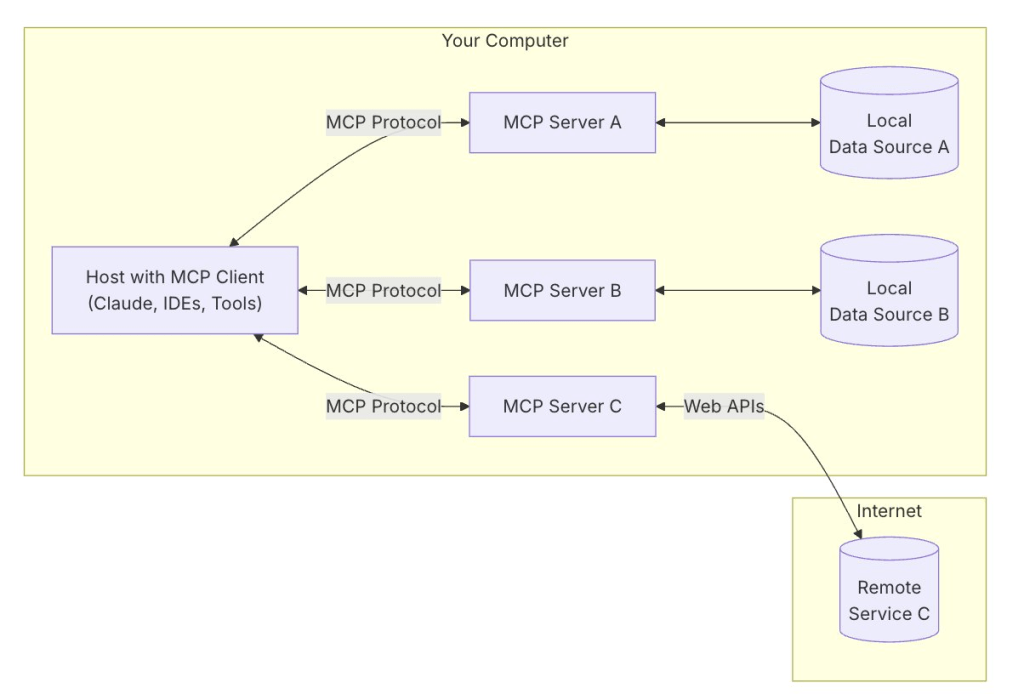
Data interchange standards enabling Agentic AI – Anil Dash describing Model Context Protocol. Strong agreement with the underlying explanation of how “slightly under-specified protocols that quickly get adopted by all the players in a space are what wins” .. this is the approach that made it possible to build out
– the public Internet (TCP/IP and Ethernet specs)
– the social Web ( HTML enabled Web 2.0)
– secure, two-way connections between data sources and AI-powered tools (MCP)
Integrations, from Anthropic “Today, we’re introducing Integrations, allowing Claude to work with remote MCP servers across the web and desktop apps. Developers can build and host servers that enhance Claude’s capabilities, while users can discover and connect any number of these to Claude.”
NLWeb from Microsoft “Our goal is for NLWeb, short for Natural Language Web, to be the fastest and easiest way to effectively turn your website into an AI app, allowing users to query the contents of the site by directly using natural language, just like with an AI assistant or Copilot.
Every NLWeb instance is also a Model Context Protocol (MCP) server, allowing websites to make their content discoverable and accessible to agents and other participants in the MCP ecosystem if they choose. Ultimately, we believe NLWeb can play a similar role to HTML in the emerging agentic web.”
Snapshot for Silicon Valley: updated to add the link to the recording.
Had been asked to do a status report on the Valley for compatriots in Scotland with Christine Esson for the Scottish Business Network insights series..
Linley Spring Processor Conference Goes Virtual The Linley Group held their conference which gathers good quality marketing information about imminent AI hardware developments on Zoom, to excellent effect. They report 700 part-time attendees, compared to the usual 300 maximum in person for the event. Listening to it it seemed that the quality of technical information imparted was at least as good as it would have been at an in-person event.
Sherwood Partners doing two to five business windups per day. “This is the great unwinding,” Pichinson said. “We don’t know what’s happening, but we do know everything we believed in is changing. Everything we thought to be true may not be true.”
He expects the number of startup companies that he is ending from the coronavirus downturn to exceed the carnage left behind in the dot-com bust.
What I’m seeing isn’t layoffs – what I’m seeing is business continuing, though not business as usual. One company was acquired by a public company for cash, another couple of public companies are being acquired by much bigger companies, another needs advice about splitting off the original technology it started with, with the potential to re-capitalize and convert to a much more sustainable business model while compensating the original investors.
There have now been 100 reported deaths in Santa Clara County attributed to Covid-19 Vehicle traffic continues to be much lighter than before the lock-down; many more people are walking and cycling along the residential streets. We ride and walk for exercise, too.
Juiced E-bike, Trek road bike
Testing, tracing and tracking an outbreak in Seoul, South Korea. Paper It’s not clear when Santa Clara County is going to be able to implement this kind of tracing and follow up; without it removing the lockdown has a high likelihood of raising the case count and death rate again.
Call to action from Jim Yong Kim : social distancing, contact tracing, testing, isolation, and treatment are essential. Massachusetts is getting started on this.
26 – 27 Feb at the Computer History Museum in Mountain View
This was the 5th year of this conference. Matroid, who put it on, pick a useful mixture of academic and industry speakers, from people working at the front edge of getting products using machine learning into early adoption. The most entertaining talk was from Josh Bloom, on applying ML in astrophysics. The most significant talks were from Jim Keller (Intel) on how Moore’s Law continues, and from Dennis Abts on his 14th chip design, Groq’s Tensor Streaming Processor.
Physics Informed Deep Learning (Part I): Data-driven Solutions of Nonlinear Partial Differential Equations: Maziar Raissi, Paris Perdikaris, George Em Karniadakis
Once you have stable data and a stable platform, the platform can evolve from CPU to GPU to special purpose accelerator.
————–
Josh Romero Nvidia Scaling Deep Learning on the Summit Supercomputer
Used Horovid (Uber) framework for DL training. Needed hierarchical all reduce
——–
Peter Mattson Google MLPerf: driving innovation by measuring performance
Need benchmarks for training, inference, mobile. Hard to get contributors. MLCommons non-profit formed to encourage innovation. People’s Speech dataset aiming for 100k hours of transcribed speech by diverse speakers.
—
Sean Lie Cerebras Wafer-Scale ML
——–
Dennis Abts Ditching the ‘C’ in CPU: Groq’s Tensor Streaming Processor (TM)
All of this points to a continuing requirement for a high degree of skilled problem analysis and systems design in order to make best use of AI/ML . There’s an opportunity for existing services companies to dramatically improve with judicious use of ML/AI .
Last year when we were preparing for the AI and ML panel at the Markets Group meeting, we spent a lot of effort to prepare for questions on potential and actual adverse effects – but no-one asked. The audience were institutional investors, many of them managing pension funds for employees, so we really had expected pointed questions about the potential for removal of existing jobs and about how new occupations might arise.
Prompted by a blog post from Timothy Taylor, and quoting from a paper titled ‘The Wrong Kind of AI’ , it seems useful to think “about the future of work as a race between automation and new, labor-intensive tasks. Labor demand has not increased steadily over the last two centuries because of technologies that have made labor more productive in everything. Rather, many new technologies have sought to eliminate labor from tasks in which it previously specialized. All the same, labor has benefited from advances in technology, because other technologies have simultaneously enabled the introduction of new labor-intensive tasks. These new tasks have done more than just reinstate labor as a central input into the production process; they have also played a vital role in productivity growth.”
References
IZA DP No. 12292 Institue of Labor Economics The Wrong Kind of AI? Artificial Intelligence and the Future of Labor Demand APRIL 2019 Daron Acemoglu MIT and IZA Pascual Restrepo Boston University


 Cunning Systems