Blog

Quantum weeknotes 3

St Mary’s Episcopal Cathedral, Edinburgh

Music as well as quantum this week since the Festival is on. The banners in the Cathedral depict bellringing changes. Artist Edward Bruce, architect Nick O’Neill. There’s a peal of 12 bells. The Cathedral has lunchtime recitals every day for the next two weeks, and other music.

IBM on quantum advantage .. quantum + classical advantage https://www.nextplatform.com/2025/08/05/ibm-outlines-steps-to-verify-claims-of-quantum-advantage/

IBM and Pasqual paper .. framework for measuring quantum advantage https://arxiv.org/pdf/2506.20658 

IBM expects the first claims of quantum advantage will come from efforts in sampling problems, variational programs, and calculating the expectation values of observables. The challenge now will be to “rigorously confirm” when an advantage has occurred, the researchers wrote. Each part of the computation will have to be verified on their own merit through error detection and mitigation.

If this is the best that IBM can do to explain for what quantum computing should be used, compared to classical computing, there’s a lot of work to do yet.

Cisco quantum marketing https://newsroom.cisco.com/c/r/newsroom/en/us/a/y2025/m07/at-cisco-bold-steps-towards-a-quantum-network.html 

 quantum entanglement source chip comes in. Pandey called it, “the first building block of a quantum network.” And Nejabati outlined its power and unique attributes.

“Our chip can generate up to 200 million pairs of entangled photons per second,” Nejabati said. “That’s a very high rate. We do it by injecting laser light into our chip, which converts every single photon to two lower-energy entangled photons. And since they are entangled at telco frequency, they can be transported easily. You don’t need a special transport catalyst, just a normal fiber can transfer your entangled photons.” .. entangled particles can transfer or share information, across any distance, via a phenomenon known as teleportation.

“The beauty of it is that photons or other particles could be separated physically, even by a large distance,”  “Entanglement actually allows us to transfer quantum information through the teleportation phenomenon.”

Marketing about UK quantum ecosystem and UK Quantum (Sussex) https://tech.eu/2025/07/31/uk-quantum-computing-is-going-universal-through-scaling 

Trapped ion “Their solution starts with the iQPU, or integrated Quantum Processing Unit—a proprietary trapped-ion chip designed from the ground up for manufacturability and performance. Each chip is fabricated on a standard 200mm commercial foundry line, a decision that makes industrial scaling feasible. The iQPU itself hosts hundreds of ion qubits on a die larger than 400mm², making it the most spacious chip of its kind in development.

Critically, the chip uses global microwave control rather than relying on traditional laser-based systems. This removed much of the optical complexity found in competing designs and simplifies the overall architecture.

To stitch multiple iQPUs together, UQ developed UQConnect, a proprietary interconnect system that links chips at a rate of 2,424 connections per second, with an ultra-high fidelity of 99.999993%.

Full stack,  €67 million contract from the German Aerospace Center (DLR) .. raised close to 100 million pounds.

Financing for quantum https://ff.co/quantum-computing/
Quantum weeknotes 2

Following the money ..

Funding for deeptech companies in Europe – 20 VCs https://tech.eu/2025/07/29/chasing-tech-milestones-not-just-capital-key-lessons-from-the-deeptech-hardware-napkin 

McKinsey quarterly report June 2025 https://www.mckinsey.com/capabilities/mckinsey-digital/our-insights/the-year-of-quantum-from-concept-to-reality-in-2025#/ 

QC companies began a shift toward revenue generation, earning an estimated $650M–$750M in 2024, and are expected to surpass $1B by the end of 2025. The QComm landscape has three key categories (security, networks, and services) and six key verticals: quantum key distribution (QKD) solutions, postquantum cryptography (PQC), modular interconnects, regional networks, quantum global internet, and QComm services. PQC, which has experienced the most commercialization, has the highest level of maturity

Quantum activity in Scotland https://technologyscotland.scot/wp-content/uploads/2023/04/Quantum-2023-Report.pdf hardware suppliers 

https://www.sdi.co.uk/news/quantum-drive-boosting-the-commercial-potential-of-tech-innovations SDI April 2024

Securing funding for quantum technology projects that may not be immediately profitable is a huge hurdle. However, there are various avenues in the UK to promote development and support ventures scaling up for commercialisation. 

Innovate UK, a UK Government agency, has assisted 15 Scottish companies involved with quantum technologies. Earlier this year, the agency awarded £2.34 million to Skylark Lasers to develop critical equipment for quantum-powered navigation systems. The company has also received investment from Scottish Enterprise. 

Scepticism and optimism

Sceptics about quantum computers and the requirement for post quantum cryptography https://www.theregister.com/2025/07/17/quantum_cryptanalysis_criticism/ 

Scott Aaronson being optimistic https://scottaaronson.blog/?p=8329 Quantum Computing: Between Hope and Hype

by Scott Aaronson September 16, 2024

Origins of quantum computing – Ray LaFlame obit https://scottaaronson.blog/?p=8949 All of a sudden, there was a viable path to building a quantum computer out of photons, where you wouldn’t need to get pairs of photons to interact with each other, which had previously been the central sticking point. The key insight was that feedforward measurements, combined with the statistical properties of identical bosons (what the photons are), are enough to simulate the effect of two-photon interactions.

A language for programming quantum algorithms, independent of the specific type of quantum computer on which they are to run. That this kind of thing gets developed is critical to the enabling larger scale use; CUDA is the NVIDIA programming language which enabled GPUs to be used for other things than ray-tracing and running graphics for gaming.

Quipper language embedded in Haskell – functional programming https://arxiv.org/abs/1304.3390 Quipper has been used to program a diverse set of non-trivial quantum algorithms, and can generate quantum gate representations using trillions of gates. It is geared towards a model of computation that uses a classical computer to control a quantum device, but is not dependent on any particular model of quantum hardware. Quipper has proven effective and easy to use, and opens the door towards using formal methods to analyze quantum algorithms.

Quantum weeknotes 1

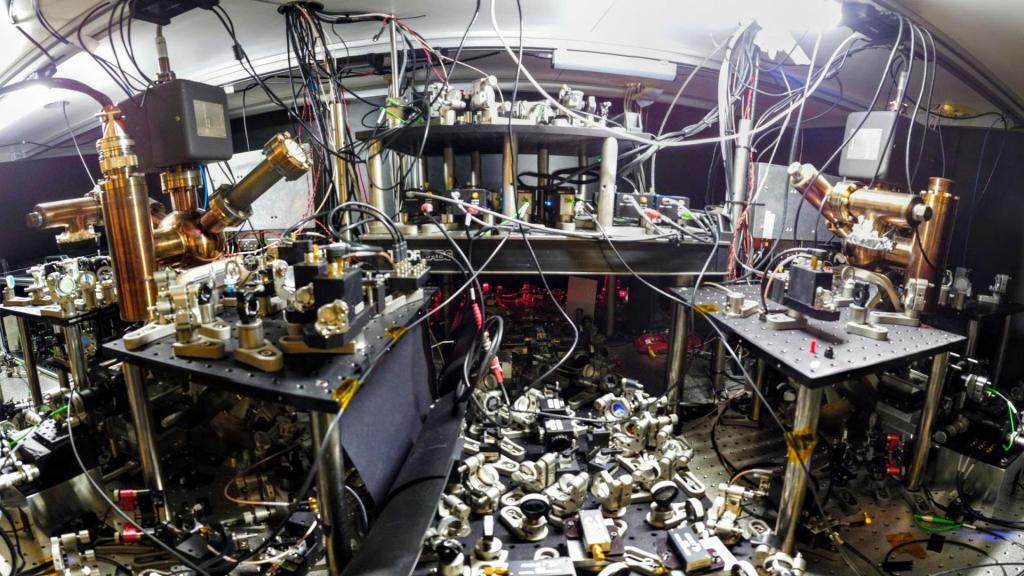
University of Oxford Department of Physics Optical lab

Image illustrating the Department of Physics page describing their quantum networking research

This is my collection of references to examples of explanations of quantum networking.

There are roughly three categories of audience

  • physicists and people who have experience with quantum mechanics
  • people who understand conventional computer networking, who start from ‘How many gigabits per second, with what delay, and what error characteristics’ and go on to ‘what do the connectors look like’ ?
  • people who are unfamiliar with both computing and networking but are interested when I say ‘I’m working with a new company’ and for whom I want a description that doesn’t start from ‘entanglement is like magic operations at a distance’

These audiences are not disjoint: any material for the non-specialists in the topic has to be accurate and precise. This is a rapidly moving field so that references to material from previous years needs to indicate that.

The Oxford description above is for physicists. So is the description from Imperial College, about ‘quantum dots’ producing (non-entangled) photons, which were then passed to a quantum memory system that stored the photons within a cloud of rubidium atoms. A laser turned the memory ‘on’ and ‘off’, allowing the photons to be stored and released on demand.

Bell Labs (of storied history) is now part of Nokia. The Register (a source of long standing for networking people) has a good attempt at addressing their audience with the description of the topological qubits Bell Labs are building, which require cryogenics. Doesn’t at all answer questions about speeds and feeds, though.

McKinsey has a description which summarizes to ‘this is still research’, but follow the money. Lists chip developments from Google (Willow) and Microsoft (Majorana 1); AWS’s Ocelot for cat qubits.

Cisco, Nvidia, and IBM all have labs with working hardware.

Useful summary for computing and network people :

  • Quantum computing. Quantum computing is a computing paradigm leveraging the laws of quantum mechanics to significantly improve the performance of certain applications and to enable new territories of computing.
  • Quantum communication. Quantum communication is the secure transfer of quantum information across distances.
  • Quantum key distribution (QKD). QKD is the use of quantum technology to securely share a secret key that can be used with classical encryption algorithms.
  • Quantum sensing. Quantum sensing uses a new generation of sensors based on quantum systems that provide measurements of various quantities—for example, electromagnetic fields, gravity, and time. Quantum sensors may be orders of magnitude more sensitive than classical sensors.

Caltech explanation “Entanglement can also occur among hundreds, millions, and even more particles. The phenomenon is thought to take place throughout nature, among the atoms and molecules in living species and within metals and other materials. When hundreds of particles become entangled, they still act as one unified object. Like a flock of birds, the particles become a whole entity unto itself without being in direct contact with one another.”

DCVC annual report

Reasons for long term optimism (beyond the current political horizon) about the US and world economy. I met Matt Ocko back in 2014, when DCVC invested in a hardware startup which was wildly overambitious about what it could achieve. Since then he has very substantially scaled the company. Here is it’s third annual report.

Pulling out just two examples

– investment in Mythic, a maker of matrix processors enabling parameters used in the training and inference phases of a generative AI program such as a large language model to be  stored directly in the processor rather than in separate memory, so as to get “more compute in more places that works faster and for less power” 

– investment in Q-CTRL, which builds error suppression software that improves the performance of quantum computers, and has pioneered a new generation of quantum-enabled navigation technology

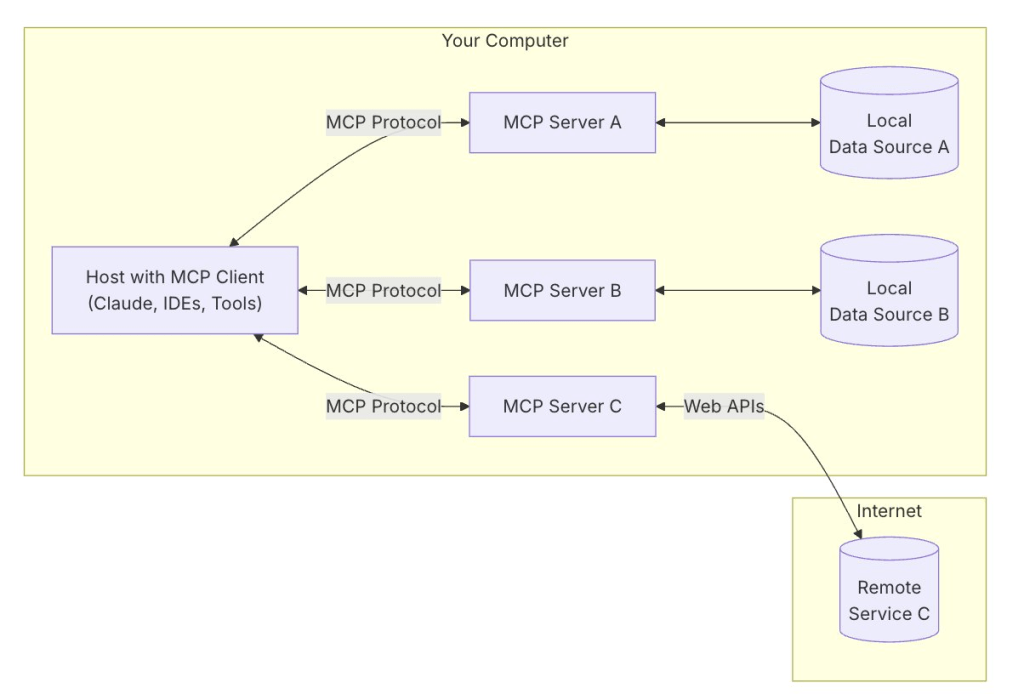
Model Context Protocol

Using MCP – credit AWS https://aws.amazon.com/blogs/machine-learning/build-aws-architecture-diagrams-using-amazon-q-cli-and-mcp/

Data interchange standards enabling Agentic AI – Anil Dash describing Model Context Protocol. Strong agreement with the underlying explanation of how “slightly under-specified protocols that quickly get adopted by all the players in a space are what wins” .. this is the approach that made it possible to build out

– the public Internet (TCP/IP and Ethernet specs)

– the social Web ( HTML enabled Web 2.0)

– secure, two-way connections between data sources and AI-powered tools (MCP)

https://www.anildash.com//2025/05/20/mcp-web20-20/

https://www.anthropic.com/news/model-context-protocol

Examples of newly announced tools (3 June 2025)

Integrations, from Anthropic “Today, we’re introducing Integrations, allowing Claude to work with remote MCP servers across the web and desktop apps. Developers can build and host servers that enhance Claude’s capabilities, while users can discover and connect any number of these to Claude.”

NLWeb from Microsoft “Our goal is for NLWeb, short for Natural Language Web, to be the fastest and easiest way to effectively turn your website into an AI app, allowing users to query the contents of the site by directly using natural language, just like with an AI assistant or Copilot.

Every NLWeb instance is also a Model Context Protocol (MCP) server, allowing websites to make their content discoverable and accessible to agents and other participants in the MCP ecosystem if they choose. Ultimately, we believe NLWeb can play a similar role to HTML in the emerging agentic web.”

Update to note – serious flaws patched https://www.databreachtoday.com/serious-flaws-patched-in-model-context-protocol-tools-a-28924

Comprehensive review of prompt injection issues from Simon Willison https://simonwillison.net/2025/Apr/9/mcp-prompt-injection/