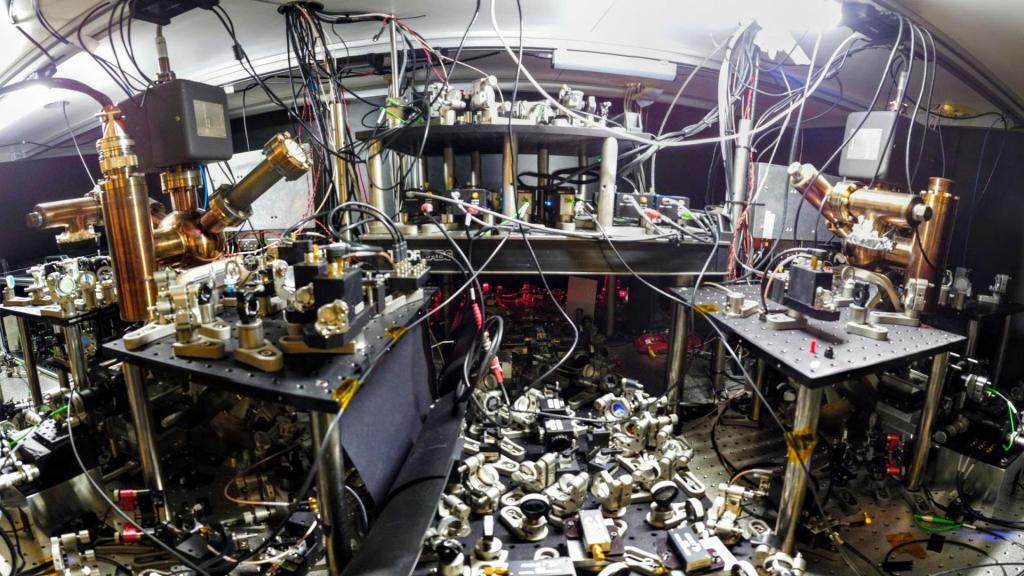
Image illustrating the Department of Physics page describing their quantum networking research
This is my collection of references to examples of explanations of quantum networking.
There are roughly three categories of audience
- physicists and people who have experience with quantum mechanics
- people who understand conventional computer networking, who start from ‘How many gigabits per second, with what delay, and what error characteristics’ and go on to ‘what do the connectors look like’ ?
- people who are unfamiliar with both computing and networking but are interested when I say ‘I’m working with a new company’ and for whom I want a description that doesn’t start from ‘entanglement is like magic operations at a distance’
These audiences are not disjoint: any material for the non-specialists in the topic has to be accurate and precise. This is a rapidly moving field so that references to material from previous years needs to indicate that.
The Oxford description above is for physicists. So is the description from Imperial College, about ‘quantum dots’ producing (non-entangled) photons, which were then passed to a quantum memory system that stored the photons within a cloud of rubidium atoms. A laser turned the memory ‘on’ and ‘off’, allowing the photons to be stored and released on demand.
Bell Labs (of storied history) is now part of Nokia. The Register (a source of long standing for networking people) has a good attempt at addressing their audience with the description of the topological qubits Bell Labs are building, which require cryogenics. Doesn’t at all answer questions about speeds and feeds, though.
McKinsey has a description which summarizes to ‘this is still research’, but follow the money. Lists chip developments from Google (Willow) and Microsoft (Majorana 1); AWS’s Ocelot for cat qubits.
Cisco, Nvidia, and IBM all have labs with working hardware.
Useful summary for computing and network people :
- Quantum computing. Quantum computing is a computing paradigm leveraging the laws of quantum mechanics to significantly improve the performance of certain applications and to enable new territories of computing.
- Quantum communication. Quantum communication is the secure transfer of quantum information across distances.
- Quantum key distribution (QKD). QKD is the use of quantum technology to securely share a secret key that can be used with classical encryption algorithms.
- Quantum sensing. Quantum sensing uses a new generation of sensors based on quantum systems that provide measurements of various quantities—for example, electromagnetic fields, gravity, and time. Quantum sensors may be orders of magnitude more sensitive than classical sensors.
Caltech explanation “Entanglement can also occur among hundreds, millions, and even more particles. The phenomenon is thought to take place throughout nature, among the atoms and molecules in living species and within metals and other materials. When hundreds of particles become entangled, they still act as one unified object. Like a flock of birds, the particles become a whole entity unto itself without being in direct contact with one another.”

 Cunning Systems