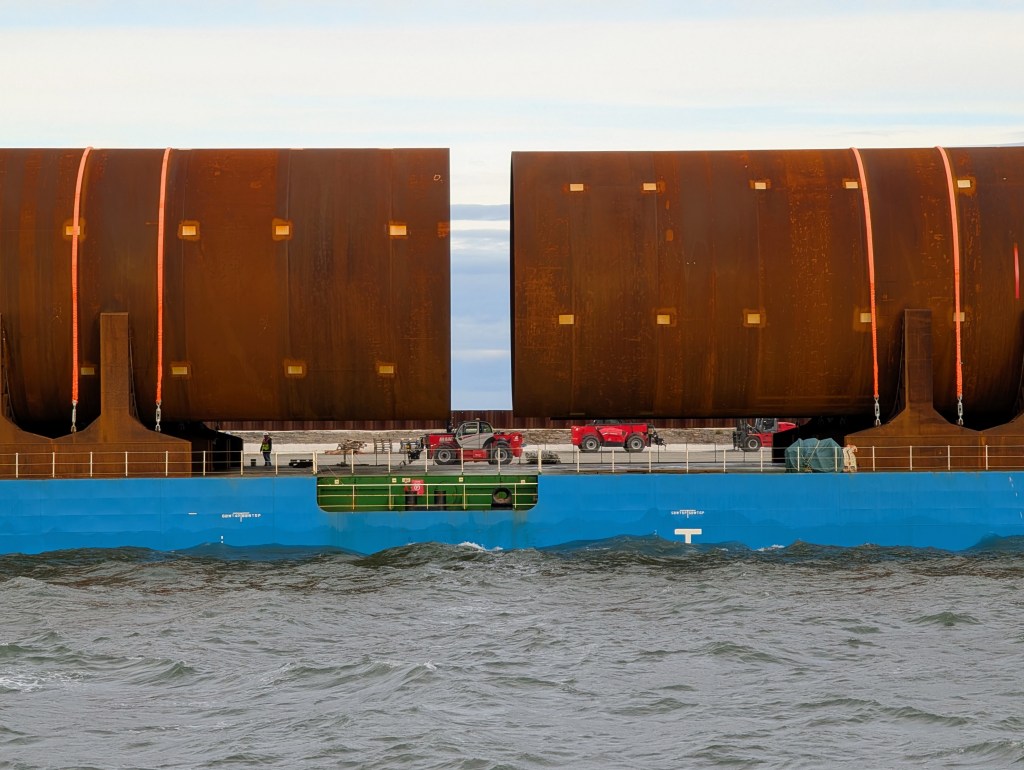
Windfarm jackets, from Wardie Bay. The seven jackets are on the Xin Hao Yua
Early in the year the semi-subs arriving started to have a mixture of transition pieces and these jackets, which are used instead of the monopiles in the previous post for deeper water.
They are much the biggest things to have arrived in Edinburgh in one piece. The thing at the left of the image is the bow of the cargo ship.
Feet of the jackets
For a hint of the scale of these things, there’s a person in a high vis jacket just to the left of the red vehicle, with his head concealed by the metal framing; this metal is welded to the deck for shipping and cut off before the things are moved. The grey thing along to the left is one of the 10 axle dollies which are inserted under the feet to roll them along the dock.
The big yellow things make a new feature on the skyline; they tend to pop up behind buildings when you didn’t think that was where the dock was..
Inchcape windfarm has many better pictures and an explanation here
There’s not been much public blogging lately because I’ve been posting the quantum notes in private, for the project which I’m supporting to spinout from Heriot Watt university.
There’s a different big infrastructure project going on, and we have a way to get pictures of some of the components that it takes to build.
The heavy semi-sub Xiang Tai Kou
We’d watched the Xiang Tai Kou backing in to the deep water dock at Leith on the evening of 11 October 2025, trying to see from 2 miles up town (with binoculars) what she was carrying. Eight huge cylinders .. monopiles for the Inch Cape windfarm. For scale, the Targe Guillemot holding position in front of it is 25m long. The big ship is 231m long and 46m wide.
This was the first arrival of a procession of these Chinese flagged heavy deck cargo vessels, last port Suez. It was preceeded by months of dredging, in the channels on the Forth as well as in the entry to the main Leith dock behind the lock.
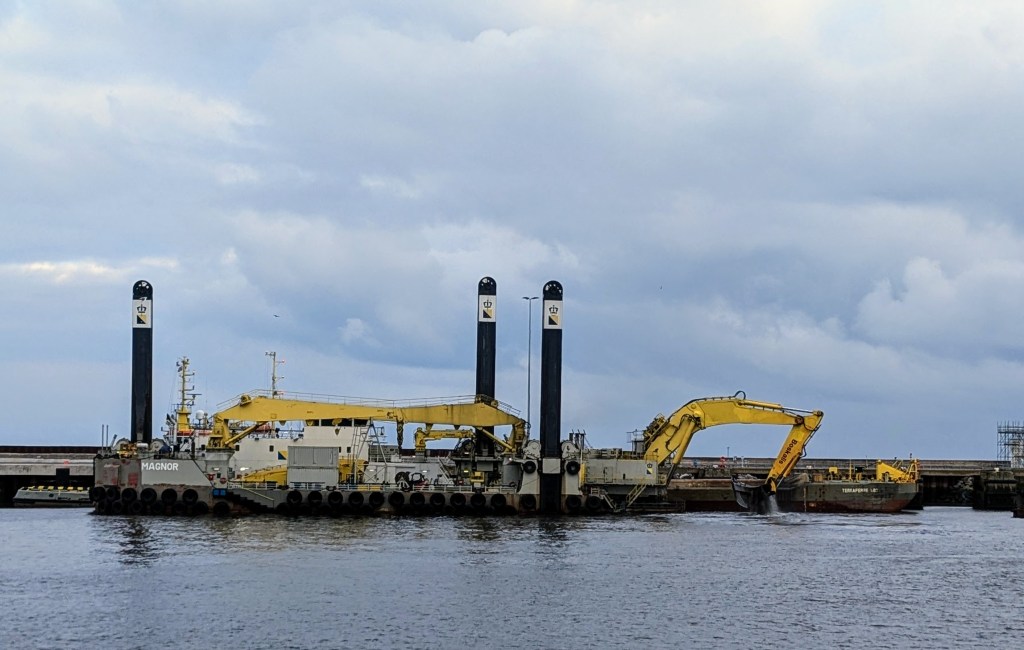
The dredger Magnor, February 2025
That operation also had at least three tugs involved, the GPS Avenger, Union Onyx and Union Topaz, moving and shepherding the big hulls being used for the material dredged up.
Sheng Chang 777 on the 23rd October 2025
The next ship in was the Sheng Chang; this image has people underneath the monopiles.
Wei Xiao Tian Shi on the 31st October 2025
This was the third ship in; there were 8 bogies with 10 axles each underneath the cylinders.
Heavy lift vessel Les Alizés, 23 December 2025
This is the start of the next stage, where the heavy lift vessel loaded on 5 of the monopiles and went off to set them in place at the windfarm, which is more or less due East of Dundee.
Inch Cape wind farm is offshore Montrose, connected to Cockenzie by subsea cable. The lift ship, made in China, is owned by a Belgian company, Jan de Nul, headquartered in Luxembourg.
The QRNG architecture can be integrated with an overhead power consumption of just 7.93 W, accounting for the opto-electronics and FPGA implementation, providing fast random number generation at up to 2 Gbps. We demonstrate the real-time seeding of a free-space decoy-state quantum key distribution system using our QRNG. Our design and implementation provides a practical solution for QRNGs requiring low-power and high bit rates.
Caltech https://www.caltech.edu/about/news/caltech-team-sets-record-with-6100-qubit-array Even with more than 6,000 qubits in a single array, the team kept them in superposition for about 13 seconds—nearly 10 times longer than what was possible in previous similar arrays—while manipulating individual qubits with 99.98 percent accuracy. Looking ahead, the researchers plan to link the qubits in their array together in a state of entanglement, where particles become correlated and behave as one. Entanglement is a necessary step for quantum computers to move beyond simply storing information in superposition; entanglement will allow them to begin carrying out full quantum computations.
Atom array architecture for continuous reloading. Credit: Nature (2025). DOI: 10.1038/s41586-025-09596-6
These notes are my collection of recent press material and research references for quantum computing and quantum networking, with emphasis on pointers towards real products developing from the theoretical physics and comprehensible explanations for businesses looking for opportunities and risks.
Advancements can enable faster, more reliable quantum networking and entanglement distribution, in addition to boosting the engineering of things like continuously operating atomic clocks and quantum sensors with higher stability and bandwidth.
Demonstrating an unconditional separation between quantum and classical information resources
William Kretschmer, Sabee Grewal, Matthew DeCross, Justin A. Gerber, Kevin Gilmore, Dan Gresh, Nicholas Hunter-Jones, Karl Mayer, Brian Neyenhuis, David Hayes, Scott Aaronson High fidelity entangling gates between two processors 0.3m apart https://phys.org/news/2025-08-high-fidelity-entangling-gates-remote.html
This was a full proof of concept in a real-world environment. The trial proved that our SAFE Series hardware can run high-speed encryption with near-zero impact on performance, even in demanding telecom conditions.
HSBC IBM research paper : Enhanced fill probability estimates in institutional algorithmic bond trading using statistical learning algorithms with quantum computers https://arxiv.org/abs/2509.17715 Our work demonstrates the emerging potential of quantum computing as a complementary explorative tool in quantitative finance and encourages applied industry research towards practical applications in trading
SEEQC designs and manufactures superconducting digital chips, firmware, and software for scalable, energy-efficient quantum computing systems based on its proprietary Single Flux Quantum (SFQ) chips produced at the company’s multi-layer superconductive electronics chip foundry located in Elmsford, NY. This chip-based architecture is designed to increase performance while reducing quantum requirements, complexity, cost, and latency. SEEQC’s chip-based solution is augmented by the company’s PRISM firmware and software that supports a full spectrum of applications for third-party developers.