1972
Now that the evenings are getting short and one can no longer get one’s daily ration of exercise, I had recourse to a dusk walk the other evening. On leaving the house I saw a flock of common gulls making their way north to the sea. I disturbed a hare from a nearby field of unharvested flattened corn and he in turn, in his mad dash across a pasture field, put up half a dozen lapwings. On approaching a grazed roundel, a circle of trees put there by the lairds many years ago to encourage game and from which when it was overgrown with rough grass, brambles, broom and whins, I once put up about twenty pheasants, I only disturbed two carrion crows. They flew off complaining raucously about my presence. Over the howe, weaned calves were bawling for their ‘lost’ mums. Across my bows, flying quite close, passed a woodcock. According to Swaysland, woodcock are shy and retiring and they feed by night. They invariably follow the same route from their cover to feeding places. This indeed follows out my own observations at dusk on their movements. “Such is their regularity in this respect, that they used formerly to be commonly taken in nets suspended across these runs and also in horsehair nooses set in similar localities.” Obviously woodcock are not nearly so numerous as they once were.
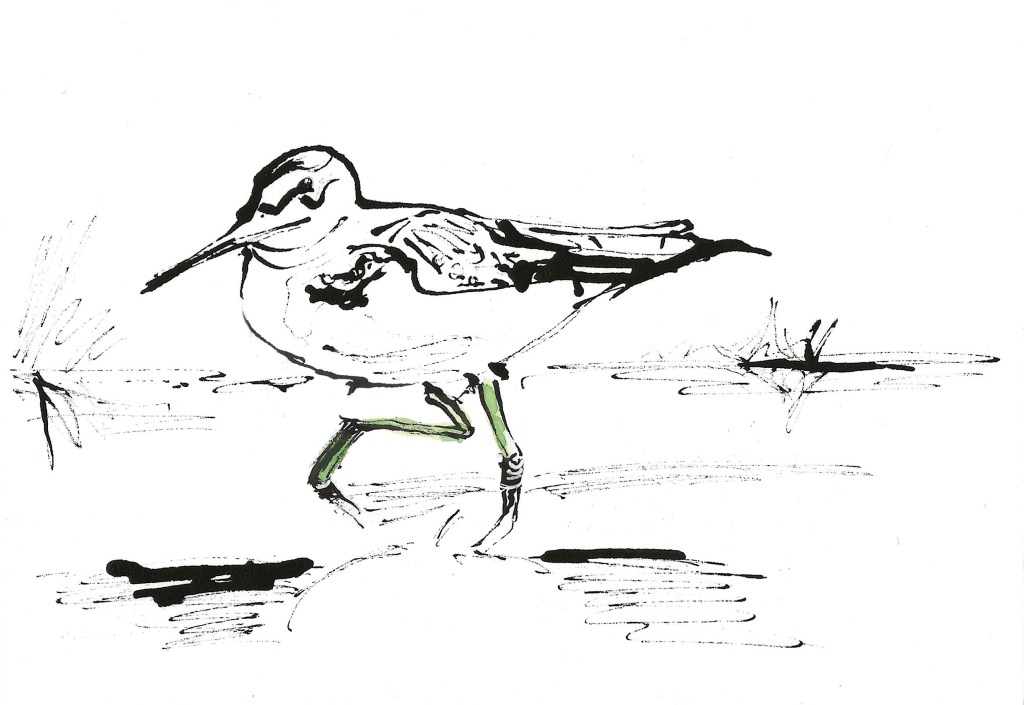
How fine it is when a week of Indian summer weather continues into the weekend and we get a fine sunny October day. For me it was a day of fine bird sightings. It started in Macduff when I observed what was almost certainly a greenshank. Slightly larger than a redshank, it is a more solitary bird.
In the same locality I saw my first flock of fieldfares of the autumn, the roddan birds, winging their way in from northern Scandinavia and the north sea against a south east wind. There is plenty of food available for them now, trees laden with beautiful red rowans, not yet affected in appearance by wind and rain. I was engaged in another activity, refereeing school football and wanted to stop and say, “Look, look, the roddan birds” ; but no doubt I would have been thought to have been touched by the sun which was beginning to warm the land at this time.
In the afternoon from the golf course at Turriff, I saw my first skeins of greylag and pink footed geese of the autumn. They were winging their way over Forglen woods, still against the south east wind and their wild honking was a delight to hear. My golfing companions were not interested. Not long after the geese went over – we were now beside the Deveron – two large grey-brown birds circled round and came in to land on the river. One of our foursome, losing his ball in the setting sun, said “Did you see it ? “ and three of us saw nothing but the grace of these fine big swans hitting the river with flaps down and feet spread. They were a pair of young whooper swans. They have a much straighter, more vertical neck than a mute swan and in silhouette, on the darkening river, the head looked almost like that of a pelican’s.
Recently, when the autumn migration was well underway, I looked out of my bedroom window and through the slats of the garden fence, at about twenty yards range, I saw a small bird, like a thin sparrow, with what looked like a rusty mark on top of its head. Never, to my knowledge, having seen one like it before I watched carefully for some time as the bird fed on seeds, on ground which had recently been cleared of potatoes. It acted in a calm, unhurried way, but after some time it flew up to the top of the beech tree into the sunshine. Here it stayed long enough, unlike many birds, for me to get the binoculars on it. It had a beautiful pinkish-red breast which positively glowed in the autumn sunshine. The bird turned out to be a male redpoll, the smallest of our finches. It gets its name from the red on the crown of its head. Formerly, evidently, it was a favourite cage bird and could be found in every bird seller’s shop. It was kept by bird lovers because it could be taught tricks. Besides eating from the feeder’s hand, it would learn to draw up water in a glass cup from the well arranged in the cage for the purpose. There are three subspecies, mealy, lesser, and greater redpoll as well as the more distinct breed of Arctic redpoll. Altogether quite an interesting bird which winters in the north east in fairly large numbers.
1973
After the gale, the garden seems to be alive with birds feeding, playing and sheltering as sometimes the gusts of wind are still quite strong. There must have been an invasion of chaffinches as there seem to be about a hundred of them in the trees, bushes and shrubs in the garden, often playing at times in pairs and sometimes causing the feeding blackbirds and thrushes to duck as they go whirling past. We had some fine close up views of male and female chaffinches as they perched on the lounge windowsill, hopped off and fed on the marigold seeds in the flower border underneath. In closeup on the male one can see red, pink, brown, green, yellow and white coloured feathers. While using the binoculars, I had the upstairs bedroom window open at the bottom and a female or young yellowhammer perched within twelve inches of my nose. The beautiful yellow and russet on it were finely displayed. One always feels privileged when one gets a really closeup view like that.
In the garden generally, the sparrow, robin, wren and dunnock were to be seen, busy feeding in various spots, sheltered from the northwest gale. If all these birds are about, one feels something more rare might be blown in. On the lawn, pied and grey wagtails were feeding and just to remind us that, in spite of the faint traces of sleet, this is still October, a pair of late nesting swallows are still here, hawking for flies, despite the cold.
Looking out of the bedroom window into the half light of dawn, through rather bleary, Monday morning eyes, I saw what at first looked like rather small, brown dumplings in the grass of the wild garden. As one’s eyes became accustomed to the light, however, one could see the dumplings moving and I had to take the luxury of watching for five minutes a covey of seven partridges feeding in the grass and under the gooseberry bushes. Always on the alert, they were making their way warily about, realising that they were very close to the house and therefore vulnerable. One or two were making the clucking noise of ordinary hens. They stopped, alarmed for a moment, but it was only a field mouse bounding speedily through the long grass. Eventually all the members of the family saw them and it was quite a subtle way of arousing some members without there being the usual Monday morning ‘grouse’.
We have spent a weekend in the Bournemouth of the north, Nairn, and it certainly lived up to its reputation for mild, sunny, dry weather. Not that there wasn’t a good nip of frost on Saturday morning with the stilts building up on one’s heels on the golf course, but after the sun chased the frost away, it was glorious, so fine in fact that some adults played tennis and the children came out of the sauna bath and jumped into the swimming pool. On the golf course we saw a pair of stonechats. Whinchats migrate south in the autumn, but stonechats winter here, generally around the coast. The male has a black head, a white collar and a red breast with light underparts. We saw a robin quite close to it. The stonechat perches much like a robin.
We also saw five whooper swans flying over quite low, towards the enormous new oil servicing building at Ardersier. One member jokingly asked us “How do you like our new caddy-car shed ?” On the shore itself we saw a flock of lapland buntings, very nondescript in their winter plumage and camouflaged most wonderfully among the seaweed and pebbles on the beach. They were often disturbed in their feeding by Sunday afternoon strollers and each time they landed they just ‘disappeared’ again.
On the morning of the storm of hail and snow, our nine year old son called from his bed, “Geese! Geese! “ There are geese which honk at the farm some two hundred yards from our house and we naturally presumed he had heard them. But no, he said he saw one passing his window and sure enough on looking to the south side of your house we saw a skein of geese flying round a stubble field on which there were heaps of dung waiting to be spread. Three times the geese circled and approached, big powerful majestic birds in flight, and at last they alighted. In all the twelve years we have stayed here, this is the first time, to our knowledge, that geese have landed. There were seventeen of them, greylags, and we had a grand view of them all. They had pink feet and orange bills, black tails with white underneath and generally were dark grey on top and sides. They are larger than their cousins, the pink footed geese, which they resemble closely. A big gander stood on top of a heap of manure to keep watch and somehow to lead and be master of his flock. They were mostly resting, with one or two feeding, taking the occasional pick of green grass here and there. One can only presume that they were unable to land near the coast or maybe they wanted a sheltered spot in the lea of the rough north wind on this wild, cold morning. After an hour they were gone, and sadly, we did not see them go.
1974
In the big bird, the Viscount, going over to Stornoway to fight the General Election as the Conservative candidate, it was rather bumpy, especially below the cloud level and of course to get over the hills one must go up and down through the air pockets. However, it was rather reassuring to look out and see ‘R.R.” printed on the Viscount’s port engine nacelle which was very close to me. Our flight only took thirty minutes from RAF Kinloss. Inverness airport at Dalcross was closed for repairs. It was nice of my wife and children to drive me up and see me off on my election adventure.
What was the dutiful politician to do on a Saturday afternoon ? Walkabout ! I saw a queue for a Sea Cadets sale of work. The very thing to go to and meet the people and so it was, as I met Donald Stewart, MP, the main SNP opposition doing the same thing. One just introduced oneself and made pleasant conversation, knowing that he has a political job to do, just as I have, being here for the election. I was in the Western Isles constituency for election experience and hoping at the end of the campaign to save my deposit.
For those who have not experienced it, Stornoway on a Sunday afternoon is like a different planet. I felt this as I locked myself out of the County Hotel where the very friendly Bill Lowe was owner and manager. If people go out on a Sunday afternoon it is mostly by car. Their religion says that this is the accepted procedure and that is what you get. During my walk I saw by the shore five hooded crows, herring and black headed gulls, some oystercatchers, a solitary curlew and diving in the harbour a pair of cormorants. A friendly chap in the hotel – he gets married on Saturday – said that while he was taking his friend’s dog for a walk on the pier in the gloaming, he saw an otter. On the edge of a housing scheme, out past the power station, there was a buzzard hunting. Further over, nearer the airport, I saw a small sparrow-sized bird and I took it to be a twite. A big flock of lapwings were feeding with sheep in a field. On my return journey I was delighted to see a wheatear. I saw the distinctive white flash above the tail and its blue-grey head.
Next report from Benbecula and the Uists where I was hoping to see a golden eagle. The hotel, the Creagorry Arms at Benbecula is, I believe, in the Guinness Book of Records and is in the enviable or unenviable position, depending on how one looks at it, of having the bar which sells most drink in Scotland over a 24 hour period. Picture about twenty people standing at a long bar being served and when they have all got their orders they step out of the way and another twenty step forward and take their places and so it goes on and on. Over the past few days I have travelled over the one track roads with passing places, lumpy roads of North Uist, Benbecula, South Uist and Barra.
Undoubtedly the bird of the islands is the lapwing. They spread themselves out to feed and every 100 yards or so a single bird is to be seen on the narrow road or on the verge. Somehow, too, the call of the curlew and redshank is more plaintive here, coming over the machair in the islands, than it is in Buchan. I have been in many houses during my campaign here as parliamentary candidate and the natural fuel is still peat with its distinctive aroma. The most colourful small bird is the stonechat. As yet no golden eagle, but I am still hoping. Of course, I’m not really over here on an ornithological expedition. I discovered an eminent person on Barra, the local parish priest no less, had as a Saturday evening feast, roast cormorant and trimmings and a bottle of Beujolais to wash it down.
After being up at 5 am to catch the ferry to Barra, the young gentleman who was to be my helper and chauffeur for the day and I, left Lochboisdale at seven and as the sun rose on the Minch, the crossing to Castlebay on a calm sea was a memorable one. I had a candidate’s disc on my lapel and this was a passport to Viscount pilots’ cockpits and also the bridge on the SS Iona. To the west the sun sparkled on the white plumage of gannets and fulmars as they quartered and soared over the waves of the Minch. To the east the mountains of the mainland and the Cuillins of Skye were etched against a cold dawn sky, like teeth on a crosscut saw. The magic of the islands was getting to me.
Donald Stewart was duly successful again in retaining the Western Isle constituency in the October election and I did not succeed in retaining my deposit, but I was the person in Scotland who had the largest increase in percentage vote and this pleased me quite a lot. After these elections I had hoped to be adopted as the candidate for Banffshire but that privilege went to David Myles from Dalbog, Edzell who was duly elected to parliament in 1979.
1975
It was an exceptionally clear morning and the Ythan estuary was quickly visible after the Viscount took off heading north. Flights are becoming almost annual events. I had chosen to sit at the starboard window as I wondered if I would see any visible oil rigs to the north east. After we passed west of Newmachar, Mormond Hill was easily picked up, but looked comparatively insignificant compared with the view one gets of this massive hill from the Fraserburgh road. This year, unlike last, I was flying over a familiar landscape and this added great interest to the flight. To the port side snow was visible on the Grampians. It had been a cold morning start with white frost. Now the wonderful pattern of Buchan was laid out below. We passed over Turriff and I could quite clearly see the new reservoir. Quickly now to Tarlair and Macduff. Just west of Banff, fresh water showed in the sea, it being a lighter colour. Duff House and the golf course greens and bunkers were clearly seen. It was a wonderful view along to Inverness in the west with Buckie clearly visible and to Fraserburgh on the other side. Soon we were in some wisps of cloud and they quickly created some turbulence.
My destination was Wick where I was going to be interviewed, attempting to become their Conservative candidate at the next election. In the harbour at Wick, cormorants were fishing. The ‘dooker’ of my boyhood always intrigued, as it came very close in to the shore or pier when after food, usually diving from the surface. It has a snake like darting head and the bird gives the impression of really belonging to its element, the sea. I can remember as a boy fishing for mackerel at the pier in Oban with, for bait, a dead two inch herring fry, sunk to a depth of about ten feet and having to pull the bait away from the underwater dooker in case one inadvertently caught one.
A report comes from the Deveron that ten days ago a kingfisher was seen and this is very interesting news. Kingfishers are comparatively rare in our area. They are the most brilliantly beautiful of all British birds. The upper parts are a bright green, shading from olive to iridescent emerald and blue. The breast and underparts are rufous deepening in colour towards the tail. The beak is long and straight. It would be interesting to know if a pair have bred.
The season of mists was followed in natural climatic sequence with “White as meal the frosty fields”. Last Saturday was such a morning with a sharp frost for the tattie pickers and dads trying to get cars started at about 6.30 am. Many dahlias and chrysanthemums ‘met the puddock’ too, killed off by the frost. We think the main number of fieldfares are here now as many flocks of the ‘chak, chak’ birds have been seen recently. When we got downstairs the other morning we found the lawn covered with fieldfares and their cousins, the redwings. Seen at a few yards range, both birds are very handsome, still in a lot of summer plumage. There must have been 40 to 50 birds spread all over the lawn and some came up to within a few yards of the kitchen window. The fieldfare is a large member of the thrush family and at close range his slate blue-grey head and rump are very noticeable. The breast is light coloured with a yellowish tinge. The redwing is smaller than the fieldfare and its creamy-white eye stripe was particularly noticeable as well as the flash of reddish-chestnut along the sides which give the bird its name.
A few years ago we planted two berried cotoneaster shrubs, bullatus and cornubia, in an attempt to attract waxwings in the winter. As well as hunting for worms, the early morning invaders were voraciously feeding on this year’s very good crop of cotoneaster berries in competition with the resident blackbirds – incidentally also a member of the thrush family – and quite a few skirmishes developed. Our eyes feasted on this interesting spectacle until something disturbed the birds and they all flew up into the surrounding trees. We may have to put some apples on thin wire if we are to attract the waxwings, as the cotoneaster shrubs are quite bare now.
1976
There had been a gale from the west and the back road was littered with broken twigs and branches. Many beech nuts, conveniently broken open for the pigeons, lay on the road. I sampled some of the beech mast and enjoyed a taste which I had not savoured for many years. Rowans also littered the road, some squashed bloody red by car wheels. Somehow it seems a shame for nature’s fruits to be so wasted. If man does not appreciate them, I think the animals and birds do. As I suspected, wood pigeons were feasting on the road and one was either stuffed full and asleep or intoxicated. It eventually flew away in a leisurely fashion when I was very close to it.
From the road I entered a field of stubble and young grass and immediately a big brown hare flattened itself in a sheltered hollow of the field. It let me get fairly close then bounded away with tremendously strong leaps. I suppose that is why we enjoy living in the country when we can appreciate being part of this autumn scene.
1977
A young enquiring mind introduced us to an interesting object this week, in the form of a sort of gall or parasite which grows on wild briar. We have not seen this phenomenon before. It is not very common. The nest-like object of what one would say was green and pink moss was bound round a joint on the stem and the whole mass was about the size of a small to medium apple. When it was dissected, small grubs were found in the centre. Like the oak apple, this is presumably the object of the insect in laying its eggs on the briar. To protect itself, the briar grows this wonderful edifice which in its turn really protects the grubs until they are mature and fly away to continue the cycle. This was a Robin’s Pincushion.
This week I refilled the fat basket and turfed out some earwigs from the bird table feeder box before putting in some toast and biscuit crumbs. I even found an earwig in the coil attached to the telephone receiver in the hall. There are flowers on the hall table of course, and the ‘crawlies’ do get into some peculiar places at this time of year.
A skein of autumn geese snaking along the sky,
The wavy line of the skein sometimes thick, sometimes thin,
Seen against the grey sky, they flew across a west wind
Now they have gone south. Were they really there ?
This is their season for coming south, maybe there will be more
Of these wonderful birds. I was luck I saw them,
I only heard one honk between the noise of an earth moving machine.
Last weekend, for the first time, we went to play golf at Ballater golf course and we had the great pleasure of seeing Deeside in the Fall. It is pictorially one of the most picturesque parts of Scotland and yet comparatively unsung. As we left home it was actually raining, but crossing Donside, the rain cleared. We went by Huntly, Rhynie and Mossat and we only saw two cars all the way until we got to Deeside. We saw pheasants, partridge and magpies and nearing Deeside itself we had a fine closeup of a buzzard which had been perched on a fence post by the side of the road. This bird was possibly moulting, as it seemed to have a lot of light grey feathers in its plumage and at first it looked owl-like.
After the bare moorish scenery around Boultenstone, we descended to Deeside. Many of the birch trees had changed colour. The early morning mists were rolling back off the hills and in places red bracken added to the autumn scene. Ballater itself is set in an amphitheatre of hills which are far enough away not to be claustrophobic. Pockets of mist and cloud clung to the high hills like cotton wool. On the course itself we saw numerous mistle thrushes. We also saw a number of long-tailed tits. They fly like wagtails with an undulating flight, not solitary or in pairs, but one after the other in flocks of fifteen or twenty.
In North Angus the other day, we stopped for a picnic at a layby on a minor road. The area was quiet and surrounded by young fir and birch trees. A young rabbit, not realising we were there, came out of the trees onto a pile of sandy gravel and we had an intimate view of his toiletry activities. He washed his face and paws and then tidied up his fur here and there. One is inclined to forget what a fine creature the rabbit is in his natural habitat. A robin appeared out of the trees to join the rabbit on his patio and a pair of coal tits flitted through the trees very close to us.
1978
Last week the countryside around us reverberated to the sound of combine harvesters and balers. We walked up the road as a combine was working and noticed a pheasant, which had been rudely put out of its summer quarters in the barley, running along the end of the field. His run reminded us of the high trotting ponies seen at Turriff Show. The other evening a phone call took us into the Inverkeithny direction to see a young bird of prey. It was larger than a seagull, had been found on the hill and could not fly properly. Excitedly, we thought that it might have been a young migrating osprey. The bird, which was perched on a bench at one end of a garage, turned out to be a fine looking young buzzard. It occasionally spread its wings to a considerable span, showing them to be dark brown on top and much lighter below. It was a fine, proud, fierce looking bird with the bird of prey attributes of sharp curved beak and vicious looking claws. We had not seen a buzzard at such close quarters before. Its wing was not broken. It was being fed on raw liver and eggs and possibly without having to forage for itself, in a few days it might be strong enough to survive on its own again in the wild. Buzzards are much more common in the high land in south west Banffshire than in the east.
Rooks are much more numerous in flocks these lazy days and as they change their feeding fields during the day one can hear the great babble of conversation that goes on as they fly over. Their ‘talk’ is interesting, a low voiced chuckle or muttering even, and sometimes grandfather will go by swearing volubly about someone not telling him where everyone else was going. Rooks pair off or get ‘engaged’ in the autumn evidently, but do not get ‘married’ until the next spring.
The Indian summer has come and not quite gone. The autumn colours are especially fine this year and because of the lack of wind, the trees have kept their leaves. The beech leaves have been a deep rusty brown and the light elm and sycamore have provided a fine contrast. The blaze of the gean leaves is always inspiring. Sometimes frost is a colouring agency, but not this year as we have had no frost at all through the month of October, a remarkable phenomenon and so colouring must be done by the sun for the most part. Frequently we have had a cold snap during the first week of October which blackens the dahlias and chrysanthemums and colours the gean.
At least two Sundays during a mild, comparatively frost free October were ‘gossamer’ Sundays, when, looking over the sun-covered fields one could see them shining with the miracle of thousands of the tiny spiders’ webs, a fantastic sight really. After the weekend of the redwings came the weekend of the fieldfares, the roddan birds, with their triple chak call. We also had an invasion of continental blackbirds. Now we wait to see what kind of year it is going to be for waxwings, whether their ‘invasion’ will be big or small. We will also be on the lookout for siskins, redpolls, bramblings and snow buntings.
1979
As we prepared to play off the high, elevated, first tee at Forres golf course, as if to order, a magnificent large black or dark blue dragonfly appeared. In our part of Buchan it never seems warm enough or sufficiently sheltered for these exotic insects to be on the wing. The dragonfly is like a sundial, in that he is very active only when the sun shines. Our one was possibly the largest British dragonfly, the Emperor. They are strange creatures and have an interesting life cycle. The eggs are laid in water. The pupa or chrysalis stage is omitted. From the egg a strange fierce larva emerges, one which is very unlike its parents. It clings to underwater weeds and catches its food by shooting out a clawed limb. The maggot form, after a year or so, changes to one that looks like a beetle. The beetle climbs up a plant stem, clear of the water, sheds its skin, and at last the dragonfly emerges in all its glory.
If someone was to ask me where to go in Scotland to see black tailed godwits then I would reply, “go in autumn to the sea shore bordering the first fairway at Nairn West golf course.” Each time we have visited Nairn, we have seen them there. They have long legs and long bills and they are some four inches shorter than curlews. Unlike the curlews, their beaks are practically straight. When in flight the white on the tail can be seen with the black band at the tip. They winter on mudflats and marshes.
On the back road or nearer the sea road from Forres to Nairn we saw only our second male hen harrier. The first one we saw some years ago was between the Pole of Itlaw and Greenlaw and it was in direct flight. This one was flying flappily, like a heron, hunting over the same area of a stubble field and the distinctive, diagnostic black tips on the wings could be clearly seen. The male and female hen harrier are quite different in colour. The male is very light, with plumage almost like a common gull. The female is dark brown, like a buzzard. In the forest we had fun discovering ant hills. They are made in mature forests only, from many pine needles dragged into the one mound, a wonderful ant city.
Last week we visited the Loch of Strathbeg which is between Fraserburgh and Peterhead and beside the Crimond airfield. It is a large shallow loch, separated from the sea by sand dunes, with plenty of feeding particularly for ducks, geese and swans. As the RSPB brochure states this is an international staging post in the north east of Scotland for migrants. Birds converge on the area from the Scandinavian countries in the north east of Europe and from Iceland in the north west. Over a winter the loch has been used by as many as 25,000 waterfowl. In marsh and woodland fringes there are roe deer, badgers, foxes and otters. Unfortunately the RSPB only leases the 2000 acres and the owners still shoot over the area which all seems a bit pointless.
There are two observation hides and on the day we were there all the excitement was among the observers in the Fen hide, reached by a 1000 ft boardwalk. Outside the hide, very close to the shore, were over seventy whooper swans feeding and displaying. When we had alighted from the bus we could hear their wild, joyous call and honking. Occasionally in the spring, I have seen smaller ducks like goldeneye displaying, but never anything on this scale and in the autumn too. Pairs of swans would intertwine their long necks and bob up and down in a most comical fashion. Chasing round in circles was another game and sometimes one bird would catch another’s wing in its beak in a mock fight. According to knowledgeable observers these were families of swans sorting themselves out or pairing. Many of the swans were just feeding, doing ‘bottoms up’ in the loch. Altogether it was a very interesting autumn experience.
1980
High tide at Scotstown, Banff brings many waders onto the rocks close to the road. On a sunny lunchtime we were thrilled by the wonderful sight of a flock of turnstones flashing in the sunshine low over the sea and then coming to land on the closest rock beside the road. The turnstone has an interesting pattern of white, brown and almost black on the back of its wings. When this is multiplied more than twenty times it makes for an invigorating and uplifting sight in the autumn sunshine. Among the turnstones on the rock we noticed a pair of darker plumaged redshanks and they turned out to be spotted redshanks and a first sighting for me. The spotted redshank has slightly longer legs than the ordinary redshank so that they trail further behind the tail when they fly. The beak is slightly longer and darker and red at the base. The spots along its sides are also more pronounced. Our new discovery was accidental, but we did look closely at all the birds on the rock, trying to see if there were any strangers among them.
The Dunbar tourist brochure states that the John Muir county park is the largest in Scotland. What we saw of it, on a cold October day, with a half a gale blowing and the waters of the Firth of Forth carrying many white horses, was quite impressive. Convenient indicators showed us where we were and what could be seen. The Fife coast to the north was bathed in sunshine and the Lomond hills dominated the skyline. In the foreground the Bass Rock stood dramatically out of the sea with the Isle of May prominent beyond. The tide was out revealing acres of mussel beds on the foreshore and here oystercatchers were busy feeding on what would be their natural winter food. We also saw a few redshanks, turnstones and gulls. There were interesting seams of seawashed red sandstone visible on the beach. This is the natural stone of the area.
Dunbar is noted as a place for wintering racehorses. We watched three horses and their jockeys exercising. First of all they trotted round the sands and then they galloped. This all looked rather grand, fine big horses with manes and tails flying in the wind, jockeys standing in the saddle, all pounding along at speed over the sands. Walking along the road behind the clubhouse at Muirfield golf course where we had played, my ears picked up strange bird noises such as I have only heard in documentary films about Australia. The noise came from numerous budgerigars which were flying in what was presumably a garden aviary. The hows and whys of this Scottish tropical extravaganza remain a mystery meantime. Strange places, strange things.
The warm sunshine of an October Indian summer day lit up the spindle tree, (euonymus planipes) in our garden. The very red lanterns on the shrub contrasted with the light yellow brown of the leaves which were dropping off as one looked at it. Earlier I thought I had detected a warbler-like bird flitting about among the shrubs. To complete the autumnal picture, a blackcap revealed itself on the spindle tree and it moved about the shrub with its distinctive, warbler-like, sinuous movements, collecting food. I wished, not for the first time, that I had a camera with a close lens that could have recorded the very beautiful picture.
1983
As we stood beside the ninth tee at Duff House Royal golf club, Banff, a large mink swam out from the river bank below, saw us and immediately dived under the surface of the Deveron and was seen no more. At first it was so big that we thought it was an otter, but as it turned its head to see us and dive, there were ripples of fur under its chin rather than the sleekness one would associate with an otter. It is not easy to be definite, only getting a brief glimpse of a creature in the water for a second or two. Across the river a grey, craggit heron was perched on a tree either digesting its breakfast or waiting for us to go away so that it could resume its fishing. More than a dozen mallard ducks were washing, preening or resting on the rocks on the far side of the Deveron above the golf pool. A wagtail was feeding there too, and various small trout were jumping out of the river. Before that a kestrel had flown past and even earlier we had seen a number of swallows, still here on October 6th, which is comparatively late. There are still a number of flies about. Almost the next birds we saw beside Duff House were some redwings and fieldfares. One usually assumes that the swallows have gone before the redwings and fieldfares arrive.
As we passed by Fyvie on our way south, there were eight pheasants perched like hens on the estate wall. At the high part of the road between Turriff and Aberdeen, just south of Oldmeldrum, we saw a large flock of lapwings and grey plovers in a roadside field. We have noticed in other years that the plovers seem to like this bit of territory as a feeding area before the extreme cold frosty weather drives them nearer the coast. On the motorway crossing Fife, between Perth and Edinburgh, we could see large numbers of geese just dropping down to a feeding area. Later in the day we climbed a bit of Arthur’s Seat and there were no birds to be seen. We took it that there were too many humans and dogs.
After golfing at Elie, where we again saw swallows on October 10th, we moved on next to Crail and just looked at Balcomie Links. The starter there Mr Jim Calder came from Aberdeen. As we were approaching Balcomin, we had noticed some small birds flying fairly low overhead and they had dark heads and yellow bellies. Mr Calder was able to confirm that these were goldfinches and that there were quite a number in that area. He had also said that in the previous week he had held in his hand an exhausted goldcrest. It had stayed with him for most of the day and had slept on top of one of his golf ball boxes. The goldcrest is the smallest British bird.
1984
Autumn seems to have rushed on us quickly with morning frost to kill off the courgettes and to ripen the plums. The cold wind from the north is not very pleasant nor are the cold wetting showers it brings. Much of the harvesting has been done, but there is still some spring barley, oats and wheat to be brought in. Fortunately, so far, we have been spared the usual equinoctial gales. As well as oilseed rape through the ground, many acres of barley have been planted and winter wheat can go in any day now. There is much talk among the farmers of pre emergent sprays and growth regulators. Undoubtedly it is the busiest time for the farmers having to turn round and plant their crops as soon as they have harvested the previous ones.
Can I take my readers in their imagination to the Garronhaugh wood overlooking the river Deveron on the south bank, above the bridge of Marnoch, on a bright breezy but beautiful sunny autumn day with creamy clouds scudding across the sky. Nearly opposite me is the House of Glennie and one cannot help but admire a beautiful house in a beautiful setting. Just west of it there were four gean trees on ‘fire’ in the autumn sunshine. Their colour had to be seen to be believed. Many more trees in their autumn colours made this a wonderful setting. To give us an appetite for our picnic, my wife and I had walked from Garronhaugh wood gate to Carniehaugh below Fourmanhill and back. At one place on the road experience seemed to say, because many sheltering saplings were growing on the sloping bank above the road that this would be a good place to see roe deer.
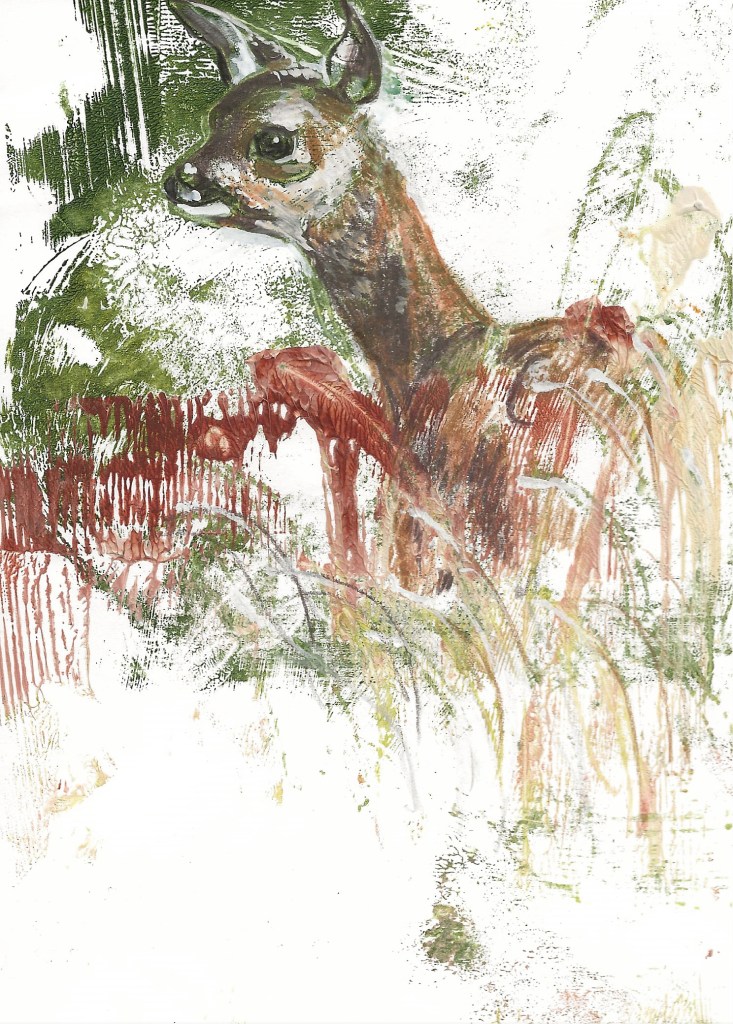
Sure enough as we looked up a roe doe moved up the slope, stopped to look at us briefly, then darted quickly away. Between ourselves and the river were three magnificent specimens of spruce trees and I reckon they stand nearly two hundred feet high. We picked up ripe hazelnuts from the road. The Deveron valley is fairly open where we sat having our picnic and there was hardly a dull moment. First we saw a pair of carrion crows attacking a buzzard and chasing him off and then a kestrel was likewise shown the aerial door by the crows. All the while wood pigeons rocketed across the river, flying fast with the strong wind.
One local road should have carried a notice recently which read “Caution – moorhens crossing’ . A grain lorry had split a quantity of barley on the road and a family of moorhens had a good time feeding off the spillings for a number of days. Moorhens are interesting birds and stay at our local dam all winter. Not far away a grey wagtail has taken up winter quarters. If it had been going to migrate it would have been gone long before the end of October. Pied wagtails usually stay here, but not so often the more delicate, grey wagtail.
1985
What do you think is the tipple of a corncrake, malt whisky or American rye ? A very strange, once in a lifetime incident happened to my wife and I the other day. A brown bird about the size of a collared dove flew down into the street beside Chalmers hospital, Banff, by the Railway Inn. As we drew level with it in the car and stopped, it moved from the pavement into the family entrance of the Inn, and acted like a pullet trying to gain entrance to a coop. After studying the bird for some time and taking careful note of the plumage, shape, colour of legs and size, we concluded that it was a corncrake, either a young bird or a female as the dark brown along its side was not so intense as that shown in the books. It is slimmer and longer legged than a partridge, though about that size.
A corncrake is nowadays a very uncommon bird and they nest in the north west of Scotland. The introduction of mechanical haycutters and forage harvesters meant that there are fewer nests in grass fields. Corncrakes are probably most numerous in the Western Isles and there was some concern about the loss of corncrake habitat there.
The illustrations in this book are the original creations of Sheila Chapman and she retains the copyright in them (Reproduced here under licence). More information about the artist can be found at http://www.sheilachapmanart.com
 Cunning Systems