1971
Have you noticed how things in nature seem to ‘move’ on filthy, foul days when it’s not fit for man nor dog to be out? St George’s Day was such a one and our first sand martins were seen then, right on schedule. I have known of numerous other instances of interesting natural happenings on wild days. I have seen my only fox, so far, in its natural element on a wild autumn day.
Once, when I was a student, I was employed by my big brother fishing salmon commercially on Loch Feochan, a sea loch south of Oban, we caught our largest catch on a windy, rainy, wild day in July. Normally the boat was rowed out from the lochside in a semicircle, what is called sweep net fishing. The net was tied off to the shore at the starting point and pulled itself gradually off the flat platform at the back of the boat as we rowed along. When we reached shore again and drew the net ends together, a large ellipse of corks and net was left in the water to be drawn in, with the bag, the strongest reinforced bit of net in the bottom, coming in last. On this particular wild day it took us all our time to row the boat. The wind was very strong. My brother Gordon, the big fisherman, was on the outside oar, doing all the pulling. I just had to keep the inside oar going. On landing I ran to untie and full further in the closed tied end. As I gave the corks a whip, a salmon jumped back into the middle of the net. One sensed that conditions were crowded in the loop of the net. After an exciting haul, and that’s putting it mildly, with one or two more fish jumping within the corks, we killed 86 salmon and grilse, average weight seven pounds, wholesaling then at six shillings a pound. The economics of the prize I’ll leave to the keen mathematicians. Usually one was lucky if one got five or six fish in a ‘shot’. Incidentally, one did not ‘shoot’ the net until one saw a fish jumping in the draw, so a constant watch had to be kept on the waters of the loch.
One can be on the lookout about now for bird movements large and small. At the beginning of the month I saw a large number of geese flying in a north-westerly direction. There were well over a hundred in two large skeins and one small one. They disappeared into the fine light of the setting sun just like the scene of a Peter Scott painting. Many geese winter in Perthshire and congregate there before setting out north on their migratory flight. We have seen the sky from Blackford to Glen Devon, a matter of four miles as the goose flies, simply full of geese, really a magnificent and stirring sight.
On May 2nd we sat in the garden having our first ‘fly’ of the summer outside – admittedly it had clouded over by this time – and watched a pair of lapwings diving and tumbling over a ploughed field, about a quarter of a mile away, uttering their pee-weep calls. As children we used to pit our wits against the peewits and try to find their nests. Sometimes we won and sometimes they were the victors. Often we would go over the marshy ground where they nested and be completely baffled as to the whereabouts of their nests. We would then retire three or four hundred yards and, keeping quiet, watch where the lapwings came to earth. If we went forward then, we still met with no success. The plover, after alighting, would walk quite a long way, often disappearing among undulations in the ground, until it came to its nest. Once the nesting spot was fixed one had to keep one’s eye on the spot and advance over quite tricky, boggy ground. The birds would not let us find their nests as easily as that and as one approached, they would dive in mock attacks, zooming very close to one’s head. Sometimes, but not always, a more desperate parent bird would go through the interesting performance of feigning injury. The bird would land about four feet away and pretend that it had a broken wing by spreading the wing to the side. One would go to pick it up and it would flop a few feet away. Again one would stoop to catch it and again it would just elude one’s grasp. Before long one was well away from the nest and had lost sight of the exact spot one was aiming for.
Going back to the site a few weeks later, we adopted the same long range technique to find the young birds. The parent birds would land and walk, calling on their offspring as they moved. Two or three black dots would rise from the ground and wobble towards the parent bird. The chick, a black to brown and white mixture, is like most of nature’s young creatures, a lovely little thing. Again it is disguised well and very difficult to find when it is keeping motionless in the grass as the parent flies off uttering a warning cry. Baby curlews are even more difficult to find.
On May 3rd I saw another large skein of geese flying north.
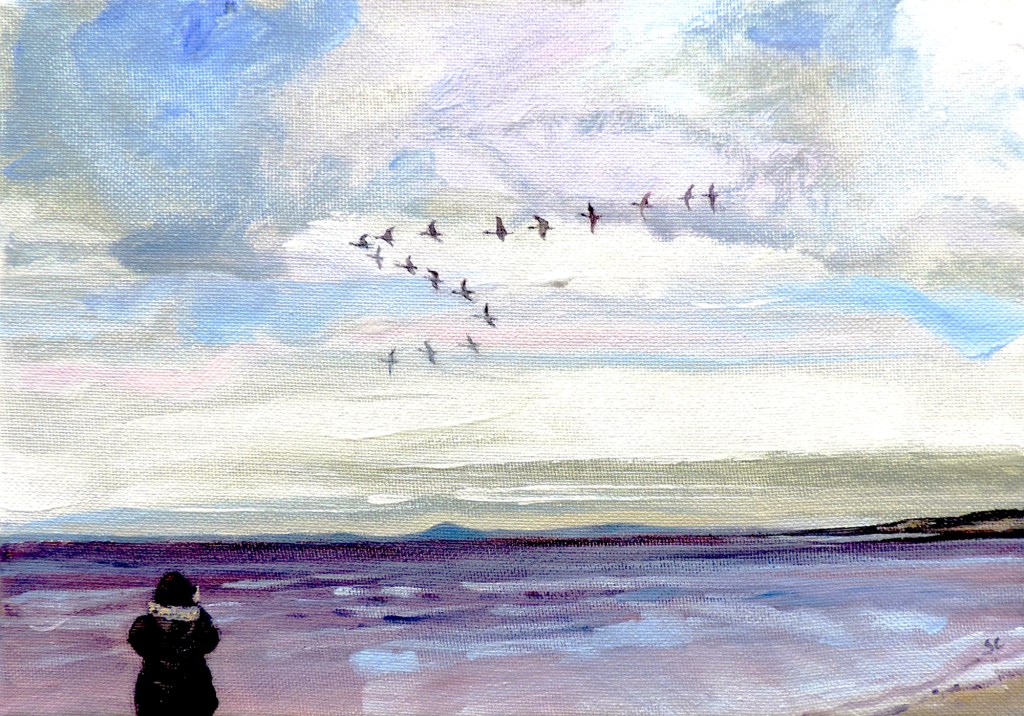
They set out over the sea between Banff and Macduff, heading for the Sutherland hills, which on this day of good visibility, were quite clear some 56 miles away across the Moray firth. When a jet plane from Lossiemouth flew somewhere near them, there was a panic massing of the ranks and the geese backed rapidly towards the coast again. The plane continued on its course and the geese gradually got back into formation and resumed their ‘long haul’ to Iceland via Caithness. I phoned the flight controller at Lossiemouth and he was very pleased to receive my information on the approximate height and flight path of the geese. Having seen the mess a gull can make of an engine or fuselage when an aircraft hits one, I presume a goose would make an even greater impact. At around a million pounds a Buccaneer, I thought it worth the call.
For a week the wind blew sunny and cool from the east and dried the land. It was good weather for hoeing paths. On May 8th, it changed to a warmer south wind. The cascade of blossoms on the gean is very pretty and heedless of its environment it graces the countryside and garden. The young leaves on the beech trees are just about at their best and from some lovely arches over the roads with the sunshine filtering through. The young crops are well through the ground and add to the pleasing picture. The hen bluetit in the nesting box has laid an egg among soft hair and feathers, and the green spotted ladybirds which live around the back seem to be enjoying themselves in the sunshine. The red spotted ladybirds which feature in the clothes adverts don’t seem to live in our area, and the green ones weren’t to be found in Perthshire.
The latest edition of the RSPB magazine has arrived with a spotted flycatcher on the cover. We are on the look-out for a pair which come to the garden and nest in the big beech tree or our open bird-box. The last husks are coming off the beech leaves and last year’s brown beech leaves are being forced off the hedges. I suspect the wood pigeons are near the laying stage because numbers of them are to be seen on the roads eating grit to help in the manufacture of their egg shells. They come by it second hand, just like the farmer’s hens, though the farmer has to pay just over 50p a hundredweight, so I’m told. Probably it’s still cheap at the price, though the farmer might not think so.
My bird of the week was going to be the swift, seen over the Dee at Banchory on May 9th when we were playing in mixed foursomes. This was our first of the year and it was hawking for flies over the river. The broad stretch of the Dee beside the golf course is quite a fine sight and my day was made when a fish, round about the three pound mark, leapt right out of the water, wriggled its tail, and fell back with a satisfying splash. However, my bird of the week is one of the rarities and it was seen by the Sharp family of Banff. It was a stork, a most unusual visitor to our part of the country – more so as it was seen near the Deveron, quite a long way from its usual migratory route. The stork is a big bird more than three feet long with red bill and legs. It has white feathers in front and jet black feathers along the trailing edge of the wing. It winters in Africa and nests in Europe, so this one, seen near the mouth of the Deveron, was a long way off course.
1972
We are almost at the peak season in the wonderland of nature. All stops are out and everything cries full speed ahead. The oak and the ash are struggling a bit, as is their wont, but most other trees have acquired their summer coat. Not only is it acquired but duly properly tested before it is right on. The gale of wind and rain which struck on Saturday, May 27th, whipped any weak ends from the mass and left the whole further refined.
The swifts arrived in Banff on May 24th. They were heard first of all and then seen. About this day also the first adult starlings were busy feeding their screeching young – newly fledged from the nest. Some starlings will hatch out another brood, but the swifts have to busy themselves to have eggs laid, hatched and young on the wing ready for a flight of thousands of miles by the second or third week of August. The swifts mate on the wing and lay their eggs on the top of walls of houses under the eaves, with a little or no nesting material. Their call is a shrill screaming and if grounded they have difficulty taking off and becoming airborne again.
1974
This is high season with many of Nature’s creatures in our area. Displaying, courting, nesting, mating, all the necessary activities are in full swing and if you have eyes to see, these many and varied activities are very interesting to behold. ‘What is this life, full of care, we have no time to stand and stare ?’
The Lords of the Air, the curlews, have gone through a gamut of calls, from the original ‘proclamation of territories’ call to the gentle ‘mewing’, courting call. Each is a delight to hear. This is the season of the call of the curlew, the cry of the tumbling lapwing and the clatter of the oystercatcher. Over the past few weeks I have heard the curlews’ wonderful notes in places as far apart as Lochindorb, Tomintoul, Mains of Badenscoth, Rothienorman and of course here at Forglen. Spring has really arrived when the curlew gives vent to its beautiful, mellifluous, piping call.
The first sighting of a sand martin, a summer migrant, came from Rothiemay on March 17th and we saw one over Turriff golf club on March 21st. It is now May and we eagerly look out for the first swallow. On the radio one morning we heard John McDonald of Pitgaveny speak about Lochindorb and its castle and over the Easter break on one of those beautifully warm days, we visited the loch. It is almost surrounded by high mountains, but they are at a distance. Going down to the loch the children disturbed a cock grouse and he spent the next hour resenting our intrusion into his territory and told us in no uncertain terms, calling all the while for us to “Go back, go back, back, back, back”. In Nairn it had been coll and the town enshrouded in mist, but up on the moor, out of the mist, it was beautifully warm. Fishermen in a boat were after trout and hares were playing by the lochside. Fast flying duck, goldeneye, were flying up and down the loch and with the sun on our backs in these wonderful surroundings we really felt we were on holiday.
1975
One day last week we paid a very informative visit to a large Buchan farm. The farmer had about 400 sheep to lamb; over three hundred ewes and the rest were last year’s lambs, now hoggs. A student from the College of Agriculture was employed as a shepherd and he explained in a most interesting fashion various facets about the lambing. Most of the ewes naturally lamb themselves quite successfully; but among the rest in the ‘casualty wards’ we found a great deal to interest us. There were orphaned lambs and mothers that had lost their lambs. We saw ewes in what the shepherd called the ‘Training College’ or what looked like stocks to us. There they were held by the head and the foster lambs could suckle them. Once the foster mother’s milk had gone through the adopted lamb’s system, then the mother accepts the lamb from the smell of her milk in the lamb.
Another mother of fortnight old twins had died the previous nights. One twin had been stealing milk from other ewes during the nights and was quite healthy. His brother was almost dead when found and was too weak even to suckle from a bottle. He was fed by milk being pumped into his stomach and this was very interesting to watch. Yet another lamb had lost the will to live according to the shepherd, and it was strange to see the mother fussing over this reluctant fellow wanting it to feed, and the lamb not being interested in survival. Obviously the casualty rate would be much higher without a good shepherd who knew what he was about. Our shepherd wasn’t just doing his job, we felt, but he had a fondness for the charges under his care which showed in the way he handled the sheep and the lambs. Our morning on the farm was altogether a most interesting experience.
The rook count has certainly come up with certain bonuses. The count is now finished, and the last bonus, meantime, was the discovery of something we knew existed in our area for a long time, but which we could not trace – namely a heronry. We had just finished counting a new rookery when we heard a harsh call coming from trees not a long way off. As we approached, the strident bird call was repeated and it dawned on us that this was the possible place we had been trying to trace for years and it proved to be. There were about a dozen nests altogether. Herons are really big birds and it was very interesting to see them flying off and back on to their nests which were about 25 feet up in the top of fairly young fir trees. Various TV programmes about storks in Europe and Africa came to mind on seeing the herons gliding, practically motionless in the strong wind, above their nests. Their peculiar shape has long droopy legs and a scrawny body with its pouch at the neck. When we saw the nests they were about the same size as a rook’s nest, but we imagine that the completed structure will be larger than it is at present. We will revisit the heronry in the not too distant future.
We had reports of swallows being seen from April 24th onwards. Our own first sighting was on May 2nd, at, as usual, The Barnyards, Banff. I heard my first cuckoo on May 3rd at Forglen. Mr John Sellar, salmon fisherman, Macduff, saw his first tern on April 18th and this arrival, strangely enough, coincides with the arrival of the sand martin. We had an interesting phone call from ex-provost Robert Henry, Macduff. He has seen recently a comparative rarity which we have never seen, namely a pied flycatcher. They are mainly black on the back with a white breast and the pied flycatcher is the only small black and white bird with the darting flycatcher habit.
1976
The wonderful scent from the whins assailed our nostrils as we made our way along the Spey Bay golf course. The skylarks were singing joyfully over the links and one felt summer had come, even though the wind was coolish. Along farm fences and boundaries, whin is often considered to be a nuisance. The yellow golden glory of the masses of it adjoining the golf course were so brilliant one felt it should be advertised as a Scottish holiday attraction to compare with mimosa in the south of France, wattle in Australia, and sagebrush in the USA. Beside the clubhouse I saw my first wheatear of the year. The unmistakable flash of white just above the tail, seen when in flight, makes it fairly easy to identify. Some terms flew past in their effortless, undulating, graceful way, uttering their screeching, strident, yet attractive call. On the whins we heard and saw genuine whinchat migrants, not the stonechats which winter here.
Hundreds of feet above the course were mighty, big, noiseless birds with a wing span of 50 feet or more. Some gliding enthusiasts were using a corner of the old airfield for their sport. The gliders brought to mind Second World War sailplanes, the Horsa and Hamilcar, used as troop carriers at the time of the Normandy landings and after, in 1944. We must have been successful in our Mixed Foursomes golf too because, most unexpectedly, we won first prize with a scratch score of 82.
At home the sycamore and beech trees are almost in full leaf and the elm is not far behind – and the cat, for some reason best known to itself, climbed up the dining room chimney. Aren’t they inquisitive.
Last week we saw four pairs of Slavonian grebes on Loch Oire, near Elgin. The grebes in their breeding plumage are quite spectacular looking birds at this time of year. The bird book shows the colourful plumage on the head and sides as reddish-brown, but we thought it a delicate shade of pink. Its head is distinctly circular in shape and it is a comparatively small bird, just 13 inches long. We were fortunate to see a pair displaying or doing a courtship dance. They prop themselves up on their tails and nod their heads towards each other in a weaving motion. We also saw mallard duck, mute swans and tufted duck on the loch. Two yards from the car a robin perched on the fence looking as if it should be fed. I looked and found an old Friday chip down beside the car seat and this was gratefully received by the robin.
1977
Man has always liked to witness a chase or hunt. In a way the excitement is natural to us and stirs up base instincts and emotions. The other day on the east side of Macduff we had a grandstand view of a hunt. A man was walking with his whippet-like dog and it put up a hare. We were on an elevated site and before our eyes, the dog, going very fast, overtook the hare, but only succeeded in tumbling it over. The hare forged to the front again and there was an exciting chase along the skyline until both animals disappeared. Eventually the dog appeared about half a mile distant at the hen houses east of Macduff, feverishly scouting around for the scent. The hare meantime appeared close on our left, crossed at speed before us and disappeared behind the man who had walked about three quarters way up the original fields. All was well that ended well for the hare on this occasion.
While dressing this morning I saw a magnificently plumaged cock bullfinch on the gean tree outside our bedroom window. It was systematically picking at the fruit buds. I thought the female should be about somewhere and sure enough, there she was down on our young apple tree at the same marauding game. After going out and shooing them away, I was informed that they would just come back again. At least I had the satisfaction of moving them on temporarily. Fruit farmers do not treat them so pleasantly. I can remember in my youth when bullfinches were still caught as cage birds.
On the way to work we pass a field and in it each morning we see an oystercatcher sitting tight on its nest. How this poor bird survives in this terrible spring we are having, we do not know. It seems to sit lower each morning, just a black smudge on the brown field, as if the cold and wet are pressing it with a heavy hand into the soil. The field is not far from a country pub, so if and when the chicks hatch out, we will rejoice with them and encourage the parent birds to take their offspring along to the hostelry for a dram. Since, evidently, some far off readers peruse these notes, this is to let you know that we have not had a completely dry day for weeks, and a retired farmer friend, who is eighty, cannot remember the crops being so late in going in. As I look out on May 3rd, there are no leaves on the majority of trees. Usually by this time we have a warm spell in March or April, but there has been no real warmth so far this year. No matter which point of the compass the wind is from, it is cold. If I sound unduly pessimistic, I am only trying to be accurate in my weather report of this truly exceptional spring.
We have seen, as already reported, swallows and sand martins, but no house martins or swifts so far. It is delightful to be in Banff some morning and discover the swifts screeching along the High Street and round St Mary’s church steeple. They usually arrive between May 14th and 20th. The week of monsoon weather has come to an end. We have never seen rain like it at this time of year. The crops which were sown most recently are bound to be partially washed away. Last Friday morning the rolled fields had a glazed appearance. The muddy water and silt flowing out to sea at the Deveron estuary at Banff caused a very marked line where the brown met the salt water. This stretches for miles on either side of the river outlet.
Nevertheless, in spite of the weather, some warblers have arrived. We have seen a willow warbler in the garden in the last few days, and heard the reed warbler churring away among the willows and giant hemlock, across the Deveron from Turriff golf club. Fairly isolated buildings like the golf course club house are sometimes quite good places for viewing wildlife. At the Turriff one the other day we were looking out at the rain, viewing the desolate spectacle of a wet, almost unplayable course, when up to the window came a stoat. We had a very fine view of this wriggly, inquisitive fellow in his creamy-brown summer coat with his black tail. A mink has been seen on the Turriff burn between the bridges on the course. From the same window a few days earlier while some heated golfing argument was going on inside the clubhouse, I think I was the only one who had a wonderful view of the fan-like fluttery dance of a pair of mating, pied wagtails.
The dark, almost black, bullet shaped chrysalis had sat in its perforated top jam jar all winter. We remember the large yellow and black caterpillars which practically stripped all the leaves off the rose bushes last summer. On passing the jam jar the other day I thought that one of the children had been poking in the jar with a piece of stick, but no, there on the dead rose leaves, left undisturbed since last year, was the fully developed buff tip moth. We were nearly sure that it was the caterpillar of the buff tip moth last year, but now we are certain. It looked like a bit of silver birch twig, silver grey in colour with two or three dark brown bands round its body. The head and tail were mustard coloured. Altogether it is a wonderful creation of nature, a beautifully camouflaged creature that has come full cycle since the female moth laid its eggs on our roses in July of last year.
We saw a large hairy caterpillar the other day and could not think why there were caterpillars on the move at this time. What we probably saw according to the Oxford Book of Insects was the caterpillar of the “woolly bear” which hibernates in the autumn as a small caterpillar about half an inch long. In May it is still a caterpillar, but about two inches long. Then it pupates in June and emerges in July as the large, beautifully coloured, garden tiger moth.
The beech hedges in the Forglen area must be among the bonniest in Scotland at this time of year. The leaves were late in opening because of our cold weather. Now the fresh green of the young hedges is delightful to behold. They stay fresh for such a short time that one has to gloat over them when they first come out. Many shells of the beech nuts litter the roads at this time too, as the mature trees cast them off.
1976
During the night this past week there was a most unusual fall of snow. It lay more than an inch deep in a belt all along the coast from Banff to Gamrie and beyond, but unusually, there was none lying a short distance inland. An acquaintance was out and about around 1 am and he said that the flakes were “as large as half crowns”. The hot morning sun melted the snow very quickly and as a result the land above the snow was enveloped in a cloud of white mist.
The other evening I received a phone call from a lady in a neighbouring parish telling me about the unusual behaviour of a bird which had come to her farmhouse kitchen window. We went round to see it and it turned out to be a male pied wagtail. We suspected that it had been seeing its reflection from a trestle opposite the window and that is why it had been flying at the window. When we saw the bird it had been behaving in this unnatural way for a day and half. It was conveniently on show when we went. It flew up to the window, landed on the sill and cheekily or prettily wagged its tail. I checked by phone to discover that the wagtail was still at it nearly a week later and had actually been striking the pane of glass. Whether it thought it was in love with itself, after a mate, or attacking an intruder, one could not tell. Certainly it was unusual behaviour in a ‘neurotic’ wagtail.
Quite often recently our evening golf attempts have been thwarted by the cold or wet. We thought, as the drizzle started on the first green at Duff House Royal, Banff, that we were in for a repeat performance. The drizzle went off however and going up the 7th hole we felt that as the sun shone summer had arrived. It was warm, a soft warmth we have not felt for a long time. We were watching a goldeneye duck, some half a dozen teal and a goosander on the rivet. Our attention was then attracted by something moving down the stones above the water’s edge on the far side of the river. We presumed right away that we were seeing a mink, for the first time too. It was larger than a stoat or a weasel. We watched it take to the water and swim with only the blob of its head and tail showing from the distance. Its coat was a rich dark colour. Now we saw another mink, again opposite us, following the track of the first. There have been reports of numerous sightings of mink at this part of the course with one actually being killed by a golfer.
For nearly a week now summer has been with us. We converted from winter to summer so quickly that it has taken our breath away and we can’t quite get used to the warmth. We thought that a young shrewmouse which we found on the lawn had been dazed by the sun too, or maybe it can been incapacitated by something it had eaten, but when disturbed by us, it took off, running with a peculiar bounding action. It was picked up in a tin (they have very sharp teeth) and put down beside a well known shrew hole on the lawn. It appeared again this morning so has not yet fallen prey to hawk or owl. The worker honey bees and the queen bees, brown and bumble, are very busy in the blossom of the blackcurrant bushes, the sycamore tree and gean. The wild cherry blossom, like the leaves on all the trees, is coming out more slowly than usual, so one can somehow get more time to appreciate it. Many people have remarked that they have never known the leaves and flowers, rhododendrons particularly, being so late in coming out.
Today I have killed four queen wasps, the only kind which are about just now. If we do not take action regarding queen wasps, then come the autumn we would be plagued out of house and home and when they get lazy and dozy and seek warm places, then one can put one’s hand on them and get stung. My father used to tell the story of an old tramp who was dozing on the side of the road and occasionally batting off flies. A wasp came along. He sleepily batted it off and it stung him. “That’s done it,” he said, rising angrily, “get off the bloody lot of you.”
We had time the other day to appreciate the distinctive flavour of Royal Tarlair golf course. The sun was glinting on the calm Moray Firth, the seagulls were wheeling and crying over the cliffs and the north east wind carried the honey-coconut scent of the gorse to one’s nostrils. Summer had come.
1979
Summer began almost, for us last week in the middle of a clearing in the Culbin forest west of Findhorn. The sun was nearly warm and there was plenty of shelter provided by the stands of Scots Pine and Coriscan Pine which were planted in the early part of this century to rehabilitate the ‘desert’ of sand which had been created there by succeeding spring winds. As we know some roads in Moray can still be blocked in late spring by blown sand and soil. We saw a badger’s sett and very interesting it was too. Some spring cleaning had been done as fresh sand and earth had recently been put out by the badgers. Fairly close by we saw their latrine pits. They are very clean animals and along their tracks snuffle (digging) holes can be seen. The change from forest to beach is quite dramatic here. We went through a ‘blow-out’, a break in the dunes with sand fanning out inland and onto the wind swept beach with groins and gabions (wire baskets filled with pebbles) erected on the beach to stop erosion.
Across the Moray Firth the snow capped peaks of Sutherland were still enshrouded in cold-looking showers. Fortunately for us the sun was still shining. We went inland again and across the former Buckie Loch. Before 1702 the Findhorn river wound its way westward to the sea. Then it burst out where the village of Findhorn is today. Now the loch is a rare meadow with alder, willow and juniper, and in summer rare orchids. In the middle of the forest again among mature pines we came across a heronry. We saw these large birds coming in onto their nests and one young bird was keeping up a constant ‘shout’. Under the trees we found empty egg shells of a beautiful light blue colour. On the way out, we stopped beside a circular anthill, more than two feet across and I have never seen such a moving mass of ants before, just on the surface of the ground. I have seen a few ants and eggs under a boulder and thought ant hills (formicarium, so the dictionary says) belonged to Africa. We are always learning.
1981
A couple of weeks ago we had the dubious pleasure of seeing at close quarters for the first time a dead female sparrowhawk. A young friend had discovered the dead bird in Duff House grounds, Banff. It had broken its neck. The corpse will find its way to Glasgow University for expert analysis. The female is larger than the male and is greyer in appearance with larger markings, a cross striping of dark grey on light grey on the underside. The sparrowhawk is a persistent and relentless destroyer of other birds. It has been calculated that it kills on average three birds a day. This would give a total of 2000 birds annually for each pair. However, they have their place in the food chain. They show great courage, audacity and swiftness in their dashing approach to their prey. Our one had needle sharp long claws so that small birds would not have much chance of survival against the pounce of this fierce swooping attacker. Large and small birds are taken. Pigeons, partridge, ducklings, snipe, blackbirds, thrushes, larks, linnets, sparrows, lapwing and bunting are among its ordinary victims. Writers have noticed, however, that it is subject to fits of cowardice, being mobbed by smaller birds who follow it and fill the air with notes of anger and alarm.
While we were watching a number of swifts feeding freely in the air over Turriff golf course and the river Deveron, we heard a sharp piercing cry or scream and all the swifts immediately went into a loose formation one behind the other and flew off in the direction of the town. It was as if the sergeant major had called, “Playtime and feeding time over, get fell in”. We have not seen this flock control exhibited by swifts before.
There is an oystercatcher nesting in the field in front of our house not twenty yards away from the position of last year’s ill fated nest. Then the young chicks were battered to death in an exceptional June hail storm. One can only hope that this spring and early summer are different. Certainly there is not the cold air about at this time of year that there was last year. When I looked at the sitting bird today, I saw the long orange beak and a very beady, red eye. The bird’s head was constantly on the move, on the lookout no doubt for predators and as I watched a solitary jackdaw flew low over the nesting oystercatcher.
There have been other recent reports of sightings of goldfinches, so they must have bred well and wintered well. At the road sides there are numerous linnets, greenfinches and yellowhammers to be seen. Most of the warblers have arrived. We have heard and seen the sedge warbler, but the more constant churring of the grasshopper warbler has been missing for a season or two. We saw a tawny owl as we motored home the other evening. It is about this time of year during the day that one should see the short-eared owl, quartering low over the ground on the lookout for food. The greens of the fields, trees and hedges of the Forglen area are fast approaching their best. Long, light summer evenings are with us when there is a magical glow in the sky to the northwest. We will glory in them up to midsummer and beyond.
1982
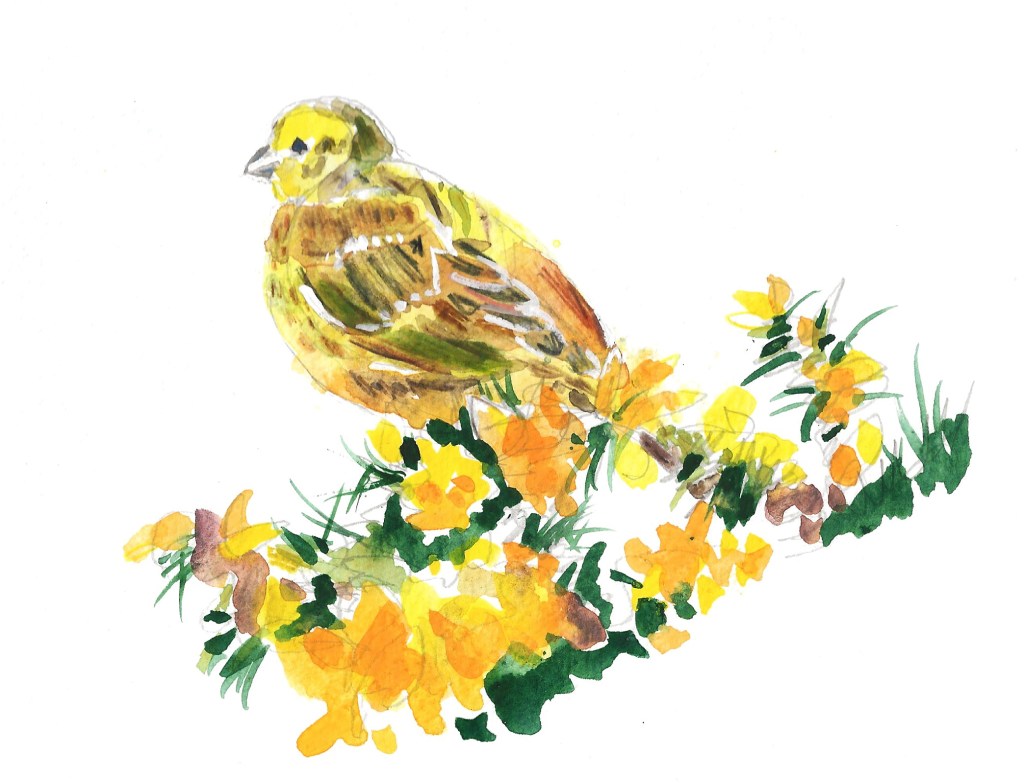
Last week we saw and heard some fieldfares. Presumably they have come back to our area from the south west and will start to assemble preparatory to taking off for Scandinavia and today in the gean tree we saw a much bedraggled, solitary redwing. This member of the thrush family has a heavily splotched breast and its white eye stripe was very prominent. The last fortnight around our house could be described as ‘the time of the yellowhammers.’ They have a beautiful yellow colour round about the head, a rufous shading on the rump and white flashes on either side of the tail. The yellow on the head can vary enormously from just a dab on the crown to nearly a whole head of brilliant yellow colour.
For the first time in our area we heard the call of the yaffle or green woodpecker. They are more common in Perthshire and occasionally on Deeside in Aberdeenshire, but this is their first foray into our area in the last twenty years or so. I had to duck from the stoop or dive of a sparrowhawk today. It was not anywhere near me really, but by the sound it made I thought it was. It is not often one sees a bird fly so fast.
1983
Summer migrant dates : the swifts come about May 12th and last to appear would be the house martins and they would be expected a few days after the swifts. The sand martins nest in holes in sand and gravel banks. The swallows like to actually nest in buildings where they can get easy access. They build mud nests. The swifts like to get into old houses, under the gutter and on top of the actual house wells and they do not need or make much of a nest as such. House martins build mud nests one usually sees, high up, outside, stuck onto the wooden eaves of houses.
The next few weeks should see a massive invasion of the above species plus warblers, flycatchers, wheatears, pipits and many others. At the same time the bramblings, redwings, fieldfares, geese, ducks and swans leave us and go north. We have been quite lucky in having three different species of warbler in the garden, the garden warbler itself, the small very delicate willow warbler and last to come, but the noisiest, the sedge warbler. It churrs and scolds away, making contrasting sweet and harsh notes. It is very secretive, but as the leaves on the trees and the shrubs are very late this year, the other evening I got a good view of its quite broad eyestripe and light underparts.
1984
At this time of year, particularly when the young leaves come on the mature trees with their delicate shades of green, one realises what a delightful part of the country we live in. Our part of the Forglen – Aberchirder road has a canopy of old beech trees and the beech hedges by the roadside help to form the arcade which is particularly pleasing to the eye in early May.
A fulmar has taken refuge in a Banff garden. Myfriends thought it was a young bird, but I think it is a mature adult. We saw it, quite hungrily eating filleted fish given to it by my friend’s wife. Certainly the adult birds have been on the ledges of St Mary’s church, Banff, for a sufficiently long time to have produced young. It is said that fulmars like to acclimatise themselves to a site for a number of years before nesting. They lay one egg. It was certainly interesting seeing the bird at close range and one could see its tubenose. Like the swift it cannot take off from the level ground and naturally prefers the sea, so it will have to be taken to the water before it becomes airborne again.
The phenomenon of the week in our countryside is undoubtedly the emergence in brilliant yellow of the fields of oilseed rape in the Deveron valley and other places. This is a new break crop which northeast farmers can grow. Last year we saw it being planted fairly early in the autumn, in some cases before the spring barley was harvested. Now it is in bloom. Some farmers are evidently importing bees to their land to help with pollination. Harvesting of the oilseed rape is evidently a delicate operation using the combine harvester, and timing is critical. At this time of year the area of yellow gives relief to the otherwise continuous shades of green in winter barley, wheat, spring barley and grass fields. Sometimes when the first crop of silage is taken off, the shorn field looks as if it is lit up by a ray of sunshine. This ‘glow’ is nothing compared with the brilliant glare of oilseed rape fields, even if the sun is missing.
A retired friend who has more time for bird watching than we have, has seen the green woodpecker we have been hearing for some time. This colonisation of our area by the yaffle is quite remarkable and sort of makes up for the falling off in the number of owls in the area. Because of the renovation of old buildings and other operations, there is said to be a great reduction in the number of barn owls particularly. The green woodpecker is the largest of the tribe. It is extremely handsome and is mostly green with a brilliant crimson head and a black moustache with a crimson streak below it. Its tail is used when ascending and descending trees and it has an interesting arrangement of two toes in front and two behind, specially adapted for climbing. Altogether the green woodpecker is a very interesting addition to the rarer birds of our region.
1985
Farmers who have large numbers of ewes are in the middle of their lambing programme, which means a 24 hour watch in many cases if lambs are not to be lost. I have had reports from the Rothiemay direction that there are buzzards on the south side of the Deveron.
Many birds are paired. One sees pairs of gulls standing or sitting side by side in the fields. The pairs of oystercatchers, lapwings and curlews are together as are the smaller birds in the garden such as blackbird, thrush, chaffinch, blue tit, coal tit, great tit, dunnock, house sparrow, starling, yellowhammer and greenfinch: but no robin to be seen. It becomes very secretive at nesting time. I had thought I had put out the last nuts into the bird baskets, but because of the cold I have had to put out more. If the tits are nesting it is getting near to hatching time for their young. If nuts are available, the parent birds can choke the young on nuts instead of giving them more natural food like caterpillars.
1986
Twice in the last week I have had reports of the peculiar narcissistic activities of wagtails. Single birds evidently become fascinated by their own image in windows which give a good reflection and the birds will continue to peck, fly and hover and admire their own images in the same window pane for a number of days.
This seems to be the season of strange beasts. The other week Mr R. J. Lobban, the Banff joiner, who carries on his business at 83 Castle Street, rang me up to say that he had killed a strange animal in his workshop. As Mr Lobban described it, I presumed it to be a mink, but when I collected the animal from him, I thought its fur was too light in colour to be that. After consultation, I have come to the conclusion that the animal, which was well over two feet long from nose to tail, was a large male polecat or polecat ferret. It is of the same family as the weasel, but longer, bigger and stronger. It is noted for its foetid smell. When attacked it can empty the containers of its scent gland and contaminate such an area that the attacker is often forced to withdraw.
In the ‘Life of a Scotch Naturalist’ by Samuel Smiles, the Banff naturalist of last century, Thomas Edward tells of an encounter he had with a polecat when he was on one of his excursions, sleeping rough in a vault at Boyne Castle. Edward had shot a waterhen and put it in his breast pocket and as he slept the polecat came into the vault to investigate. After a two hour struggle when he was contaminated by the polecat, Edward managed to chloroform the animal and so kill it.
A rather sinister finish to my encounter with the polecat was that last week after addressing the Electrical Association for Women, one of the ladies who lives in Battery Green and has an Alsatian, told me that one evening recently her dog scratched at her door so much that she let it out. Outside there were rough animal noises and eventually when the Alsatian could be persuaded to return it came in smelling most horribly. So it could have been contaminated by the female polecat and there may be one still roaming around the north end of Banff trying to rear young and looking for its mate.
1987
Yesterday was a red letter day and a possibly once in a lifetime sighting of a rare, exotic, migrant, undoubtedly brought in from the continent by the warm summertime like weather and possibly disoriented by the fog of the previous day. The brilliant stranger was a male golden oriole. My wife was altered to its presence by the other birds in the garden being disturbed. The last northeast sighting that I know about was some four or five years ago during a warm spell in May when it was cold in the south, a golden oriole was seen at Cruden Bay and a hoopoe in a garden at Mintlaw.
I have it on authority that one pair of golden orioles are known to nest in the south east of England. About the size of a blackbird, shaped like a woodpecker and daffodil yellow in colour, it stayed in the garden flying about from different perches for about half an hour until a blackbird or starling became too aggressive and chased it off in an easterly direction. It is usually a very retiring, secretive, skulking bird, but because of the lack of cover at the present time it did not attempt to conceal itself, and we had some very good views of it in the gooseberry and blackcurrant bushes and on the birch trees. We phoned friends in Turriff and Portsoy and they hurried out to see the rarity, but as often happens on these occasions, when they arrived the golden oriole had gone. Looking back one wonders whether it had not all been a dream, but I think life is made that little bit richer for having had such an exciting, uplifting, ornithological experience.
The pair of siskins I have in the garden are still feeding regularly at the nut basket. I am in a quandary as to whether to take the nuts away or not, as the tits may have hatched out young. However, for the sake of keeping the siskins coming, I will play it by ear and leave the nuts up for a few more days yet.
I had to go on business to Dundee and having half an hour to spare on a warm, windless, sunny day, I spent it on the banks of the Tay at the small village of Kingoodie. There I was my first house martin of the season. The tide was out on the estuary and on the mudflats were carrion crows, oystercatchers, a solitary sandpiper and I counted eight pairs of shelduck. They are attractive ducks with a large patch of orange on their side. They are slightly larger than mallards and appear black and white in flight. On the mudflats they occasionally ‘speak’ or gabble in an interesting way when they are feeding. They are burrow nesters, the location of the nest often being in holes under whin or gorse bushes. We are indeed fortunate in Scotland that depending on the time of year, one can visit different localities and see and appreciate many of the wonders of nature as I did in Kingoodie.
The illustrations in this book are the original creations of Sheila Chapman and she retains the copyright in them (Reproduced here under licence). More information about the artist can be found at http://www.sheilachapmanart.com
 Cunning Systems