Chapter 3
1971
We had a fortunate escape going to work last week. Three roe deer were crossing the road and we passed between the second and the third one. I was probably going at about 50 m.p.h. When we saw the first one appear from behind some trees. It had plenty of time to cross. As a second one appeared I braked furiously. It just scraped across before we drew level. Fortunately the third one applied its brakes and ended up with its front feet dug in hard to the road looking in the car window as we went past. So the moral must be if in the distance one sees one roe deer crossing, assume that there will be two or three following behind.
The roe is the smallest of our native deer. We have seen wild fallow deer on Perthsire estates. The stag is majestic with its heavy load of broad elk-like antlers. The largest, the red deer, is familiar to most people. I have been close to great herds of red deer on the rugged mountainous east side of the island of Islay.
Now that morning and evening bird song is established, it is worth stepping aside, from the morning or evening rush, to listen to this gradual swelling chorus.
The other day on leaving Macduff we saw an unusual behavioural occurrence. A piece of mature, but recently dug out, manure had fallen off a tractor bogey and a well-nurtured, sophisticated, golden labrador was rolling vigorously on the dung in the middle of the road, much to the consternation of its young chaperone. Not only did it relish what it was doing, because it repeated the performance several times, but it was oblivious to all else and we had to motor by very slowly on the wrong side.
To me it seemed as if the dog was not only trying to dirty his coat, but trying to get the dung into his being, if that were possible. My good friend, the local veterinary surgeon, Mr Charles Fraser, Banff, might be able to offer some theories.
Last week we were in Perthshire, traveling through the picturesque countryside at the foothills of the Grampians, south-west of Kirriemuir, when we saw a black pheasant. This was probably one that had very dark green plumage, but from the distance it appeared to be black. We have seen the silver and golden varieties before, but this was our first black one. These varieties have been introduced to his county at various times from the Far East and escaped from captivity or have been deliberately set free.
With annual shoots on big estates, these unusual birds are gradually eliminated until only our familiar bird is left. Isn’t the cock bird, in his breeding plumage, a wonderful fellow at this time of year ? He struts about in all his glory at the side of the road knowing full well, it would seem, that shooting season is over. His head and neck seem to radiate many glorious colours and one feels one wants to get closer to the bird for a proper inspection.
Two years ago in late June, after a cold spring, we saw a cock-pheasant strutting around our gooseberry bushes in the garden without realising the significance of his visits. In late August or September I came across the remains of the hen pheasant’s nest, including egg shells, in the middle of a clump of delphiniums which I had scythed round in the wild garden.
We noticed in the south large numbers of fieldfares feeding in young grass or stubble fields. There are large numbers of them in this district too. They are members of the thrush family having a dark brown back with quite a light breast which is especially noticeable in flight. They often fly in straggly flocks with an undulating flight with occasional birds emitting a harsh “chack, chack” call. Very often they are in company with their smaller, more beautiful cousins, the redwings, so called because of the warm pinkish-chestnut on their flanks.
Looking out at a window in Keith recently on to a large expanse of cut grass, I was watching a pair of courting herring gulls. One, presumably the male bird, was ‘pattering’, getting up worms and offering them to his mate. The offering of choice morsels to the female is a procedure in which a number of courting birds participate.
The pattering operation performed by the larger variety of gull is interesting. It is usually done on a lawn or an area of cut grass, and the gulls run on the spot, presumably to make the worms think that it is raining. On hearing the “rain” the worms or other grubs come to the surface and are gobbled up by the gulls. During the whole procedure the gulls appear to be concentrating tremendously. This, however, is not a completely logical operation, as gulls can be seen going through the ritual even on a very wet day.
It is nice to see the daffodils out in the garden. We had one in bloom on March 11th, at least a fortnight earlier than last year. A facetious reader jibed, “You’ll be hearing the cuckoo next.” Believe it or not, in a letter to an east coast paper, a minister at Kettins, near Coupar Angus, has heard the cuckoo. If it was anyone else but the minister who had reported it, indeed one might have doubted its veracity.
The saxifrage we grew in the garden just a yard from the kitchen window might be described as the lazy man’s ground cover. However for three weeks in May it gives the path on the north face a wonderful carpet of rose pink. The wrens and blue tits like feeding on the seed or insects on the saxifrage too.
Further to our trip to Perthshire recently, we noticed the large number of mole hills which are evident this year. A farmer friend there pooh-poohed the idea that there has been any increase in their activities this mild winter. “Like the poor, the moles are always with us,” he said. “This winter their workings are more evident because the fields have been free of frost or snow. “
This is the time of year when one is most likely to see in the garden that beautiful, destructive marauder, the bullfinch. Buds of all varieties are bursting forth and the bullfinches are particularly partial to buds on fruit bushes and trees. One’s loyalties as a nature lover are put to the test when one sees, as we did last week, a pair of bullfinches busy stripping buds off the gooseberry bushes and so directly diminishing the crop.
A friend said recently, and I’m inclined to agree, that no one has really succeeded in capturing in water colour or oils, or any other medium for that matter, the beautiful deep rose-pink on the breast of the cock bullfinch. Everything considered this is probably a good thing too. So the cock “bully” has to be seen to be believed. The female is duller but she probably shows in flight a greater flash of white on the rump. Both birds have black heads and blue-grey on their backs.
Having come from the baths in Huntly we stopped the car to have our ‘chittery piece’. A mile or so out of Huntly on one of those long straight stretches of the Banff road we saw quite close to us feeding in a ploughed field an ordinary rook. And what an extraordinarily handsome fellow he was! It is not often one gets close enough to this common member of the crow family, but this one had a beautiful purple sheen on his dark coat which positively gleamed in the spring sunshine. He didn’t pay any attention to the car but continued busilly probing his long grey beak into the soil searching for grubs. The rook, with his grey beak, is what most people call the crow. Rooks are mostly gregarious and build in a rookery. Very often the carrion crow hops off a dead rabbit or hare on the road for long enough to let a vehicle pass. If you look in your mirror usually he is back doing his scavenging job very quickly.
1973
In our adventures into the Parish of Gamrie, we did not realise how Northfield farmhouse and farm buildings are steeped in history. The Keiths of Troup and Northfield were persons of power in the area in the 18th century. The tower at Northfield, which until recently was part of the farm steading, is of great interest. Parts of it possibly date back to the 13th century when the land in the vicinity belonged to the monks of Kinloss.
At the Mill Shore, where the Tore of Troup enters the sea, we saw the unusual scene of outwintered cows, and their very young calves, literally on the sea shore. This one expects, in the more mellow climate of the West of Scotland, but not, somehow, in the north-east. Fulmars were cackling on the cliffs at the eastern edge of the bay. On a power line beside the main road we studied a large flock of what we thought were redpolls, twittering and chattering away in the evening light. The sheltered Tore must hold many migrants before they leave for Norway and beyond.
1974
If the premise is correct that good weather favours the Labour Party, or now possibly the SN.N.P., in the north-east, in the final analysis, the Tories would not have an election at this time of year if they had asked the birds.
Because of the mild weather there has been great activity both on a large scale and in the garden. Great flocks of starlings and rooks are to be seen hurrying here and there. In the sky the silent rustling starlings are somehow more sinister than the noisy, or when homeward bound, chatty, rooks, talking away about the day’s activities. Gulls are much noisier, too now, both by the sea and inland. This morning a flock of 16 lapwings flew over, the noise made by their large flappy wings attracting my attention. This evening, close by the house in the nearly dark dusk, a mallard duck was, I think, prospecting for a nesting site, her soft repeated quack carrying very clearly in the still evening air.
In the garden the bluetits are scolding, the great tits carrying on their sawing call and the chaffinch is going through almost his complete repertoire of song. If one can go by the large waders, then this may be the earliest genuine spring for some years. The oystercatchers usually have sorties into our Howe before coming to take up territory, but they have been in permanent residence since February 16th, at least three weeks earlier than last year. The curlews usually arrive in mid March, but this year they have come much earlier. I think the caveman of long ago would have had a quiet smile for his wife and a pat for the children when he saw the return of the large waders and felt again the warmth of the sun on his back.
The winter coastal parliament has been dissolved, curlews and oystercatchers are in the constituencies. Their parliament will not reassemble until late August or September.
1975
Each weekend during February when we visited Turriff Golf Club, the skylarks were singing over the course and this is one of the things we miss when we go to Duff House Royal. But, of course, the Banff club has its compensations from an ornithological point of view, offering birds which we do not normally see at Turriff.
As we were going down the 17th hole at Banff the other evening when the tide was in and the river was broad and calm, we saw a number of tufted duck. The male tufted duck is black with a large patch of white on his side. From the distance his tuft is not seen. The female is a nondescript dark brown to black. In some ways the goldeneye duck is rather like the tufted, but the tufted dives more continuously than the goldeneye and the female goldeneye has more colour.
Mallard duck, mute swans and greater black-backed gulls can be seen at both courses. In a recent daily paper someone wrote saying that they had seen a dipper on the River Kelvin at Garscube, Estate, Glasgow. Dippers can be seen in the Deveron at Banff, opposite the ninth green, and at Turriff below the third green. Come to think of it, one probably hears more individual birds at Turriff. The woodpecker at Forglen and the corncrake (one season only ) and reed warblers at Knockiemill. But the early season singing of blackbirds and thrushes in the wood above the Macduff distillery are also a delight. Late April sees the sand martins at Turriff and the swallows at the Barnyards at Banff, usually by May 1.
I could wander to grouse in the autumn at Pitlochry and Dufftown Golf courses, wheatears and shelduck at Montrose and buzzards at Glencruitten, Oban, but possibly there is material for the future here, even to seeing exotic hoopoes on Ugolino golf course south of Florence in Italy.
1976
From my near daily vantage point above Macduff I saw some geese flying in over Tarlair Golf Course. Casually I put the glasses on them and immediately saw that they were not greylags or pink-feet. Large areas of white showed as they were flying, fourteen of them, and because they were big birds I took them to be Canada geese rather than barnacle geese. They came to rest on a hill-side field at Longmanhill and I could still see the large areas of white on the birds although they were more than a mile away.
At this time of year, if one is observant, one can see more in nature than at any other time. The many breeding movements and sex drives that are on make creatures forget their natural caution and often we have an opportunity of seeing animals and birds which we would otherwise not see.
The pair of roe deer we saw last week would probably be a male chasing off another male or just male chasing female. Last week I ran over a cat. It happened this wise. I was motoring into Turriff for my evening class when a cat crossed the road in front of me. I slowed to let it pass and then accelerated. At this moment another cat chased across the road after the first one. I got out and walked back, but there was no sign of the cat. It may have got away without broken bones, but as I was braking again, I doubt it. One of its nine lives gone. Cats are not usually so incautious, but at this season, well !
What a remarkable creature is the mole. He can be ploughed, harrowed, seeded and rolled over and almost as soon as the roller is finished, up comes the mole hills on the newly planted field. The new mole hills are very obvious just now, much to the annoyance of the farmer.
At dusk the partridge start calling and we have a very noisy cock pheasant on our back road. Late the other evening something disturbed him and he was rocketing about calling loudly. Then an owl further up the road started hooting to keep him company.
The snowdrops are just at their best now before the strength of the sun causes them to wither. The flowers seem particularly strong this year. The carpet in the woods to the left of the 12th hole at Duff House Royal is particularly showy.
1977
It has been a dull dreich week-end especially yesterday when it rained all day. Today it is still dull, but dry with no wind. This spring, particularly after the snow and hard frost, the grass has a compressed, hard-used look and there are a number of patches on the lawn where the grass seems to have died. There must have been numerous bird casualties due to the cold weather. A farmer friend told me that the gulls have been so hungry that, in some instances, they have been eating the turnips. I have never seen gulls do this, though on the morning after it was drawn to my attention, I saw two carrion crows pecking at the turnips.
Recently a keen-eyed young chap of my acquaintance drew my attention to a gull flying strenuously towards the coast over Macduff about a hundred feet up with a long streamer of string or some plastic material about an inch wide getting towed along by the gull. One supposed this happens occasionally considering all the rubbish gulls consume, but this is the first time I have seen one trailing such a long appendage.
Now that the fields are bare, except for an early morning skiff of snow, one sees large patches of blue on the young grass where wood pigeons have massed to fill their crops. More than twice their own weight in grass per day consumed is a lot of grass. Some farmers started sowing during the last week of February last year. I do not think that will happen this year.
1978
Since the very quick thaw, spring has arrived with such a rush that it is not easy keeping track of all that is going on. The snowdrops and aconites had continued to grow under the blanket of snow. The butterbur by the roadsides is well forward too. Unseen under the snow the molehills ‘gre’ and we had two or three on our lawn. I put the mole traps into action and the day after setting it I caught a large , fat mole. Our daughter seemed to think that many students had never seen a mole so this one went to Aberdeen University. Where it ended up, goodness only knows. On the land ploughing is going on a-pace. A farmer told me the other day that last year they started sowing on the 3rd March, worked for five days, were interrupted by bad weather, and then didn’t get back to the land for five weeks and three days. This year the farmers will certainly be later in starting sowing.
Mad March hares are to be seen cavorting around the fields. Their coats turn darker at this time, appearing almost rusty at times. At the seaside, the redshanks not gone to nest yet, are definitely a darker grey colour and they have even redder legs.
Encouraged by the improved weather, I was doing some light digging hoping not to get too ‘hipped’ in the process. As I straightened up from the spade, a very small bird flew past me into the fir trees. I waited patiently and was rewarded with a lovely sighting of Britain’s smallest bird, the goldcrest. At close range its orange-gold crest was quite distinct. Maxim: if you want goldcrests in your garden and you have room, plant a few fir trees.
Someone in the Alvah direction must have had very poor telephone reception for the last couple of months. Metaphorically speaking, they have had a bird in their ear. More than two months ago a lapwing struck the wires beside Greenlaw cottage. Its wing bone became entangled in the wire and the skeleton and feathers hang there still. On going to press the thaw arrived. The black and white landscape reminds one of a creation scene and the Land God gave to Cain.
It was a March day of very strong wind with spots of rain falling, very near the equinox when the length of day and nights are the same. We walked up the back road behind a double belt of old beech and sycamore trees and it was so sheltered it was like being in a different world. It was one of the few occasions when I felt I would have liked to have been able to see the wind and to see the effects the trees have on the wind, breaking it up to make the leeward side of the trees so sheltered.
In spite of the roughness of the day a skylark was singing lustily. Skylarks are the makers of spring with their songs. As far as I am concerned they are one of the most clever birds at concealing their nests. I have only come across the nest, with its dark, almost chocolate coloured eggs, accidentally. I have often watched a lark descending at nesting time and have tried to follow it to its nest after it alights, but for various reasons I have never yet been successful in this ploy. This is the lapwing tumbling season and we have seen quite a number of them flinging themselves about the sky. They do this after dark too, and one can sometimes hear the whirring beat of their wings at night without actually seeing the peewits. Pigeons were feeding on the young grass in the stubble fields and ‘baggy pants’ rooks were there too.
The curlew arrived in our area on March 6th, much the same time as last year according to my notebook. He is our ‘king of the sky’, our aristocrat of the air’, and various pairs will be with us now until August when, with luck, they will have reared their young. The male bird is very alert, guarding his territory against carrion crows and hooded crows particularly, and if any of them overfly his area he is after them wil powerful thrust of his wings and long beak outstretched. The threat of the long powerful beak is sufficient and the combatants never come to blows, the crows usually retiring as if saying “ I did not want to fly there anyway”, but with the threat of “Watch it mate, I’ll be back!” When the female is sitting on eggs the male curlew has quite a bit of chasing to do. Not so long ago someone brought me the skeleton of a curlew and its beach is really phenomenally long when looked at in this way. We heard the curlew long before we saw it and again the long beak must be a good sounding pipe because the call of a curlew can carry a long way. They have their communications calls, territory calls, love calls, nursery calls and warning-to-their-young calls which we can almost identify; so they have quite a language really.
As readers may gather we are fond of curlews and naturally we are quite excited when the first call of the year is heard locally.
1979
When the temperature is about freezing point and a strong east wind is blowing making it feel about ten degrees below freezing, we head for the woods where, in the shelter, it is like a different world. We have had snow lying since New Year’s Day and it is deeper than ever and drifting these last few days. We have never seen the wintering sheep and horse do as much scraping at the snow with their feet trying to find a bite to eat. In the woods the bark of many of the young trees has been stripped off by hares. Garage and shed doors and garden gates have all ‘gone to pot’ with the continuous frost and will not close properly. Country roads have some peculiar bumps in them too.
On our walk, as we approached the Deveron near Todlaw at Forglen, we thought we could hear voices, but it turned out to be the noise of the wings of three whooper swans which took off from the river with great slapping and singing of wings.
Near the river we got a wonderful view of a lovely barn owl, white, creamy and brown, which has its home in a hollow in a split about twenty feet up in a big, old ash tree. We were surprised when we saw it emerge from a large vertical crack in the tree, move round the bole of the tree and disappear into a hole left by a broken-off branch. Then to our delight, it repeated this circuit round its verandah, giving us another fine view of it. Under the tree we saw numerous droppings and owl pellets.

Black-headed gulls flew lazily up river and a solitary reconnoitering curlew flew down river while among the different varieties of duck were mallard, goldeneye, teal and a solitary merganser. Back home the brief early discomfort of cold cheeks was easily off-set by the invigorating after-glow of the winter walk and the consolation of a warm log fire and a hot cup of tea.
Before winter departs and spring arrives, there are two wintry happenings that I found interesting. The first I saw was in a turnip field adjacent to the road leading west out of Cullen. A flock of herring gulls were gorging themselves on turnips in a corner of the field. I have seen gulls flocking and feeding on a refuse dump, a midden, but not in a turnip field, though a farmer had told me this happened. One thing it showed was how hungry the gulls were. It has been that kind of winter.
The second unusual happening was that I had to look at a treecreeper that had been put through my letter box, by design. This small denizen had been found by a lady who wondered what it was. Never having handled one before it is always interesting to see it close up. The treecreeper is the only small land bird in our area with a curved beak. Its feet are specially adapted for running up tree trunks and its tail is used as a prop against the bark. Its breast feathers were a grey white, the back feathers were brown with some fine mixed tan feathers just above the tail.
As I write it is snowing again and if I had been a seer, I might have prophesied that there was going to be more snow by the curious carrion crow that I saw when I arrived at work yesterday. As I drew up in my car four yards away it did not take off and I noticed that it had a lump of crust in its beak. It searched around on the cut grass beside the car park for a hole and when it had found one, it deposited the bread in the hole and then pulled out grass from round about with its beak and covered over the bread. Then it repeated the process with an even larger crust which it had cached in another hole. After its magpie-like act, it went and had a drink out of a receptacle in a nearby garden. Now if I had been a real researcher or experimenter, I would have given up all else for the next day or two to see if the carrion crow remembered where his treasures were hidden and came back to claim them. Then I would have proved something or nothing and had no job to go to.
1980
Regressions are not necessarily bad, but when they happen as they inevitably do at this time of year with regard to the weather then one is inevitably discouraged when it goes cold again after a warm spell. If I were writing this last weekend when we had wonderful warm spring sunshine, I would be extolling the success of my long range weather forecasting, but this weekend with a cold east wind and occasional drizzle, I’m not so sure I still think we are having an early spring.
The grass is definitely greening and buds are to be seen on trees and shrubs. One could say the daphne mezereum is in flower. Aconites are past, some snowdrops too. The crocuses are at their best and the daffodils will not be long in coming out.
The first sowing was done at Greenlaw on the 4th of March. The fields were rolled next day. The busy Buchan agricultural surge is about to get into top gear. The clock went on, the weather back, but the sun will come again.
1983
An example of the mildness and warmth of the weather came about at another time and place when I asked someone to shut a window. We then discovered a large queen bumble bee trapped in the inside. She was getting a little frustrated buzzing and flying and not getting anywhere until we managed to open a lower window and set her free. At this time we will usually see queen wasps and queen brown bees too, and maybe a few worker honey bees from the hives.
Once again this evening the daffodils are ‘tossing their heads in sprightly dance’, but this morning they were borne to the ground under the heavy weight of snow. Somehow, inevitably, it seems to happen to them every year just as they are looking so fine and handsome, a snowstorm comes and weighs they to the ground. Fortunately, they do lift up their heads again. There is something incongruous about their yellow heads peeping through the white carpet of snow. No doubt the skiers will be looking for more snow, but for the sake of the garden and the flowers we can say: “Enough is enough!”
A gentleman phoned to say he had seen an Icelandic gull at Banff harbour. By the time we arrived it had moved over to the mouth of the Deveron. Later when we were standing there in the shelter of the car being spattered by salt spray and stinging sand which was being borne in on a very strong north west wind, we were unable to see the strange gull. An Icelandic gull, quite a rare visitor, is about the size of a herring gull, but it is much whiter. Its larger cousin is the glaucous gull. The Icelandic flies with a quick wing beat almost like a kittiwake and it is different from most of our gulls in that it does not have black tips to its wings.
Did we make a mistake when we cut the grass for the first time last weekend ? Since then winter has returned with a vengeance. As we came home this evening we could see a large number of small lambs all huddled on the sheltered side of some large straw bales. They will need all the protection they can get in such rough weather as we have had this week when spring turned back to winter.
Not Kentucky, but Forglen Mountblairy and Alvah are what I would call blue grass country at the moment. Blue from the hundreds, in some case thousands of wood pigeons, feeding on the young grass in the fields in the parishes and feeding together in such masses that the land appears blue. To make the effect the pigeons’ feathers are a more colourful blue in the spring.
Last Saturday, as I opened the bedroom curtains, my day started when I disturbed a pigeon-like bird and saw it soar up from the garden and then swing away very swiftly round the corner of the house. It was my first sparrow hawk of the year. It is pigeon-like in appearance with its broad wings which are slate black on top. Late in the day I saw our other more common hawk, the kestrel. It was dawdling, coming up Deveron Road, Turriff, and hovering as it hunted. It is much narrower winged than the sparrow hawk and as it passed by us we saw that the top of its wings were a beautiful, rich, tawny, tan colour. It was in its spring plumage too.
1984
A kind gentleman on overhearing that I was to be golfing the following morning said: “I suppose we’ll get gold in the Nature Notes again ?” Well in order not to disappoint, here goes.
Spring is coming with a rush. The grass is greening, winter barley is greening and not looking so blae as when the snow melted from it. Some fields have even been sprayed twice since the thaw, witness the fresh slippery looking tram lines. From Turriff golf course we could hear the tapping of the great spotted woodpecker in Forglen woods and we look forward to maybe hearing the call of the green woodpecker, the yaffle, again this spring. In the mist we heard oystercatchers and we have since heard them at Bogton and seen them at Linhead, Alvah and they were reported at Lochagan.
There have been many more geese movements recently. A large skein, 150 strong, was seen over Aberchirder. The skeins of greylags I have seen and heard have been heading west early in the morning. I suspected these were north-east wintering geese from the Loch of Strathbeg area, going west to find fresh feeding and also getting some longer flights in preparation for the off to Iceland or Greenland at the end of April.
Last weekend we went to Deskford to see our first siskins. We were not disappointed and added them to our all-time list. Often one goes in expectation only to find the quarry gone. Not so on this occasion. What delightful, lively, agile little birds they are. They were feeding at a nut basket. The male is particularly brightly coloured with a yellow breast and prominent yellow wing bars. He has dark feathers on his head. The female is not so colourful. Their tails are quite forked. They are small, about the size of a blue tit, but slimmer and not so dumpy.
At the coast at Banff we saw scores of gulls congregating, feeding on the surface about half a mile offshore. I can only presume they were after sprats, but someone better versed in the ways of the sea might let me know if I am wrong. There were herring, greater black-backed, common and black-headed gulls about and cormorants, eider and tufted duck and goldeneye. The common and herring gulls have beautiful clean white heads now compared to their dirty grey heads in winter. Quite a large flock of turnstones came into focus after being invisible at first. They were sunning themselves on the rocks at high tide right in front of us and were so well camouflaged that at first we could not see them.
I had my birthday recently and on it, just for luck or anything else, when I was in the garden, I was marked by the cat. Would you believe it! Is it a sign of affection on the cat’s part or senility on my part ? I know he marks his territory and I am a mobile part of that. Fortunately it was still cold and I was wearing old golfing waterproofs and the waldies, but the indignity of it ! It happened to my wife last year and I had a good laugh and enquired “Why did you let it ?” On my birthday the boot was firmly on the other foot. Such indignities come to use from time to time. However, we are not buying a dog, yet.
During the second World War or possibly it was in the early 1950s when I was doing my National Service, I can remember visiting London Zoo where Prime Minister Winston Churchill’s lion was on display in a cage up above the public walking are and frequently the lion would urinate and spray unsuspecting members of the innocent public who came too close to admire it. It was a rather un-Churchillian-like gesture, or was it !
Towards the end of March spring comes with such a rush that one cannot keep up with it. For me one of the sounds of spring comes from the rooks in the rookeries. Their discordant, but yet musical, caw, cawing evokes all sorts of memories of rookeries in various parts of Scotland from Dunbar, St Andrews, Hatton (Turriff), Eagle’s Gate, Banff, Forglen, Turriff and to Southend at Kintyre in Argyll. Noisy masses of black birds saying “ we are here to nest. Can’t you hear us. Leave us alone and let us get on with it. “
Recent weather has been good and clear with frost early and late and warmth in the midday sun. It is fine if one can get out of the light wind and into a sheltered spot. We had coffee outside in such a spot last weekend. To the south of us in the sun we could see gossamer glinting and sparkling on the grass. This is usually an autumnal sight. On another walk I disturbed a flock of redwings and fieldfares. They kept flying off the top of high beech trees as I went up the back road. They are congregating for their late spring safari across the North sea to their breeding grounds in northern Scandinavia.
Having seen a dead guillemot found on the Duff House Royal golf course at Banff and having heard reports of another two dead birds, one was interested to read in the press of large numbers found dead in the Inverness Firth and Black Isle areas. A number had even strayed inland and had been returned to the sea, still alive. It is difficult to know why this has happened at this time of year as there have been no severe storms lately.
1985
The majority of folk are not as fortunate as I am. Going half-a-mile in the car I can get into the fir woods immediately and obtain shelter from the cold east wind, seemingly from the Steppes of Russia. This is what I did the other day and was surprised at the depth of snow still lying in the woods. Out in the open it is almost gone. Quite a number of nature’s creatures were seeking shelter too. First I came across a gathering of bullfinches, nine of them. Their brilliant colours were immediately evident, the black head and red breast and particularly their white rump as they flew off. Wood pigeons rocketed out of the trees fairly often. A little further on I disturbed three roe deer. These animals never give one long to admire them. They very quickly make themselves scarce. As they moved off through the wood one could see the large patches of white on their rear ends.
I frequently saw the arrowhead formation in the snow indicating that a pheasant had walked that way, then I came across a pheasant feeding barrel at which a blackbird was feeding, the pheasants presumably having moved off at my approach. Birds evidently have the highest temperature of any animals and the pheasant’s 104 Fahrenheit footprints had melted the snow as he went on his way leaving his distinct tracks. I heard the raucous call of a carrion crow and as I got out of the wood paths onto the wood road a large flock of about a hundred snow buntings took off from some tall firs and went on their way with their skipping distinctive flight.
In March herring gulls start to fly high up in the sky and give their springtime voices a tryout. Not very melodious, but nevertheless, one of the distinctive sounds of the coming of spring. The smaller birds in the garden are singing their welcome to spring more sweetly. The wren was sounding forth quite prettily and the robin was singing its sort of mournful, plaintive, goodbye to winter.
1986
Our land is completely covered in a large white blanket which gets its top renewed almost every day just now. I am losing count of the number of fresh falls we have had. I think it is eleven since the winter started in November and I suspect it is coming on to be the second worst winter this century, only surpassed by that of the famous 1947. One not remembered by the parents of the present day children, but maybe by their grandparents. I have been wanting to ask the weather men, Ian McAskill and company, “What signs should we be looking for that the long cold spell is coming to an end ? Will the barometer go back, meaning rain, wind and higher temperatures ? Where can we look for a change ? How will it come about ?” I suppose if they knew they would tell us.
My twenty eight pounds bulk buy of monkey nuts for the tits will probably last the winter, but it was a good job it was purchased at the new year. As well as coal tits, great tits and bluetits, the robin and chaffinch try the ‘hanging onto the basket’ trick. The chaffinch is more successful. Occasionally a starling or a female blackbird comes onto the post and one is surprised by how large they are compared to the tits, when they are near the window.
It is hard weather for all nature’s creatures. Last weekend I saw two skeins of pink-footed geese flying west in brilliant sunshine in search of food. My old second World War, second-hand, fighter pilot sunglasses are a necessity if one is to avoid sore eyes and also appreciate the beauties of the brilliant, gleaming, snow-covered countryside. Once in 1955 on a Kelvinside Academy school trip in the Swiss Alps at Bretaye, above Villars, along from Lake Geneva, I was afflicted by snow-blindness. It is certainly confusing to be nearly blinded in this way.
Three aconites were showing in the border above the snow at the gate into the garden. Then there were five. Now that the thaw has arrived, there are two gold clusters still to show off their open-petalled beauty in the March sunshine. Only now are the snowdrops appearing again out of the snow, a bit bedraggled, but it is amazing what the sun can do.
Before the end of the cold spell on February 28th, I recorded the lowest temperature for 25 years of five Fahrenheit, (-15 Celcius) or 27 degrees of frost. Many cold water supplies were frozen that morning, as was ours, but fortunately it thawed out without any bursts during the day. Last weekend a friend phoned to say that a pair of mute swans were frozen into the ice on the River Deveron, just below where the Turriff Burn enters the river, but on the Forglen bank. My wife and I set out to help with a large axe, fence post, and wellingtons, in the boot of the car. By the time we arrived the strong March sun had melted the ice and the swans had liberated themselves.
As we were watching T.V. last weekend a peculiar incident happened. The Sunday evening BBC ‘Living Isles’ programme was on showing a fieldfare pecking at a rotten apple. All of a sudden our cat made a run and spring across the room at the T.V. screen and at the same time, fortunately, the scene changed. The cat then looked around rather sheepishly as if to say “ What a fool I’ve been diving at nothing.” We always thought that the cat did not pay attention to the T.V., but there was certainly evil intent meant towards the fieldfare. It makes me wonder how other people’s pets react to the varied scenes of animals and birds that we get on TV.
The land turned a dirty grey-brown in the thaw. I saw four mallard duck flying up from a field puddle and change their feeding ground. They are about a month late in appearing to prospect for nesting sites. As my wife and I went for a walk the other day, “The frost and snow had gone from the lane, They both had to go as the sun came again.” After a frost free night, with a strong south west wind blowing, most of the snow had gone, even from the backs of the dykes and from the ditches. As we walked up the road, great flocks of wood pigeons and starlings were flying and wheeling about the sky just for the fun of it. There was a feeling of spring and freedom in the air, and release from a long winter, and the birds were feeling it too, cavorting about all over the sky. We saw a pair of lapwings, tumbling and calling in their aerial dance to spring.
“The lark in the sky climbs up as it signs, We watch it soar high and wish we had wings.” We had our first sighting of a skylark singing in fine style high up in the sky. Other years we have heard them in January, so they will have to make up for lost time. Early and late snowdrops have come out together from under the snow. They have to catch up too. We saw great numbers of gulls following the plough and carrion crows and jackdaws busy looking for grubs and worms among the ploughed land. The farmers are undoubtedly making up for lost time and the land must be drying up as some farmers are applying fertilisers to winter crops.
At dusk a cock pheasant flew up, missed his perch on the elm tree and landed on the lawn. Even in the half light, his brilliant colours were dazzling. I tried to follow him to his roosting place but he eluded me.
I was golfing at the second hole at Turriff golf club and as the spate had abated somewhat, the river was in good trim. A man across the river had hooked a salmon. The sun was warm enough on my back to allow me to stand and watch him play the fish. He knew something I did not know. His spinning rod bent, but he was a good fisherman and very gentle and patient, sometimes reeling in and sometimes giving the fish a bit more room to run. One could see the silver sides of quite a big fish being tired out in the water. Eventually the fisherman took his pipe out of his mouth, the fish was grassed, and the spinner hook taken gently from its mouth. Then the fisherman carefully carried the fish back to the river, held it facing upstream to get water passing over its gills and then let it go. I shouted across the river , “ a kelt ?” “Yes “ said the fisherman, “I knew it was as soon as I hooked it”. We agreed that it would be about 10 or 12 pounds. I wished him luck and that next time he might get a clean-run fish.
There was little wind. What there was came from the east. What my family call an Easter easterly, cool across the face, Easter holiday weather. The sun lit up everything including the very dark red tops of a dogwood shrub. At the seventh hole the sticky, dark brown buds on a small chestnut tree were not as dark as the dark brown backs of the ponies across the river. They were lit up brilliantly by the slanting sunshine.
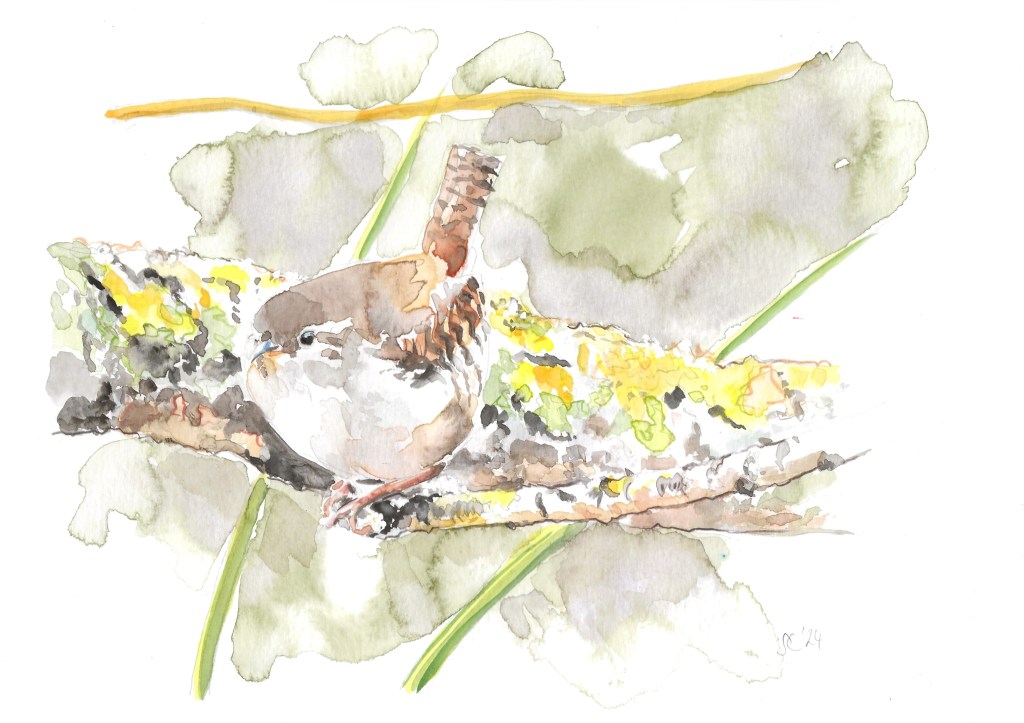
The illustrations in this book are the original creations of Sheila Chapman and she retains the copyright in them (Reproduced here under licence). More information about the artist can be found at http://www.sheilachapmanart.com
 Cunning Systems