1971
Flaming June has arrived with a tempting long range forecast from the weathermen, but still no sign of the flycatchers. From early morning until late at night the dominant sound to be heard is the ‘screeching’, the raucous, rasping noise made by broods of young starlings just out of the nest, clamouring for food. Initially they just stand and ‘stuffed’ by their doting parents. After a day or two the young tyrants condescend to try to pick up a grub or two on their own and soon they are well on the way to independence and the ‘gaining of their wings’. On our lawn with the puffed young starlings has appeared a beautiful young grey pied wagtail. He or she is a different kettle of fish. It is a well camouflage young bird, hardly distinguishable when motionless. The parent birds, for a few days, put on demonstrations of how to collect insects with their short speedy runs, ending with a few violent tail wags. Then junior, in his fine speckled mantle, follows suit.
How do you gather your parsley ? We shoot ours from the bedroom window with a shotgun. Really, a rabbit was in front of the parsley (last year’s still with nice tops), and having missed with a shot from our upstairs window I went to investigate and found I was aiming high. I was able to gather some parsley that was neatly severed.
My attention was brought to a recent advertisement that the island of Erraid is for sale. It lies off the south west corner of Mull, just south east of Iona and it was made famous by being written about by Robert Louis Stevenson in ‘Kidnapped’. As a youth I once spent a month there in the summer, running wild. One of our main pursuits was chasing rabbits barefoot through the bracken. So if you want to get away from it all and indulge in some quiet sailing and fishing and maybe keep a few sheep or goats on your approximately 612 acres, then Erraid is the place for you. Before the Second World War it was the shore station for the families of the lighthouse keepers who manned Skerryvore and Dubh Artach (pronounced Ju-herr-tach) lighthouse. The shore station was situated there because on a clear day, with the aid of a telescope, one could see both lighthouses away out in the Minch. Before the days of wireless, if the keepers wanted help, they would raise a distress signal and the boat would sail. It was just hard luck, I suppose, if shore help was needed and visibility was poor for days on end.
The island is joined to the mainland by a narrow neck of land, but one can only cross at low tide. This is explained in ‘Kidnapped’. The sand beside the ford is quick, and this particular quicksand looked blue in colour. At each low tide large pools were left and we often went along them to spear flounders. I had my first experience of poaching on Erraid, working the splash net at the mouth of a burn. I can remember the keeper with whom I was staying shaking me on the shoulder at 3 o’clock in the morning and asking if I still wanted to go. We rowed the boat to the mouth of the burn and quietly put out the net in an arc covering about 30 to 40 yards of either side of the burn. Then we got action on the word “splash!”. Why was it called a splash net ? One walked along the water’s edge splashing in the water to make the fish run out and get ‘meshed’, caught behind the gills in the mesh of the net. Sometimes one would hear a satisfying ping as a frightened fish hit the net going at high speed. If one was lucky one might get a salmon or a few trout. I don’t know how long one can be held responsible for such crimes. I trust the police do not read my notes. Maybe I could have pled diminished responsibility or simply that I was under age.
Our children came running in the other day saying that there was a rabbit with something wrong with it up beside one of our outbuildings. Mum went to see and reported that it wasn’t moving but that it did not seem to have myxomatosis or to be otherwise diseased as its eyes looked very clear. I went to have a look and discovered that the animal causing concern was a very lively looking young hare which I estimated to be about three-quarters grown. Mother hare’s instructions must be very strong as in most cases young leverets avoid detection by remaining motionless. This one certainly did and even though we were all gathered over it, it did not move until I attempted to pick it up. Then it was all action and it seemed to scurry through everyone’s legs. I was left with a sizeable tuft of soft fur in my hand as it went running off into the long grass uttering quite loud baby-like squeals.
1972
Unlike swifts which use next to no nesting material, the third largest of our gulls, the herring gulls, are nesting on the roofs of various buildings in Macduff. Their nests contain a mass of materials some pounds in weight, which can easily block gutters, rones and other down-fall pipes. Dried grass roots, dung, dried hog-weed stalks, drinking straws, and plastic covered electrical cable were only some of the materials to be seen in one nest I inspected. It is better for all concerned, I think, if the nest and the eggs are removed before the eggs hatch.
Still no sign locally of wheatears, but we have seen an increasing number of linnets. These are delightfully sweet summer songsters. The male has a russet-crimson forehead and breast. The female is less colourful but more striped.

1973
Summer heat is here and since we did not get any warmth until July last year we must consider ourselves more fortunate this season. The broom and whin which are in flower are worth more than a passing glance. The blossom is so profuse in places as to present a solid yellow wall. The fresh green of the countryside is much to be admired also, especially in beech hedges, and perchance we were to tire of the scene it is quickly interrupted as some farmers have commended silage operations so changing the colour pattern of the land.
A Banff golfing friend told us the interesting tale about a greater black-backed gull which caught an eighteen inch eel in the Deveron and took it onto the 9th tee and Duff House Royal to have a meal. The golfers watched as it swallowed the eel head first and still living. It got half of it over and then finding this too much, regurgitated it. Then it doubled the eel and got it partly over again and again had to cough it up. The gull then tried to break the eel into small pieces with its beak and at this stage our golfing friends intervened, much to the annoyance of the gull. The eel was put back in the river and it swam away apparently unharmed.
On June 13th we motored to Banff through drifts of blowing yellow broom petals, lighter yellow laburnum blossom and young green leaves. It seems a shame for such a strong wind to blow at this time of year just when the blossoms are so lovely and when the leaves have barely reached maturity, but ‘The Wind Cannot Read’. The gale made a swishing sound in the trees, blowing through the now dense foliage.
Motoring home the other evening we saw a hen pheasant crossing the road. Usually they are not very speedy about getting out of the way, but at the last second they do speed up their efforts to avoid being hit. This hen did not do this, however, and as we drew level, we saw she was escorting some very young chicks. These tiny fluffy balls were a light yellow and brown colour, somewhat similar to the young ducklings we saw some weeks ago. When one sees how small and helpless these little things are, it is little wonder so many are killed off by the ‘plouts’ of rain we are presently having. One has read stories and can easily imagine a dozen of these little creatures being carried home in the gamekeeper’s hat.
1974
Our ‘bird’ man is dead and somehow Saturday won’t be the same without him. Professor Meiklejohn (he signed himself M.F.M.M) wrote a weekly column in the ‘Glasgow Herald’ and there was something in it for nearly everyone. He was Professor of Italian at Glasgow University and he had made ornithology a lifelong study. No one is irreplaceable, but something like an individual style of writing is unique to a person and can never be replaced. He was the type of individual who, at a meeting of ornithologists, would see a rarity from the conference hotel window while everyone else scrambled all over the countryside vainly looking for unusual birds.
We attended a wedding at Oban at the weekend and sat down at the same table at the reception with two ladies from Turriff whom we had never met before. It’s a small world.
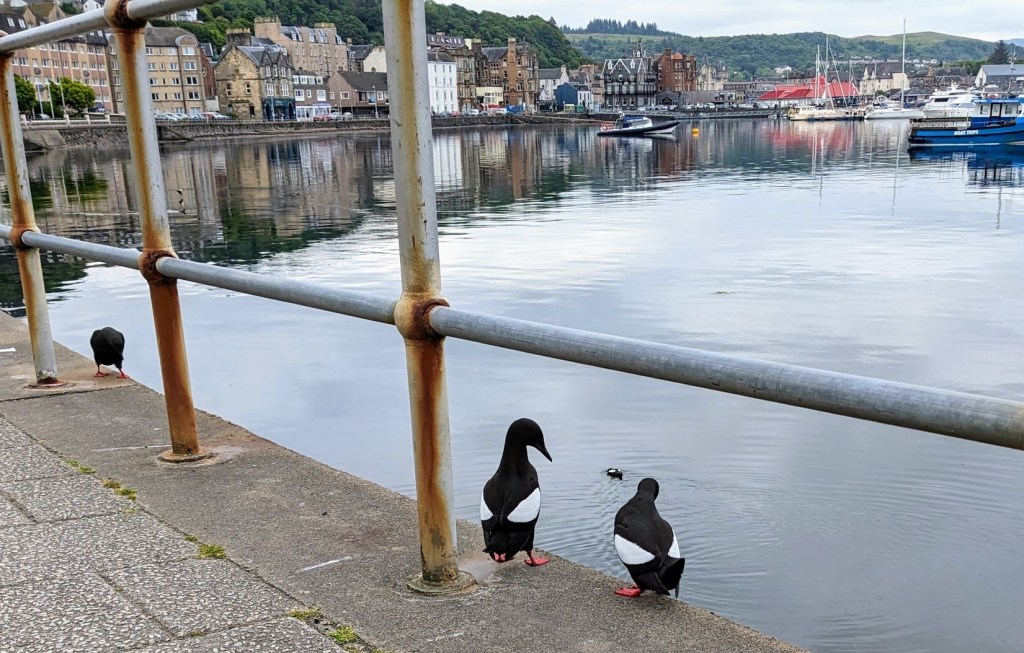
In the bay at Oban we saw a small diving duck with white flashes on its wings. This turned out to be a member of the auk family, a black guillemot. The puffin and razorbill also belong to this group. In summer the black guillemot is the only seabird which is all black with white wing patches. They are quite small ducks, only thirteen inches, and this one was all on its own. “The least sociable duck” according to the book. In the suburban garden of the house where we were staying we saw a pair of west coast hooded crows. They are larger than their east coast cousins, and the grey and black markings were so contrasting as almost to make them look, at a glance, like magpies. This pair were scavenging and strangely enough the female had a white V marking on her right wing so the next morning we were easily able to identify the same pair.
I have found that I have a fascination for watching animals and birds feeding. A psychiatrist would probably discover that I was deprived somewhere during childhood. A black backed gull on a fishing boat was endeavouring to swallow a flat fish that was slightly too large for it. After getting the fish over the side and into the water and expertly disgorging it a few times, it eventually swallowed it amid many shakes of its head and dips of its bill into the water. No wonder we need a wee something to aid the gastric juices when we are engaged in gastronomic, nuptial junketing.
The big event of the week was the news that a pair of flamingos were seen at Banff Links by supervisor Mr James Barnett and some other lucky people, shortly after 3 p.m. on Tuesday afternoon June 11th. The flamingo has pink plumage and is a beautiful, stately bird with red and black contrasting wings in flight. It has a large curved bill specially adapted to sieving animal and vegetable food from shallow water. Normally one immediately suspects that rarities to our northern shores like these flamingos are escapees from some zoo or safari park, but there is also the possibility that this pair may be extraordinary migrants that have come a little too far north. The furthest north they breed is in the Rhone delta or the Camargue of southern France, or in southern Spain. The pair at the Links were seen for some time before they flew off in the Banff direction and then headed north out to sea. Presumably they then swung east and landed at the Loch of Strathbeg, because a pair of flamingos were seen there on the next day. Unusual wanderers like this pair fairly hot up the phone lines between interested ornithologists.
At home this is queen wasp season and one can be on the lookout for the queen starting to build her bike or nest in unwanted places. One had the audacity to start building in a corner of Snowball the rabbit’s hutch and that wouldn’t do. Her small nest was a work of art, but as it would grow and the young wasps hatch, it would not have been much appreciated by humans or the rabbit.
One migrant which will not return south was a swallow which my daughter found dead on the road. It is always interesting to see these delicate birds at close quarters and to see how wonderful is their colouring. The sheen of blue on the back and brown under the chin cannot, I think, be captured by man in any of his coloured fabrics or garments.
1975
A week or two ago now we visited the nesting place of thousands of common gulls on a heathery grouse moor on high land in Aberdeenshire. Unusually the climb looked more difficult than it actually was. Apart from needing a few tackets in my old Army boots to stop them sliding on the heather, my old faithfuls stood the test very well. It was a sunny, almost windless day with only a slight ‘air’ out of the north east. The gulls nest about 1500 feet up and the nests were not difficult to find. Some nests had one, two or three eggs in them, but never more than three. The chicks were in different stages of emerging from the eggs, from the slightest crack in the shell of some, to others with beaks and throats clear of shell and pulsing quickly. Our party gathered round one very recently hatched youngster which called loudly from his nest for food and we found two older chicks which were well camouflaged. They could move quite quickly through the heather.
We had passed lapwings on the lower slopes and curlews a few hundred feet higher up. How much poorer our countryside would be without the plaintive call of the curlew. The valleys below us looked wonderful in the sunshine. Bennachie was practically due east and the peaks of the Grampians reared their heads to the west.
After the poor months of April and May, from a weather point of view – some crop fields have unusually large bare patches and the barley is short in the stalk this year – June has given us more summer sunshine than for some years past. Snow lying on June 2nd, and a rare frost on June 28th were unusual features. In the frost, some growing potatoes were blackened in the Deveron Valley and in other parts. Red and yellow tulips look strange sticking up out of the snow. For the first time ever in June, we have had a fall like this.
Wrens build interesting nests in a variety of unusual places. I have found one in the gooseberry bushes of my boyhood home. Here we have found them hidden among the younger shoots of the bole of the elm tree and down among the masses of ivy which grow on the old dyke at the bottom of the garden. This year’s nest has been found in what one can describe as a cancerous growth on a gean tree in the bottom garden. The gean tree has three or four of these whorls, rather like the witches’ brooms on the birch trees, but of course the twigs or branches on the gean are stronger in growing in the ball-shaped mass. A piece of moss was noticed in the middle of a growth and so the nest was discovered. A wren builds a dome shaped nest, mostly of moss lined with soft material, with the entry hole at the side. I poked an exploratory finger into the nest, but it appeared to be empty. If the wrens have succeeded in raising a brood they may come back to roost at night. The pair may construct a few nests before the female is satisfied with one.
1976 (?)
This is the time of year when nature is at the gallop. The starlings are very busy food-gathering and the blackbirds and thrushes can be seen with beakfuls of worms. We saw an almost black pheasant at the road side at Fyvie, hobnobbing, strangely enough, with a number of rooks on and around the road in the early morning. On the mill pond we saw most delightful mallard ducklings shooting about on the surface like water boatmen on a puddle.
The next month, the two weeks before midsummer day and two weeks after, is one of the nicest times of the year in our northern climes, when we are almost the land of the midnight sun. The season is so brief one has to do with a little less sleep to get all its benefits, especially those of the warm soft sunsets and sunrises which more or less all blend into one.
We are reminded of Nature’s cycle of life by two events this week concerning creatures close to us.
Our rabbit, Snowball, died today after living with us for ten years. This was fairly old for a rabbit, evidently. She won a prize at a pet show once, and was part of the family, giving us and particularly the children, great pleasure over the years. When she was still immature she had, by mistake, a litter to her brother and fortunately none of the young survived. To see her when she was still young pull out her fur to line her nest and let us know a family was expected was very interesting. She flitted to Perthshire and back to Banffshire successfully and existed all her life without a regular supply of water. Any receptacle she usually upended and offered water in the hollow of a brick she just seemed to paddle in it. She suffered laterally, but it was not easy after all these years to be cruel to be kind and apply the coup de grace. We found her lying in a peaceful posture in her hutch.
A few days ago the mare in the next field had its foal and we’ve watched it grow with interest. It had enormously long gangling legs when born and a very short body from nose to tail. The long legs were still wobbly, but a necessity to get at mother’s milk supply. It was able to run a little or stagger when just over an hour old and at less than a week it is nibbling grass and experimenting and touching all the various things it can find in its field. Mother is very protective and one is allowed so close and no further.
So our lives are touched a little by these creatures and they make their small mark on the overall parchment of life.
Last Sunday, June 27th, I dug a shaw of potatoes and they were cooked in their skins, a dash of butter added and consumed with due relish – the first of the year. They were ready three days earlier than last year. We have also had some delicious ripe strawberries from our patch. I know many gardens are earlier than ours, but merely by mentioning this, I hope that the delights of these early-ripe foods will be shared by others who have sampled early.
1977
The other evening as we neared home a strange bird about the size of a blackbird or a thrush crossed in front of the car. This bird was unusual, with a different flight pattern. It perched low down on a tree and as I drew up beside it, it flew on up the brae. Again I stopped beside it and we had a good view of it before it flew away, very low, across the newly sown turnip drills to our left hand. We are nearly certain we saw a male merlin, the smallest bird of prey that we have in the British Isles. It was dark on top and white on its throat underneath its beak. It might have been a hobby, which is slightly larger than a merlin, but our member of the falcon family was certainly much smaller than a kestrel.
If animals such as hares breathe sighs of relief, then they must do so at this time of year when the crops are high enough to hide them again. They all disappear for a few months now, until harvest lays the fields bare and man again becomes the major predator. Food is no problem now either and they should be putting on fat.
Last week after a gap of some years we again visited what used to be Airthrey Castle and now is the campus of Stirling University. The setting is a beautiful one with halls of residence on one side and various administrative and lecture buildings on the other, connected by walks and bridges over small and large areas of water, large enough to fish in and sail a boat. The grounds are beautifully kept with banks of rhododendron and azaleas of many different hues and colours. At one lunch time we saw on the loch a fight between a mother coot with three young and a mother mallard with six ducklings. The mother coot won and mother mallard had to settle her ruffled feathers and find somewhere else to feed with her offspring. Beautiful blue dragonflies flew around the loch side and over the water lily pads. At one part of the walk there was a wide spreading carpet of blue gentians.
The humble mountain ash shared place with the more exotic acers, prunuses and cotoneasters. The evening scene with football and cricket on the lawn, fishing from a punt on the lochs and later still with a pair of swans settling down for the night with their four cygnets uttering little cluckings, was somehow to me more English than Scottish. Unfortunately we were in the wrong location to hear the early morning green woodpeckers. Again in our beds we were alternately roasted or frozen with the ‘modern’ downies.
As usual the blue tits commenced nesting in their box on the side of our house and then, we presumed because of the cat, they stopped building. The other evening on passing the box I thought I noticed a queen wasp coming out and on closer inspection, sure enough, inside attached to the roof of the nesting box, I found a wasp’s bike, quite large for this early in the season and almost large enough for young wasps to be hatching out. What to do now ? ‘Wasp End’ used to be available at the chemist’s, but not now. There was talk of flooding the box, but the hose would not reach that far. Burning was suggested. This would lead to loss of box and possibly loss of house. An old champagne cork with two layers of cloth wrapped round it had been used as a bung and here the matter rests for the present.
1978
It is a breezy summer day outside and on the lawn it is as if it has been snowing slightly. There is a carpet of white petals blown from the gean and from the apple tree. A careful look at a single petal from the apple tree shows what a wonderful creation it is. Certain flowers and plants have in the warmth of the past week, caught up in growth after our long cold spring. Peony roses, lilac and lupins have reacted favourably in the heat. But ordinary roses are still far behind. Some are probably dead from the very hard frost of winter and some show a little growth very low down. Our wonderful yellow hypericum hidcote seems to have ‘met the puddock’. It looks very brown and dead, but time will tell.
Nearly four weeks ago now we saw a willow warbler and, we thought, the more noisy reed warbler. Whether they moved on or have become involved in nesting, we do not know. We have not heard them for a week or two. A pair of blackbirds are feeding young, at least Mrs is collecting worms, and Mr is acting queer, running along low to the ground, tail fanned out, encouraging Mrs to have another brood, I think. He says, “It’s early in the year yet”, and she says “Dinna be daft man, can you not see I’m still feeding this lot !”
What have an auld clout, an owlet and Mr James Baxter, the Banff Museum curator, got in common. The answer is vaguely pellets, bird pellets, or particularly owl pellets. The auld clout of cloth, maybe a bit of a towel about four inches square, I found all rolled up in the form of a pellet on Turriff golf course. It had been regurgitated by a gull or an oystercatcher, after the bird had swallowed it. The former, I think, as gulls are apt to eat any old rubbish. Now owls regurgitate pellets too and Mr Baxter has a young tawny old which had been found abandoned by some boys from Crossroads School. The owl was quite big and almost at the flying stage and as Mr Baxter moved it up and down on his ungloved hand, brave man, it would open its wings to help it keep its balance. It was getting some of its mature feathers, but still looked a delightful fluffy creature, able to be stroked and most interesting to see at close quarters with its sharp, curved beak and long talons.
During the night in the Baxter sitting room it had escaped from its box and Mrs Baxter had to clean up the resultant mess, so since then it has spent its nights in the Baxter garden, sometimes in the ivy. It enjoys gobbling real meat, of course. Maybe all it lacks is some roughage. It is this indigestible matter in the form of feathers and bones of small birds and animals which after the goodness has been extracted, the owls regurgitate again. Owls can often be seen at this time of year during the day when they have to hunt for food for their young. Ten or twelve hours without food and the owlets could die. Owls have their place in history, at least since Roman times.
Thomas Gray in his Elegy says :
Save that from yonder ivy-mantled tower
The moping owl does to the moon complain
Of such as, wandering near her secret bower
Molest her ancient, solitary reign
This week we have heard of the record prices being paid in London for antiques and works of art. Something which cannot be put for sale and kept in the same way as an oil painting is a fine garden and maybe in the age we live in, not enough attention has been given to the preservation of the grand gardens which have existed on estates and been kept lovingly for generations by employed gardeners. A couple of miles away there was the walled Forglen estate garden. One has the memory of walking through it in winter and smelling the fine scent of winter flowering viburnum. In spring the daffodils, many expensive new varieties among them, bought by Lady Eleanor Abercromby annually at the Chelsea Flower show, were a wonder to behold. In summer there was a magnificent display of vegetables and flowers for the big house. In autumn the ripe peaches and clusters of grapes in the heated greenhouse made the mouth water and there were ripe apples, pears and plums on the sheltered wall-trees. Alas all this has gone.
Last weekend we visited a grand estate garden in Ross-shire, the home of Sir William Murray at Geanies House, Fearn. Still lovingly maintained in magnificent fashion by gardeners and the big house still lived in by Sir Kenneth and Lady Murray, we were struck forcibly by the thought “How long can this continue and what will happen in the future to the exotic Californian and Chinese shrubs to mention only two which grow so well in that North of Scotland Eden “ The exterior of the house is itself a work of art with special stones set into the vertical walls of the house. Too many of these garden glories, which have been in existence for many years, have been lost already. No matter the colour or creed of one’s politics, I think something should be done to preserve these magnificent moving works of art which exist in the shape of old estate gardens before they are lost completely to future generations. I just read in the national press of the world famous garden founded in the 1930s in Northern Italy by the Scottish millionaire, Neil McEachern at Villa Taranto which managed to survive the 2nd World War. It covers more than 100 acres.
1979
This is stone gathering season in the fields of growing barley, no one seems to grow corn nowadays, and when the crops are short, one can see the hares standing out, as the only untoward protuberances in the fields.
I parked at the seaside close to a tamer than usual herring gull and when it took off I saw that it had a club foot. Nature quickly makes outcast and solitary one of its kind that is not perfect. When I was young, occasionally one of our free range (gan aboot) hens would have a bad foot and I had to operate on the swollen part and remove lumps which had built up around thorns or other foreign bodies. The foot would be dipped in iodine and wrapped up for a time. Sometimes there was a good recovery and sometimes not. There is something dreamlike in recounting this youthful veterinary task, but it was real enough.
We thought the shepherd who showed us round Gellyhill farm had an amulet round his neck and we were going to ask about it, but we did not need to. When we came near to the field where the sheep were, we saw its use. This was the high pitched whistle with which he controlled the movements of the sheep dogs. There are four or five different calls which the dogs understand and they make them change their actions. ‘Bruce’, the trials dog, a bit lazy and fat through want of work, according to his master, did most of the running, sometimes fast, sometimes slow at half crouch, sometimes he even stopped, belly on the ground. ‘Dot’ joined in eventually and the sheep and lambs were brought in very close. When the dogs were called off Bruche gave a triumphant, spectacular leap, clean over the fence and came up tail wagging, saying “Wasn’t I clever!” and he was.
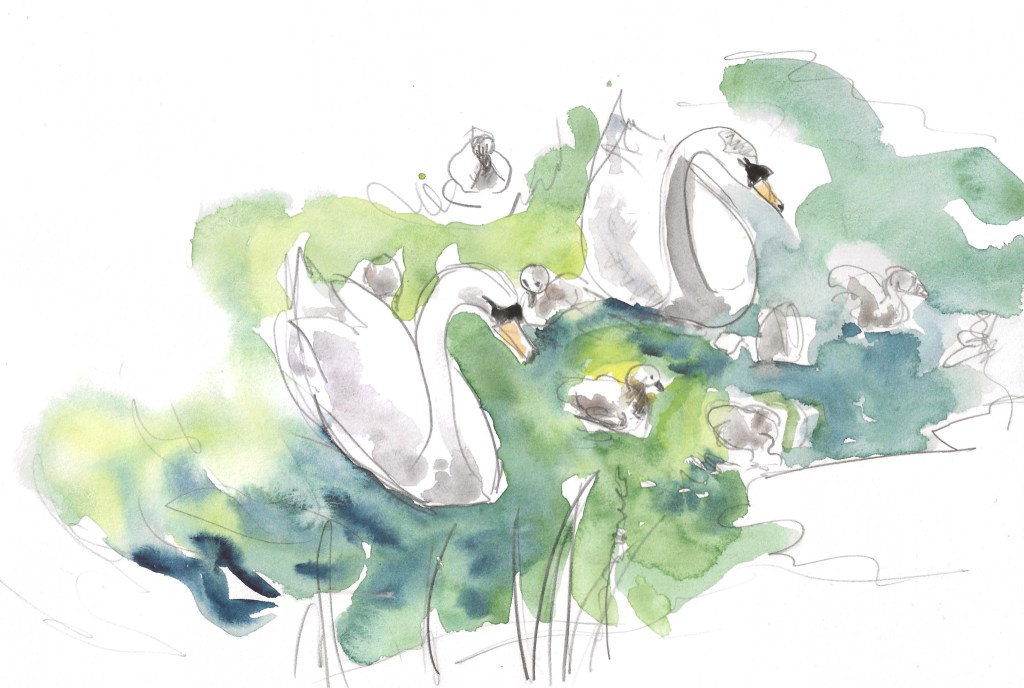
Last weekend when we attended the E.I.S. AGM we had a short walk along Ayr harbour and the banks of the river Ayr. We counted fourteen pairs of mute swans, large mature birds, we thought, but presumably still too immature to breed, otherwise they would not be in that busy part of the river at this time of year, but away nesting in some more secluded spot. They were used to being fed as they turned and came towards us when I did my ordinary ‘dog’ whistle.
At home in the country the day was a normal sunny one with the usual high drama for the hunter and the hunted. One can nearly always tell when a hawk is on the prowl as the starlings and the swallows become noisy and sometimes mob it in no uncertain manner, but just a little jink of the hawk’s wings is enough toward off any swoop by the smaller birds. The hawk I watched may have made a kill. When I saw it quite close at first, it seemed to have something in its talons and to avoid its pursuers it used some thermals which were below some loose cloud; he quickly ascended literally thousands of feet. The smaller birds, not being able to keep up the climb, lost interest. Oystercatchers and lapwings have a continual battle against the carrion crows too, especially if the young of the former are scattered and away from the nest. The parent birds dive and swoop on the crows and drive them just so far away, but the ‘black’ birds just sit on a fence post, a vantage point, and look out for their next opportunity to attack. It is difficult for these large waders to be on guard all the time.
1980
It is indeed fortunate that we, in our corner of these islands, are not often subjected to such violent weather as we had on Thursday, June 5th. Mini-tornadoes are not often visited upon us, but something of that sort struck us then. When we arrived home in the late afternoon there were heaps of very large, cold hailstones lying about in strange places, mainly under or out from roof gullies. One such volcano shaped pile was more than two feet in diameter and eight inches high. All the hail had not melted away by next morning. The damage to soft growing plants in the garden was quite severe. Some farmers were fearful for their young turnip plants. The buddleia was practically stripped of its leaves and many small berries were knocked off the blackcurrant and gooseberry bushes.
A hundred yards or so in front of our house a pair of oystercatchers had, after nearly six weeks of incubation and gradually disappearing into the growing barley, hatched out two chicks. Daily we watched the little ones grow and the parents had to defend them from carrion crow and hawk. It was strange to see one of the parent birds sit broodily over the chicks, one under each wing, the puffed out black and white ‘hen’. On the day after the storm I watched the parent birds stand motionless for an hour in an adjoining potato field. Something was obviously far wrong. As I approached the birds ran down the potato drill. I crossed the ditch and fence and found two lifeless small bodies of the young oystercatcher chicks lying side by side, presumably battered to death by the enormous hailstones of the previous day. The parent birds were obviously very much affected by their loss. Violent death in the afternoon. Why had the parent birds not sheltered them ? Maybe it was a them or us situation, the storm was so severe. Most likely it is too late now for the oystercatchers to raise another brood.
1981
We had lunch in a wonderful summer yellow carpet of kidney vetch and lesser clumps of different green and yellow birdsfoot trefoil, just about where the old railway platform used to be at Scotstown, Banff. Sea pinks and pink clover added to the variety of nature’s carpet. At sea, fulmars were wheeling in fine gliding form and a flock of kittiwakes flew east. A pied wagtail was busy stuffing insects into its mouth as hard as it could until it looked as if it had a considerable moustache. Then it hopped over the sea wall to feed its young and was back in a flash for more food. Occasional sorties were made by a solitary land based swift and a black backed gull. A solitary small diving sea duck puzzled us. It had a dark head, a white neck ring and white breast, a grey back, and white on either side of its tail. There was something very familiar about its shape and on returning to base and bird book we decided it was a female goldeneye. She could not tell us what she was doing there, and why she was so busy fishing. Could she be nesting ?
1984
The ears are on the winter barley and so one can see the ‘wind across the barley’, a phenomenon of this time of year, but earlier than usual by a month or so in the winter barley than in the spring sown crop. The curlews have hatched out their young and they are now calling their long soft call and not their earlier sharp trilling one. The greenfinch is busy among the clusters of seeds on the elm tree. It makes a nice picture. His green and yellow plumage is very like that of the elm tree seeds, so he is well camouflaged. There is a constant stream of seeds falling as he works at his picking. The elm seeds are abundant this year, hanging in grouped bunches and weighing the branches down quite heavily.
The other evening I heard the cuckoo calling for the first time in a number of years. Very occasionally I have seen and heard it coming up the howe where we live, but the cuckoo seems to have become scarcer these last few years. I was taking the walk on the west side of Aberchirder on Clean Hill and it is a very pleasant one in mixed conifer and deciduous woodland, with some fine views, particularly to the south and west with the Knock Hill at Glenbarry sticking up in the distance. Redshanks go to nest on higher land during the summer. I came across a pair by an undrained field pond on the left hand side of the road between Cornhill and the Ord church. On this upland field a courting display attracted my attention and some days later when I again passed the pon, the male redshank was bobbing and feeding at the pond’s edge.
1985
Other birds are still nesting, of course, and at the weekend my wife came across the beautiful nest of the willow warblers. They build a green, mossy, dome shaped nest on or just above the ground, concealed in grass or other thick ground cover and it is often very hard to see. The female usually lays six or seven white eggs, densely spotted with light red. I knew it was a willow warbler’s nest because the parent birds were flitting about in a very agitated fashion in the lower branches of a beech tree just above our heads. Some of this area is scythed and fly-mowed, but I managed to stop cutting operations far enough away from the nest to leave it undisturbed and with some cover. The cat is a danger. He might come across the nest, but as the young warblers have survived in other years, it is to be hoped that they are lucky this year too. The wren builds a dome shaped nest, but well up off the ground. I have come across the nest of a goldfinch in the garden. It can be hidden in the end of a branch or spray and sometimes it is even garlanded with small flowers or vegetable fluff or matter. I have a goldfinch nest with two eggs in it which was abandoned last year (1988) . The magpie builds a dome shaped nest too, but it is an enormous pile of sticks compared to the willow warbler’s abode.
1986
This is feeding time at our particular ‘zoo’, our collection of birds in their ordinary environment in our garden. A few moments ago I watched the robins. They must be worn to a frazzle, collecting insects for their young and carrying them to their nest in a low wall beside the burn. Each time they have a large, black, leggy mouthful of insects. The young must be getting big now; they have been feeding them for almost two weeks. Normally with us the robins disappear in the spring and we do not see them until they return to the garden in the autumn. This year has been an exception.
As I crossed Buchan on my way to Fraserburgh a few days ago, I saw a short eared owl about the locality of Cowbog farm. It is unusual to see owls out hunting, but the short eared owl can be seen at this time of year hunting for food during the day. Formerly I have seen them flying only a few feet above the ground when hunting for prey over the rough at the golf course, but this one was quite high up and glided on large flappy wings.
The glory of the “bride” in white is brief and fleeting. The gean tree in all its summer glory of beautiful blossoms – they last such a short time – is past its best, and the white petals fall to the ground in the light summer wind. Sparrows, too, take their toll of the white blossoms, pulling them off after a little shake. Presumably, they get nectar when doing so rather than insects.
The oil seed rape blossoms of heavy yellow are at their vivid best in the Deveron valley. The large splashes of lime yellow give the area a different look. The rape gives off a heady perfume. It seems to be doing rather better this year than last, providing good cover for partridge and pheasant.
Those most brilliant of shrubs, the azaleas, are coming into flower. Their brilliance somehow epitomises flaming June.
For the past week I have been keeping watch on a party of mistle thrushes. They are the largest members of the thrush family and I suspect they have bred further west and come to our area to feed. The young have light speckled feathers on their backs and the adults are a darker grey-brown. It is rather interesting to see them hop with both feet together in distinctive fashion as they move over the grass.
A couple of weeks ago a friend with my wife and I went to Upper Banffshire to try to see a blackcocks’ lek by the side of Clashindarroch forest, but we were not successful in our safari. I think we were too late in the season and probably too early in the evening. We were there before 9 p.m. The blackcock is the black grouse, a bigger bird than the red grouse, (the go-back bird) and is almost 21 inches long; the female, the grey hen, being a few inches smaller. Their habitat is on the edge of moorland and woodland and they have a particular liking for newly planted areas of conifers. The lek is an open space beside or in a wood and the cock birds gather there to display at dawn or dusk. They threaten each other by fanning their tails and fluffing their wings. The red wattles on their heads get very colourful. They behave aggressively towards each other, but seldom fight in earnest. The hens come to the lek to mate, but do not spend long with the male birds. The sight of a blackcock lek is one of the more remarkable sights of the great outdoors in Scotland. On our trip via Gartly and Rhynie, we were delighted to have to stop on the road to avoid a very young curlew. We were not absolutely sure as to the identity of this fairly long-beaked youngster with brown down and darker spots, but as we moved further on we saw one of the parent birds land on the road behind us.
The other day, motoring south from Turriff with my wife driving, I saw the flash as a swift-flying bird changed direction over the burn which is a tributary of the Ythan, just north of Fyvie estate. It turned out to be a tern, or sea swallow, and what it was doing so far inland on such a limited stretch of water was rather puzzling. There would be plenty of food in the form of young trout, but the mystery was that the tern was such a long way from the sea. In the north-east where there are not so many offshore rocks, terns often nest in the shingle and pebbles just above the high water mark, or they may nest in a hollow in the sand, such as at the Sands of Forvie at Newburgh.
Later in the day as we were beside Marlee loch in Perthshire in the valley west of Blairgowrie, we saw a great crested grebe on the surface of the loch with its young. The grebe has a large, comical, feathery head on a fairly long neck, such that is is not easily confused with any other bird, especially as the breeding season at this time of year. The grebes often carry out the protective parental act of taking their young on their backs. Their usual brood is between three and six young. West of Marlee loch, and the nearest to Dunkeld, is the Loch of the Lowes and it is here, in my opinion, that from a hide one gets the best view in Scotland of an osprey. The nest is at the north side of the loch, high up in a fir tree, and one can often see the male osprey plunge into the loch, feet first, grab a large trout in its talons, carry it back to its nest and give it to the female to feed to the young birds. The feeding can be seen at Boat of Garten, but not usually the catching of the fish. We ended the day watching lapwings flying around and into a mature ash tree, uttering mournful, plaintive cries. In the ash tree were jackdaws which presumably had raided the lapwings’ nest and stolen the eggs.
1987
A few days ago I was handed the body of a dead buzzard which had been found in Forglen estate. The bird had apparently broken its neck. It was a magnificent specimen and to see it up close for the first time is always very interesting. Two or three years ago I was handed a live kestrel from Whitehills and it died because it was emaciated and starved. The buzzard, however, was in good condition with food in its crop. The upper feathers were dark brown and under the wings the feathers were a paler, creamier colour. Its talons were very sharp, also its beak, typical tools of the bird of prey that has to tear up the feathers and flesh of its victim. The wingspan was well over a metre and the body length measured nearly two feet. Why a bird which has such magnificent eyesight and is the largest bird predator in our region should accidentally do something to break its neck may always remain a mystery.
1990
Midsummer day was our annual trip with Banffshire Senior golfers to Garmouth and Kingston golf course and like last year my companions and I were delighted to see an osprey flighting over the River Spey looking for food. In the quite strong south east wind it was dropping, spilling wind out of its wings, probably seeing a fish, getting lower in the sky preparing for the final drop which we did not see. With its white underparts and bird of prey beak it was unmistakable. According to the green keepers at Garmouth, its nesting tree is said to be some miles away, up in the Teinland forest beyond Fochabers. This is a place we used to go to some years ago to see the high speed cars screaming along the forest roads in the Snowman Car rally.
Anne Johnson retains the copyright in the photograph. The illustrations in this book are the original creations of Sheila Chapman and she retains the copyright in them (Reproduced here under licence). More information about the artist can be found at http://www.sheilachapmanart.com
 Cunning Systems