1971
0n a recent journey to the west coast we stopped at the car park above the Devil’s Elbow, west of Braemar, to have a picnic. We were pleased to see numerous pairs of black grouse or blackcock flying overhead. One bold cock bird showed himself in the heather about thirty yards off and jumped up and down and crowed. His lyre-shaped tail was easily distinguished. We saw some other black grouse close to the road and the scarlet wattle above the eye was easily seen.
There was no need to visit an African Safari Park when in Oban. There, we witnessed free, its natural maritime wonderland or nature playground at the Railway Pier. Because some of the west coast fishing fleet are landing catches of herring, a number of grey seals have been wintering in the bay and feeding on the herring which slip over the side during landing operations. The seals swim to within thirty or forty yards of the pier and then dive under. One can stand on the pier and watch them feeding off the bottom. Sometimes they will come near the surface, tread water for a time and then gracefully turn their enormous grey-speckled bulk over before diving down again. One with only one eye, which was bolder than the rest, would surface close to the pier and beg for food by partially lifting itself out of the water. Evidently the seals would only take perfect fish. Any that were torn or even slightly squashed by being stood on, were left for the crabs.
On our return journey we saw a wonderful red rhododendron shrub in fuII bloom in Crieff. Back home, we hear that some farmers in the Turriff area have sown barley.
A very rewarding tree or shrub to have in the garden for the month of February is the large pussy-willow (salix daphnoides). I say shrub because it is most showy if kept pruned down and then the large catkins, about an inch long, show their beautiful silvery colour against any garden background. If left to grow too high, then this silver beauty is lost against the sky.
The bark of the willow is a very nice rich coppery colour and it is decorative in itself, with a sort of ‘bloom’ forming on it. A cutting will root very easily in a jar of water. In April or May it can be planted out in a flower border and after a year or two it can be put in its permanent position in the garden. It may have to be staked at this stage. If the lady of the house is keen on floral decoration or floral art, then a few twigs of this sallow can be the foundation of a good floral decoration. From experience, one precaution must be taken in the summer time. Regular visits must be paid to the shrub to ensure that the caterpillar of the cabbage butterfly does not strip the leaves. If this happens, then there will be few silver-golden catkins the following year.
Many and quite wonderful will be the tales told this spring, 1971, about flowers blooming out of season. Our first snowdrops were picked on January 21. It is worth having a few aconites in the garden for this time of year too, just to see their glorious glint of yellow against the dark earth. In our more normal winters, one sees them peeping through the late February snows, but this year some aconites have been blooming since Christmas.
The usual upheaval of earth in the flower beds is taking place much earlier than usual. The daffodil stems are performing their annual ‘push’ and if one didn’t know better, one might say there is a mole working under there.
The butterburs are already through the ground and their large pale-green heads, rising on thick stalks, are to be seen on the damp ground beside roads, ditches and hedges. A friend who lives in what is normally a frosty hollow at this time of year, Inverurie, tells me he thinks his antirrhinums will bloom again in another week. An elderly person was reported to have said that the last winter, as mild as this one, was in 1916.
1972
Well, the big fall of snow has been and gone again. l say big deliberately as it was easily our heaviest fall in the last ten years. It was an unusual fall for the north-east as it fell with practically no accompanying wind and the picture presented as daylight came was really very beautiful. Snow festooned everything with its decorative hat.
Buildings, trees, walls, dustbins, the bird table, the rabbit’s hutch, all had on this unusual heavy headgear. I have never seen the shrubs so blanketed or shrouded and weighed to the ground in snow billows like large bundles of cotton wool. The sprawling shrubs like the snowberry had an unusual complete covering. When one knocked off the snow, they lifted up their branches and seemed quite relieved to be rid of this extraordinary heavy burden. At this time, keen photographers were busy and they should have some interesting slides to show.
I have never seen such a heavy fall of snow come and go so quickly. The Deveron was spectacularly full, but not, fortunately, to bursting point, though there was a little flooding here and there.
‘Forced’ out into the garden by a midday power cut I went to inspect the shrubs which have suffered from the attentions of rabbits and hares. They have nibbled the sweet bark off the apple and prunus shrubs particularly.
Forced is the wrong word, really, as it was a grand sunny day and a pleasure to be out, especially in a part of the garden exposed to the south. The warmth of the sun was to be preferred, however, to a house cooling through lack of electrically operated heating pumps.
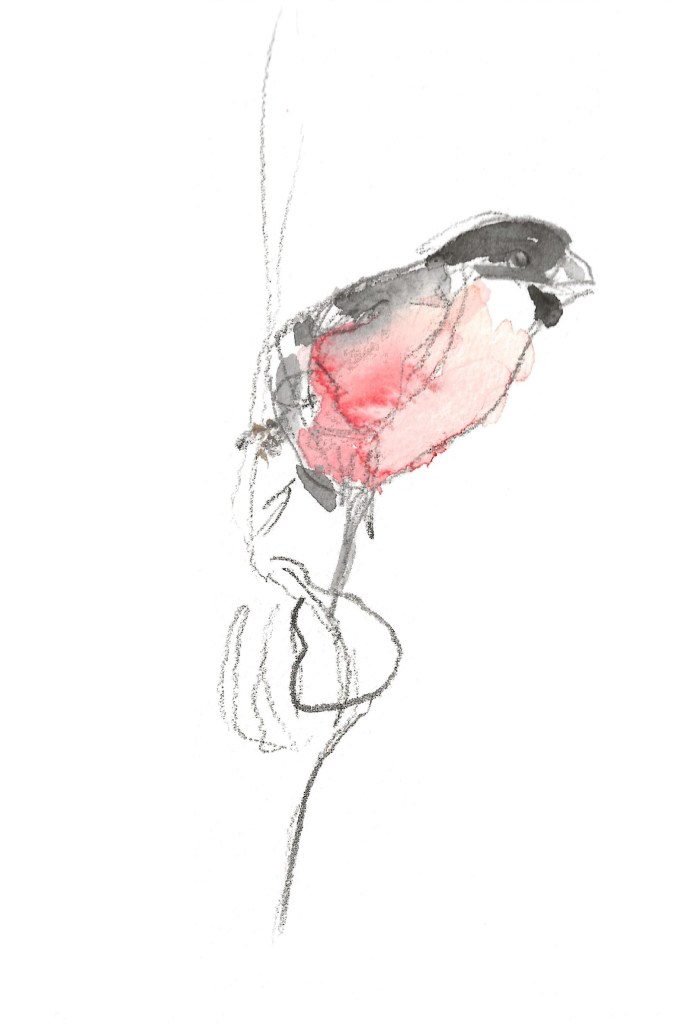
While thus occupied my attention was drawn to a bird call which I have not heard since about this time last year. The bird turned out to be a cock bullfinch which was eating the buds on the snowberry and giving what the bird book calls, “a soft melancholy ‘peu, peu’.” If one cares to look closely at one’s shrubs, one can see that the buds are quite well formed and I can see life in almost all my newly planted shrubs with the exception of rhu cotinus. So, at this time of year the bullfinch likes to feast on a variety of newly formed buds, particularly those on fruit trees and so he is something of a pest to the fruit farmer. He is quite partial to seeds also as we later saw him picking at docken seeds.
This particular cock bird was a big one, so big in fact in comparison to our bird-table regulars, the blue tit, coal tit and great tit, that I had to get the binoculars to make sure that it wasn’t something more rare like a hawfinch. However, it could have been a Northern European variety of bullfinch which is distinctly larger and more colourful than its British counterpart. Our bullfinch is smaller than the chaffinch by a quarter of an inch, so we might, indeed, have seen a rarity. When everything in the garden is so drab with some exceptions like the periwinkle, the snowdrops, the aconites, and the dogwood bark, the bullfinch in his brilliant plumage, is very noticeable.
1973
A local farmer has said that the ‘fishers’ have forecast that there is going to be snow in February. If the glorious sunny Candlemas Day was anything to go by, “half the winter’s to come and mair.” On the horizon to the north-east of Banff and Macduff , the Banff Baillies or ‘cairts’, according to the fishers, the great heads of cumulus storm clouds, have been building up. These massive mountain ranges of cloud are quite spectacular at this time of year, rearing up on the horizon to the north in great creamy billows.
A visitor this winter is the red-legged partridge. A pair have wintered at Kirton farm beside the Deveron quite close to where we stay. There have been numerous reports of sightings in Aberdeenshire. The red-Iegged partridge is slightly larger than the common partridge, is much more colourful and is much more loathe to take off and fly away. It is the partridge in the pear tree of the Twelve Days of Christmas and they do roost in trees. The common partridge does not.

If you enjoy a quiet drive in your car to view spring flowers, you can do worse than take the Alvah river-side road from Banff, branch south or left on the low road below Bagrae Farm, and after about a mile come upon the farm of Newton of Mountblairy. This early in the season the garden is a mass of beautiful crocuses. I have been told that the crocuses have bloomed here each spring for more than seventy years.
0n Sunday last we filled in two outstanding points on our Banffshire itinerary with visits to Portsoy, to see where the marble, or more correctly serpentine, is obtained, and to Findlater Castle.
At the harbour at Portsoy, it was interesting to see some of the fine restoration work of buildings which has been done and is being carried out at present. Looking out to sea at the west end of the harbour we surprised a flock of eider ducks which were very close to the shore. We are always on the lookout for a king eider which has an orange head and bill, but they are usually found north of Britain, in Arctic climes.
Two worthy Banff gentlemen informed me that the rocks from Gardenstown to Findlater Castle, or as they would have it east and west of Banff, are among the oldest in Britain , indeed the world. We duly returned home with a considerable selection of light green, red and brown serpentine.
Thousands of gulls were resting on the sea and cliffs all the way along the shore. Ducks, pigeons, shags and other divers were to be seen from the improved pathway.
After identifying redshanks and turnstones on the beach at Sandend, we watched the rainbows come and go as the evening sun shone through the spray of the rolling green waves.
On Thursday morning February 15, our thermometer was at 10 F, or 22 degrees of frost. When the air temperature is as cold as that, then we see the interesting phenomenon of the sea ‘steaming’ and on this day it was quite evident over the sea between Banff and Macduff.
1974
One of the most wonderful sights in the world of nature is that of a swan flying by fairly close. One then realises how large, powerful and majestic these big birds are. At Turriff golf course at the week-end, we saw a solitary mute swan circle low over us two or three times before coming in to land on the Deveron with tail down and feet spread, like an aeroplane’s wing flaps. With long neck and graceful wings, it reminds one of a heavy bomber, a B.52 say, once described from a pilot’s point of view as ‘sitting in a bay window and driving a house.’
Some years ago now when I was golfing in frosty conditions on the 7th hole at Douglas Park Golf Course, near Glasgow, five mute swans alighted near me with a bump on the ground, just yards from the unfrozen River Allander. Why they came down on the land I do not know, they seemed a bit shaken and breathless after the bump, as if something had gone wrong with their navigation. They soon settled ruffled feathers however, and waddled away towards the river.
It was dry at 7 a,m, evidently and so ‘our’ hockey was on and incidentally ‘we’ were the only Banff team to win. At 9 a.m. there was much more than a steady drizzle and it was raw and cold. By lunch time it was dry and the afternoon was mild and fairly spring-like.
While waiting for the hockeyite, I went to watch birds. There is a convenient parking place on the seaward side of Palmer Cove. With our car suitably parked to stop the rain coming in at the open window I saw greater black-backed, herring, common and black headed gulls in plenty. There were no rare glaucous or Icelandic gulls. Some gulls were washing in the fresh water of the Deveron as it entered the sea. After being carried out by the current the gulls would fly up river again and continue their toilet. There were redshanks, two pairs of carrion crows and oystercatchers on the shore.
Just below the bridge I counted 37 goldeneye duck. They were diving, feeding presumably, and occasionally displaying. With the naked eye one extra white flash caught my eye. Through the glasses I saw that a cormorant had caught an extra large dab, flounder or flat fish of some kind. It was pushing it up in the air and trying to swallow it. I was seeing the white belly of the fish being thrust upwards. In spite of extended beak and neck the task proved too much for the cormorant and after a struggle it had to release the fish.
At half time, moving to the Banff sewage outfaIl, I watched gulls glide on an updraft of the north-west wind. On the rocks were purple sandpipers, turnstones and rock pipits. ‘Our’ hair was wet, but we were happy in victory. Peanuts, crisps and home. We enjoyed our birds and hockey.
Motoring to school recently we nearly ended up down the middle part of a Y-junction. It’s a good job the car can nearly find its own way to work.
We saw a pale coloured member of the hawk family which we have never seen before. The bird had black tips to its wings and was almost as big as a common gull. it glided swiftly, fairly low over the land. In some flight attitudes it looked like a black-headed gull. It flew roughly (and obligingly) parallel to the road from marshy ground opposite the Mountblairy Arms to somewhere below Greenlaw, where we lost sight of it.
It was an exciting first time for us all and it turned out to be a male hen harrier. We have heard of one being seen in the Ord Church direction at Ordiquhill. Collins book, “Birds of Britain and Europe,” describes it as “ash grey, flight usually low, gliding buoyantly, with wings held in a shallow ‘V’ “.
Strangely enough the day after the hen harrier sighting, other newcomers entered the lists. Parked just below Banff Bridge we got a good view of a pair of long tailed ducks. The pair appeared to be doing a courtship splashabout – well bathing together ! – the female being the more aggressive, flying towards the male who, before her arrival, would dive under the surface of the bath – I mean river.
They are diving sea ducks. The male only has the long tail and he is rather clownish in appearance, mostly white at the moment with dark patches. In summer or late spring, possibly before they leave for the Arctic, where they breed, the male plumage changes to dark neck and dark brown on his back.
1975
According to some experts in the U. S. A. driving on the right hand side of the road there causes spirals of air to rotate and make tornadoes. On B. B. C. last week we saw some of these ‘twisters’. They do a lot of damage and cause loss of life.
The other evening driving home had we not known better we might have thought we had seen a ‘twister’. Ours turned out to be our friends the hundreds of thousands of starlings gathering and circling in the air before going down to roost. We had seen the starlings from close up but, from the main Banff-Turriff road at about half a mile distance, the effect of this great mass of birds on the wing was quite dramatic. As the birds turn and wheel in the air, so the black cloud rolls almost menacingly across the sky.
One recent evening at dusk I listened to the cock pheasants crowing. One starts off, another takes it up and the calls echo round the valley. Much nearer in the adjoining field, a partridge gives his churring call. Later still I visited Deveron Terrace, (Carnousie not Banff, I hasten to add) and heard the most interesting call coming over the water from the Laithers side of the river. The call was a cross between the sharp bleat of a lamb, a bark, and a bird cawing. My guess was that it was a courting fox on the move. I’ll know the call if I hear it again.
Candlemas Day, Sunday February 2, 1975, was an intoxicating day of brilliant warm sunshine. In the garden numerous mosquitoes were lazily flying to and fro. We discovered the first early purple crocuses in bloom and the viburnum bodnantense was almost out. The snowdrops and aconites continue to make a brave show. It was warm enough too, for my wife to sit out in a deck chair in the garden. Down the road, small boys played football against the garage door for hours on end. I almost completed my winter digging. I put compost round some shrubs, chopped kindlings and turned over the engine of the motor mower. I must get it serviced soon.
A robin gave us a pretty snatch of song and the great tit was ‘sawing’ away on the gean tree. I took off the front of the nesting box and cleared out last year’s blue tit’s nest, appreciating briefly this work of art of moss, hair, feather and wool. I weeded some of the fast-growing bishop weed from among the rhubarb.
It was that kind of day. A multitude of jobs to be done. I raised my first ‘sweat’ of the year in the garden and discarded some top winter woolies. My pitching was weak yesterday, as usual, so I even stole time to pitch a few golf balls up the front lawn and I think I’ve discovered the secret. Hope it keeps for next Saturday.
The calling of the gulls was that energetic cry which one only gets in the spring. The startling clarity of the atmosphere was maintained right to the end of the day. It had remained unusually calm and windless. Then the frost came down.
1977
A very unusual bird in Scotland, a bittern, has been found dead near Castle Eden east of the Deveron, on the Banffshire-Aberdeenshire border. The number of times this bird has been seen alive in Scotland this century is very few. What this one was doing so far north of the border will always remain a mystery, I suppose.
It is a long, brown, secretive bird, like a heron, though about six inches shorter, it frequents marshes and swamps and breeds in the south east of England though it is reckoned to be a dying species as there are less than 100 hundred pairs left in Britain. One sixth of the breeding pairs are found in the R. S. P. B. reserve at Minsmere in Suffolk. Bitterns make a loud booming sound when calling. In 1986 we went to Minsmere hoping to hear or see a bittern, but no such luck. We did see avocets though.
Last century most birds seem to have been kept in cages or eaten. There are social reasons for this, of course. Swaysland wrote, “According to some authorities the flesh of the bittern was at one time held in high estimation for the table, being said to be quite equal to that of the heron; a recommendation which would not perhaps weigh very much in the estimation of the modern public, ” This, the modern public of 1895 too.
Having hit our first drives for 1977 down the first fairway at Duff House Royal Golf Club – these are always a bit special, but more so this season after our long lay-off, because of snow and frost – we marched away. We found the fairway was littered with interesting regurgitation from the many gulls which roost here in stormy weather.
Some evenings in the dusk, the roosting gulls appear like large circular carpets on the course. Broken up mussel shells are easily identified and provide good lime for the course. There are small fish bones including vertebrae, barley leftovers and frequently one comes on a white, jelly-like mass which is fishy, but not easily identified.
A heron, possibly Big Bill of the R.S.P.B. film, landed with a loud squawk on the distillery side of the Deveron when we were on the third green. Later as we approached the 16th green with the river very full and broad with the melted snow water meeting the incoming tide, a flock of about 30 oystercatchers flew down river and made a wonderful picture of orange bills and black and white plumage, flying low over the wide, calm, powerful river, all in bright, winter sunshine. Nearer the bridge a pair of goosander were diving. What would one do without golf and birds.
15 February 1977
I’m an admirer, but not a constant listener to Alistair Cook’s “Letter from America. ” Like good wine I think he gets better as the years go on.
Last Sunday’s recording was particularly interesting and of course the topic was the American snowstorm, the greatest since 1888. I have earnestly recorded our five or six inches this winter, especially if we still have snow here and there is nothing in Banff. Now to have a fall of 84 inches as they have had in Buffalo, New York State, or 124 inches altogether there in four weeks takes some imagining. They have had a different wind looping north from the Pacific and then coming down from the Arctic with disastrous consequences – people frozen in their cars, people confined to their houses, and their eight-lane highways rendered impassable.
Alistair Cook also mentioned some new terminology about something he called the “wind cold factor”, and this is something we do experience in the north-east. He said that if it is ten degrees below zero and a 45 mph wind is blowing this is the equivalent of more than 20 degrees of frost. In the spring, particularly in Buchan, the temperature may be in the fifties, but with our usual strong winds blowing this is the equivalent of being out in a much lower temperature and don’t we know it.
1978
Sunday night, February 19th, was the coldest we have recorded at Forglen in the 17 years we have been here. We had 6 degrees F, or 20 degrees of frost. Whether these conditions are horrific or a bonanza to a plumber I do not know, but there were certainly many frozen pipes. Next morning the frozen snow in the fields sparkled like thousands of diamonds. In the Deveron estuary at Banff, the sea was ‘steaming’. Great billows of mist hovered over the waves. The sea water would be warmer than the fresh river water and so the mist would be caused.
Time may reveal the mortality in bird life at this extraordinarily cold time. I found a dead pigeon on Shore Street, Macduff and consigned it to the deep of Macduff harbour. I saw a female blackbird with only a few feathers left on one wing. On the way home we saw something which we have never seen before. A pair of partridge beside the road took off and collided. They bounced off one another. Whether this was caused by fatigue or sheer coincidence one did not know, but it is very rarely one seems this happen. There could be a lot of damage done to fast moving wings. At our bird table we had another unusual visitor for us, a very large mistle thrush with its feathers all puffed out in the cold. It fairly gobbled up the porridge on the bird table.
1979
In Forglen wood there is a large old beech tree stump that we know and it looks as if someone has been having practice with a pellet gun or a .22 rifle. There are a number of holes in the bare trunk. These holes have been caused by an avian marksman, the great spotted woodpecker. Whether he bores a hole by chance or whether he hears the insects working under the bark, like a thrush listening for a worm under the grass, I do not know, but the woodpecker hammers these holes in the dead trunk in search of insect food. Dead trees have an important part to play in the food chain. As well as breeding places for insects, they act as hosts for parasites and fungi and some wonderful toadstools can sometimes be seen on
dead trees.
Sunday 21 February was a day out of winter, however, with the temperature above freezing and not too much wind. We went to Cullen to play golf and it was a wonderful tonic. As well as the golf there were fulmars cackling on the viaduct and out on the large bluff of red sandstone rock to the left of the fourteenth hole. I counted ten pairs and they were having a great time wheeling and flying round the rock. Fulmars are tube-noses, having external tubular nostrils and these can be seen at close range. There have not been many clement courting days this year and the Cullen fulmars were enjoying the better day. Sometimes one would approach with its feet spread like paddles to enable it to hold its position almost motionless in the air before wheeling away on another flap and glide.
How would you like a badger snuffing at your door? This happened at a house in the Tipperty area during the week. It was not known whether the badger was hungry, curious, or just looking for human company.
1981
On a mild day at home I made an unusual discovery about the coal tit. I had replenished the fat basket and was in the garden tucked in against a fir tree watching a large flock of chaffinches go through the garden. While I was semi-concealed, I watched a coal tit make four or five separate journeys to the fat basket. Each time it picked a piece of fat, carried it to a neighbouring fir tree and proceeded to insert the blob of fat into the end of a small fir branch. To all intent and purposes the coal tit was doing a squirrel, making a store of fat for itself which it was easy to get from the basket. That this small bird should show such a degree of intelligence was quite interesting.
The rich warm colour of something animal-like caught my eye as we were motoring to Banff on the Aberchirder road. We stopped at Eagle’s Gate and went back about a hundred yards or so and there on the verge of the road was a dead badger. It had presumably been struck on the side of the head by a vehicle which must have sustained quite a bump. There was a lot of blood on the road and on one side of the badger’s head. I slung it into the boot, turned the car and we were on our way.
Not many people have seen a badger live or dead as we were to discover later on in the day, though there must be quite a number of badgers in our north-east area. Badgers in Britain are not true hibernators, but wake several times during the winter. When the young are born in February or March, the male badger is frequently away from the set and if the additional orifice on the one we found was its scent gland, then everything, else was in the right place for it to be a male, though one must adult that sexing badgers is not an everyday pastime. Kittens are bad enough.
The badger has a bulky body with strong-looking fore legs and long digging claws. It has peculiar markings. The head is familiar black and white, but these colours cease fairly abruptly on its neck, to be replaced by mostly a grey fur tinged with orangy-brown. Badger fur was once thought to have power to ward off witchcraft. The skins are used rarely for occasional rugs, shaving brushes and sporrans.
1982
We have been adopted by a black-headed gull. When we lunch at Scotstown, Banff, it comes to within three yards of the car, looking for scraps of food. On seeing it at close quarters, it is interesting to notice how its black head actually develops. At the moment there are two semi-circular rings about half and inch apart over the top of its head from eye to eye. The winter smudge behind the eye, is now a black spot. Crying raucously to warn off other gulls, it tries to keep us to itself.
1983
The malles are back! The malles are the fulmars. Chambers’s dictionary calls them mallemucks (Du. mallemock – mal. foolish, mok, gull). About January 19 was my date for their return to St. Mary’s steeple, Banff, and they were there on Monday 24, so they were only a day or two late. These interesting gull-like birds spend most of the year at sea, but return about this time to nesting sites. Whether they have actually reared young on the ledges of St. Mary’s yet, I am not sure. Evidently they like to test out nesting sites for a year or two.
They are very good fliers, beating their wings for a few strokes and then gliding on stiff, long narrow wings, using the air currents to the best advantage. Four or five pairs spend most of the morning “speaking” to each other, uttering their peculiar guttural cackles. They have a lot of “newsing” to catch up on, as they are silent at sea. In the afternoon they fly off to feed.
Last week we saw a solitary guillemot close to the shore at Scotstoun, Banff. Presumably it had got oil on its plumage because it frequently reared up on its tail and beat its wings. Then it scrabbled around on the water, sometimes putting one wing up in the air. It continued these strenuous movements for about fifteen minutes. When it reached the rocks it clambered up very clumsily and weakly and continued to stretch its wings.
We find diving ducks are not always easy to identify. We had a puzzle at Banff recently with a pair of ducks we saw diving off the harbour, at least until a mate arrived. The male was passing and swooped suddenly when he saw the females. When he landed we saw that he was a red-breasted merganser and he started to display and carry on in great style. Presumably he had not made any mistake with his dames, so they must have been female mergansers.
It is not easy being cruel to be kind, but that was what I had to be on giving advice to a caller from Macduff the other day. He phoned to say that he had found a bird on the shore, alive, but with a broken wing. The bird had a long beak and may have been a redshank. The gentleman was naturally very concerned for the bird. I had to suggest that he should try and get hold of someone to put it down for him. Easier said than done, I know, but most authorities on the subject agree that it is the best advice in the long run.
No doubt that this advice will have had to be given often in recent days. Because of the tremendously fierce winds we have been experiencing, many birds might have been injured by being blown into obstacles or by hitting wires. The terrific seas which swept over Palmer Cove recently, blocking the Banff-Macduff road for a time, were, I thought, much more spectacular than anything shown on T.V. that night, depicting storms in other parts of
Britain. Sometimes spray from a breaking wave would rise to a tremendous height or again a heavy wall of water would just roll over and fill the road. A good thing for all concerned that the wind abated and the tide went out. Seen from the top of Banff, the seas were in the most strikingly spectacular mood that we have observed. Great shoulders of water from the depth of the trough to the tip of the crest of each gigantic wave were coming in with enormous power, witness the great hole in Banff harbour wall.
Two more additions to the annual list in February were a sparrow hawk and a missel thrush, the storm cock, in seasonal weather. The sparrow hawk has darker, broader wings than the kestrel and frequently flies low over the ground before pouncing on its prey. Since the new year they have been very scarce but the one we saw crossed the road ahead of us at the top of Tipperty brae. The missel thrush at Duff House grounds flew away from us and we saw quite clearly the white wing bars underneath its wings and the whitish feathers on either side of its tail.
22 February 1983 or the week before was the time of the little auks. Our one was found at Gellyhill Farm, Macduff by farmer Mr. Ian Wilson. Another was found near the gate of an oil- related company office at Peterhead and it was being attacked by a carrion crow. The little auk is a rounded little bird. It is black and white with a white bib almost forming a collar at the back of its neck. Its neck is black in summer. It breeds from the north of Iceland into the Arctic. One egg is laid and the young are most often reared successfully. In winter time they come further south to around the northern parts of Great Britain and recently the very strong north-east wind has blown some onto our coasts. Flock of more than a thousand have been seen off the coast of Northumberland.
1984
The last week in January has been one of exceptional severity weatherwise. The strongest winds we have known brought the most numerous snowdrifts for more than 20 years. They blocked roads and cut off electricity.
The night of Robert Burns’ birthday, 25th January, brought the lowest temperature ever recorded, 4 degrees F. or 28 degrees of frost. This was 4 degrees colder than the previous lowest recorded by myself at Forglen two years ago.
In such severe weather the birds became more noticeable and more vulnerable. Redwings seem to be quite common in Banff gardens. They often puff themselves up to about twice their normal size to trap air under their feathers and keep themselves warm. They are members of the thrush family, about the size of a mavis, grey-brown on top, nearly white underneath with a speckled breast.
During the week, again lunching in the sunshine of Banff middle harbour where the yachts tie up in summer, I was watching many gulls feeding in the harbour and preening on the shore, herring, common and black-headed gulls. I also saw redshanks, turnstones and rock pipits.
On the beach the pecking order prevailed and in the absence of greater black-backed gulls, the boss of the beach was the carrion crow. A herring gull was pecking away at a large rotten fish-head above the high water mark and it had to give way to the carrion crow. When it was no longer interested and cleared out, a turnstone pecked at the offal until a black-headed gull took over at the ‘table’ .
At this time on the upper slip a feral pigeon, which presumably had been weakened by lack of food, was quickly pounced on and knocked sideways by the carrion crow which then pecked viciously at the pigeon’s head. Over a period of ten minutes and after a few ineffectual flutterings, the pigeon departed the scene. Only the fit survive in this cruel weather and nature is red in tooth and claw and beak, especially that of the carrion crow.
In many respects the thaw is worse than the freeze and if one has been packing down the snow and not shoveling or brushing it off when it was falling, then one has to look out the ashes quickly. Underfoot conditions can be very treacherous in this thaw-freeze situation. I notice at the moment that we are going to work as the sun peeps over the eastern horizon and coming home when the sun sinks brilliantly in the west and leaves an ethereal glow in the sky which reflects onto the land, appearing to warm it up long after the sun has gone down.
Saturday was a thaw morning and when I met the post he said it would be quicker walking than using his van. I notice on walks in wooded areas where there are immature trees that the heads of young birches and beeches, which were bent over by the weight of the snow in the storm are still trapped in the drifts. In the press I saw a picture of the gardeners at Crathie shaking the snow off the yew hedges there to save them from damage.
I know that many animals and birds survive in the Arctic in much colder conditions than we experience here in the north-east, nevertheless I must take my hat off to the snipe I put up from the burn in front of my house at the week-end. To survive in that wet, boggy, cold, bone-chilling, damp habitat, does not seem possible and yet that is where it likes to be. I have noticed very few brown hare tracks in the snow and their scarcity has worried me, I must say. I spoke to a biologist friend and he says their numbers go in cycles from high to low, and at the moment we seem to have hit a low and have continued in it for a year or so. I just hope nothing more sinister has happened to these fine creatures to reduce their numbers so.
I make no apologies for singing the praises of the winter flowering shrub, viburnum bodnantense. At this time of year if one cuts off some of the flowering buds and takes them into a warmer temperature, then the small florets will bloom and give off the most wonderful perfume.
It is a good job that we all do not think and act alike. I had missed seeing the skating stars Torvill and Dean and I was being informed that I could have seen them skating again on breakfast TV. My ‘live coverage’ breakfast T. V. is the constant activity, the to-ing and fro-ing, the up-ing and down-ing of the great tits, blue tits and coal tits as they feed at the nut basket just outside our window.
I can sit just five feet away from them and watch them feeding. They are very well adapted and efficient at it and the basket has to be frequently replenished. The great tit has mostly yellow on his breast with a black collar below white cheeks and a black head. He has a black band where in the old days one would tie one’s waistcoat. His back is greeny-yellow, with the outer primary feathers being striped. The blue tit is like the great tit, but smaller with a blue head and blue wing and tail feathers. My favourite is the small round bundle of feathers, the coal tit, which comes at the end of the pecking order. He has a black head and his breast feathers are browny-pink.
The ‘road closed’ sign lying on its back obviously meant what it said when it was in operation. The first big storm of the year blew down and across the road at Forglen North Lodge two mighty beech trees and an ash tree. “How are the mighty fallen in the midst of the battle.” They fell into a plantation of fir trees, cutting a large swathe in them and leaving a great gap. The beech trees looked to be in the hundred year old category, though I did not go and count the rings. The modern power saw certainly helps in clearing up such road blockages. People did not seem so hurried in the days when the old cross-cut saw had to be used to clear up such a barrier.
29 February 1984
After last week-end the question we are asking ourselves is “Are we going to make our cat redundant?”
Two weeks ago we discovered we had a mouse, evidently a sophisticated mouse, an educated mouse with a taste for high living. I had two sections of Christmas Bendix chocolate left over in a package on the dresser and he took that and left the empty package and he just had a nibble at the skin of an orange in passing. I set the mouse trap with smelly blue Cheddar cheese and he took that too with relish presumably, without springing the trap. The next night, however, he met the puddock.
The cat told us there was still another mouse about. How? He half interestedly went in behind the fridge and sniffed about and came out again. Nothing more. Again I set the trap. In the morning it was sprung, but alas, no mouse, just a couple of tiny droplets of blood on the floor beside where the trap had been set. Had this come from the mouse or the cat’s ear? We had had him at the vet the previous week with an infected ear, but we thought it had cleared up. The cat fairly smacked his lips at his daily vet’s antibiotic pill and looked about for more.
In mid-morning when I was in the stick shed my wife came to inform me that a mouse had come out from behind the fridge, gone to the cat’s dish, circled round the cat’s box and gone back to its hole and the cat had not moved. I ask you! What do we feed him all that Whiskas and KiteKat for?
Later that same day when we were at lunch my wife said, “There is the mouse ! “
It made its way to the cat’s milk dish and tried to climb into it. The trap must have struck it after all. It would never have come out carelessly like that, in broad daylight, if it had been in possession of all its faculties. The belt on the head must have left it with a thirst too.
I’ll spare readers the gory details, but it was a fairly noisy dispatch and who was asleep in his box and never batted an eyelid or showed the slightest interest. Yes, the cat. As cat lovers will know a mouse is for playing with or having fun with and maybe losing behind a press or something, not for catching or dispatching. Redundancy notices will not be accepted. No enquiry for unfair dismissal will be contemplated. Redundancy, humph!
1985
The other day at Duff House grounds, Banff, I watched blackbirds, redwings, fieldfares, redshanks and starling busy feeding where there was still green grass. The more snow, of course, the more difficult it is for birds to obtain food and survive.
It is some time since I have seen those handsome members of the thrush family, the redwings, at such close quarters. They really are a delight to see with the warm red flush along their sides, their quite heavily spotted
breast and the heavy white eye-strip above their eye. “They do grace our land in the winter time”
On another day recently in Banff, while watching four turnstones feeding on the beach at the edge of, the sea, I was conscious, all of a sudden, that one of the birds in the group was different. It was smaller by an inch or so than the turnstones and it did not have the turnstone’s distinctive winter colouring of black above and white below. It turned out to be a ringed plover which was starting to get its breeding plumage, as it had a distinct black ring round its neck. The feathers on its back were not nearly so dark as that of the turnstone. To me this was a further example of the fact that one must look carefully at flocks of birds and assume that they are not all of the same kind until one has looked to see that they are. Always be on the lookout for the stranger!
The other week I had the privilege of seeing at close quarters a beautiful bird of prey, a female kestrel (falco tinnunculus). John’s wife from Whitehills had seen it at at the door and when she opened the door, it flew into the kitchen. The family looked after it for a while, tried to feed it and then brought it to me. I kept it in a box overnight, but unfortunately, it was dead in the morning.
To see such a wonderful bird at close quarters, alive, and then, unfortunately, dead, was very interesting. Its plumage was generally light brown with uniform bars or stripes right from bead to tail. The male kestrel, the tiercel, has a grey or slate coloured head and tail. This female had very yellow legs and sharp, powerful talons, big in relation to the overall size of the bird. When we opened them out the wings were long and pointed.
One of her last acts of defiance, when I lifted her, was to get hold of my gloved finger in her beak. Handling her, after finding her dead, I discovered that she was very light with her breastbone very sharp. The poor bird was starving and not getting much food in the very cold weather.
John said he had tried to feed it. I should have tried cat food at least and I berate myself for not doing so. Had I read, “Kestrels in the Kitchen, ” a story of Bob and Pat Ratcliffe as told to Meg Elizabeth Atkins, the kestrel might have been alive today. Their basic principle with birds was “Feed them first, then get them right. “
I saw a flock of about a hundred chaffinches feeding on my lawn the other day along with yellow hammers, blue tits and great tits. In other winters if I saw such a large flock of chaffinches there would be bramblings in among them. This winter and last there have been no bramblings to be seen.
Presumably , if it is cold in our area they must move to the west of Scotland or Ireland. The T.V. programme, “The Living Isles,” recently showed a large flock of bramblings wintering in the west of Ireland.
Bramblings are very like chaffinches. Chaffinches have a whiter wing bar. Bramblings have darker red on their breast and shoulders. Another distinguishing feature of the brambling is its white rump which is conspicuous when it is flying away.
Close to the River Deveron, while golfing at the week-end, I was delighted to see a pair of goosanders alight onto the surface of the river. The male goosander has a lot of white on his neck and body. As they came in to land on the fast flowing river, I was able to see their distinctive flight with the heads of the ducks sticking straight out level with their bodles.
1986
A commission has come my way from James Baxter, assistant rector at Banff Academy, to procure for him some owl pellets. Now what is the use of living in the country with some country lore at one’s fingertips if one cannot respond to such a request? My wife and I set sail to accomplish the task and soon had two or three owl pellets and a small bird or animal skull wrapped up in a plastic bag.
We are nearly sure that an old ash tree site is the living quarters of a barn owl and they have become very scarce in Britain in the last few years. At the present time or very shortly the owls will be nesting as they are one of our earliest breeders. The barn owl is the most ghostly of the owls being golden brown on top and almost white underneath.
Owl pellets which are regurgitated or spat up, contain undigested bones of birds and animals which the owl catches for its food. It can be a very interesting experiment to tease out the hair and feathers in the pellet to try and identify from the bones what the owl has been eating.
Our outing took place on a snowy day and the tracks of rabbits and pheasants were evident in the snow. We could also see mouse tracks which disappeared into a hole in the snow and also tinier tracks belonging to the
shrew. As we approached the river we put up five tufted duck and then we followed the tracks of a fox along the river bank. We could hear a flock of noisy rooks in the distance. At this time our attention was attracted by the song of the dipper singing somewhere on the far bank of the river and though we searched for it for some time we only heard its sweet winter melody.
It is not often that I am tempted to recommend a walk, but recently my wife and I walked from Sandend almost to Findlater Castle. One goes west from Sandend towards Cullen and there are paths up from the middle of the village. The snow was on the ground and our hike was invigorating, interesting and uplifting. Wellingtons are necessary, I would say, as quite a few boggy bits of land had to be traversed. They were mostly frozen solid when we crossed them.
At Sandend harbour we saw a solitary little grebe. The smallest of the grebes, sometimes called the dabchick, it is often found alone by the sea in winter time. By the harbour there were tufted duck, oystercatchers and various gulls. After negotiating a couple of stiles to get onto the first field, we put up a brown hare, the first we have seen for a long time.
Before arriving at Sandend, we saw a large flock of curlews feeding in a field on the south side of the main road west. The field had a covering of snow, but the long bills of the curlews can get down to quite a depth in the search for food. When one gets to a point overlooking the sea, the view over the Moray Firth was as ever, grand and solid, without being immensely spectacular.
Below us on the rocks we could see cormorants and flying out from the cliff face were fulmars. We could also hear them cackling on the ledges. Rock doves sometimes passed us by, flying rapidly down to the water and the rocks. We were treated to the grand spring song of a pair of greater blacked-back gull. It was not a very melodious duet, but if one makes allowances for tone and discords, they performed very well in their duo.
As we approached Sandend again at the end of our walk, the sun peeped out from below the clouds making the land a remarkable rosy-pink colour at the finish of the day.
1987
Normally I start looking for pet days in February , but I could say that after the thaw last week, came two windless, fine warm days, one with sunshine, when the temperature reached 52 degrees F, which Is a remarkable high for February, and days like these give everyone a tremendous fillip at this time of year.
I suspect, though, that there is still a bit of winter to come yet. Many good folk had been heeding the advice of the RSPB, and others and were putting out food for the birds in the cold weather.
There are plenty of nut and seed bags available in shops and stores. Bread crusts and biscuit scraps are acceptable and the smaller pieces can be broken or crushed up, the better for tits, robins, blackbirds, sparrows
and finches.
Visiting a friends house during the snowy time I went into the kitchen for warmth. This looked out on the back garden where she had nut and seed containers hanging outside the window. The finches have difficulty in getting food when the seed put out is often covered up by falling snow. Maybe T.V. had shown her ingenious device, I do not know, but she had built a small igloo in the garden about two feet in diameter and two feet high with the only aperture, about eight inches across, facing the kitchen window.
In the igloo she put seed for the chaffinches and in no time at all they were using the food from their new “house”. There were even perching sticks stuck into the outside of the igloo. I should think small children would love making such a shelter-feeder for the birds.
As far as I am aware I have not had a siskin at my nut basket until a few days ago when one joined the blue tits, great tits and coal tits at the food source. It was a female and was prominently striped. The male siskin is more brilliantly coloured yellow and green with his distinguishing features from other finches of a black crown and chin. Siskins are small finches being less than five inches long. Normally they exist near mature fir trees and as there is a small plantation maturing next to my house we can possibly look forward to seeing more of these attractive birds.
Already I have seen pheasants prowling about among the young conifers and I had the surprise one day of seeing a large fox go louping through the trees, going from one side of the coppice to the other.
The illustrations in this book are the original creations of Sheila Chapman and she retains the copyright in them (Reproduced here under licence). More information about the artist can be found at http://www.sheilachapmanart.com
 Cunning Systems