1971
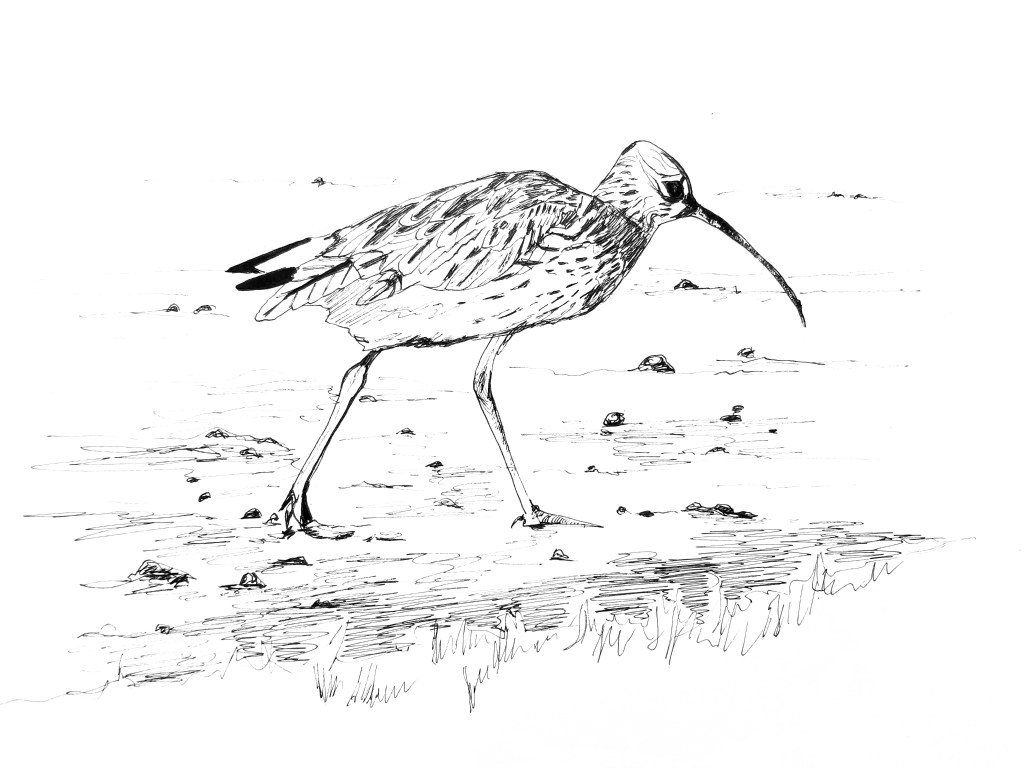
Near Whitehills, beyond the turkey farm, there were a number of curlews feeding in a field close to the road. To me the curlew is always an interesting bird, especially when one gets a closeup view. One forgets how enormously long and sometimes awkward looking is its long downward curved bill. The curlew makes good use of this very efficient feeding device, prodding and probing for food which most other birds cannot reach.
Looking from the road above Banff, the sea was calm and the line of silt cast out by the muddy full flowing river Deveron was dramatically etched. It was as if some gigantic net was holding all the silty fresh water in its confines and beyond was the salt sea water and the two couldn’t mix. The actual line stretched from the rocks at the end of Banff harbour out in a wide arc and it came in to land again well beyond Macduff harbour. Possibly in the future as man becomes more efficient at harnessing the power of nature, he will try and regain some of those enormous amounts of valuable soil, silt, fertilisers, etc.
Now that the land is under a four inch carpet of snow and frost, the bird table and fat basket have really come into their own again. One can have a lot of pleasure watching the various birds come and go. The most common birds around our table are the great tit and blue tit which will almost come to hand later in the winter, but at the moment just alight nearby when one goes out with food in the morning. The house sparrows, of course, get more than their fair share of the pickings, but what can one do. Sometimes the other regular, the robin, tries to show all and sundry that this really is his territory and he chases many of the above mentioned birds away. The other day I saw him deal quite a savage blow to a house sparrow which was picking up overspill from the snow. Robin flew down from the apple tree and landed with a thump on his back and the poor sparrow didn’t quite know what hit it and it wasn’t long in escaping into the shrubbery. That quiet, nice, small variety of sparrow, the hedge sparrow or dunnock feeds unobtrusively on the ground around the bottom of the apple tree where we hang our bird table. It is a graceful likeable bird, not at all like his cheeky noisy cousin, the house sparrow.
This must be known as the week of the snow, and one must hasten to add, frost, as we have had 22 degrees of frost overnight. We still have a level fall of eight inches and have been literally digging ourselves out every morning. Saturday in the sun and frost, the world was a picture, the ideal Christmas scene only a little too early. The cold came a little too soon for some farmers too, we imagine, especially those who work the turnips. It is usually into December before they take in their store of neeps. The children were skiing as the snow was too crisp for snowballing or for building snowmen. The pecking order at the bird table seemed to be cock blackbird, starling, great tit, robin, blue tit, dunnock and chaffinch.
Last Sunday as I went out to put crumbs on the bird table I saw a bird and thought immediately that it was smaller than a blue tit. On closer inspection it turned out to be a gold crest, Britain’s smallest bird. It was not interested in my crumbs, but was picking at insects on the stem of the standard roses. It was a welcome addition to a cold morning as was the closeup we got of a fieldfare later in the day. It was feeding on the rosehips on the white English rose next to the wall of the house. His slate-blue head and back were very prominent. Now that the cold weather has come, the large flocks of fieldfares seem to have broken up, and individual birds are foraging for themselves.
Seen at dusk, caught in the car headlights, what could only have been a jack snipe, an interesting winter visitor. It was right for size at about eight inches, and when it took off, it was right for flight, slower and less erratic than the common snipe and its beak was much shorter too. An unusual and welcome end of term addition to our annual list. This has been a fairytale day, at least from an appearance point of view, in which the temperature never rose above freezing point. We have had eleven degrees of frost overnight on one night already this winter, but last night there were fourteen degrees. Today everything is coated in rather beautiful form, the grass, broom, shrubs, bushes and even the tops of the highest trees, wreathed in frost, appeared very pretty against the smoke-blue sky.
In the paper shop in Turriff I shook hands with Melanie’s owner. It is not every day that a Forglen farmer breeds the Reserve Supreme Champion at the Royal Smithfield Show in London and receives a magnificent trophy from Princess Anne. Mr Leslie Mutch said that the nervous tension was quite considerable and caused him to lose a few pounds, but the whole trip was ‘a wonderful experience’.
Out for our constitutional last Sunday, we met the under keeper and like us, he was pleased to see the ‘fresh’, the thaw for anyone not used to the north east term. We asked about foxes and were told by the keeper that they have destroyed 150 in nine years. An interesting fact he has observed is that litter numbers seem to be increasing. He has known a vixen which had eleven cubs with the sexes fairly evenly divided. After leaving the keeper I went into the long grass by the mill pond and disturbed a hare. He scrambled through the deep snow, onto the road and went towards my wife, stopped, turned and raced away along the road in the other direction at a rare old pace. From the green pond-side weed, just where the burn flows into the dam, a snipe took off with its characteristic zigzag flight. We always feel great sympathy for the snipe as it has a hard existence in cold damp marshy places.
At this time of year one has to keep reminding oneself that the best part of the day weather-wise is in the morning and one has to make the effort, especially at the weekend, to get out then. I walked a short way up the road behind our house and stopped beside a stubble field of young grass where some grey-faced ewes were finding a winter bite. A small flock of starlings were feeding in the field and many more finches. Through the binoculars one could see chaffinches were in the majority and the cock bird himself is very colourful with his beautiful rosy breast. As well as chaffinches, there were greenfinches and bramblings to delight the eye with other splashes of exotic colour in winter time. The greenfinch most closely resembles the caged budgerigar and the cock brambling has more white on him than the chaffinch and has a rusty chest and shoulders.
The weather at the time of the winter solstice, December 21st, was exceptionally mild. Strange and sudden half gales disturb the nights. Christmas Eve was another fine one. A skein of 60 greylag geese flew over and I watched them for a long time quartering Buchan, searching for feeding grounds, until they looked like a faint wavering wisp of smoke above the horizon.
1975
Last week there were reports of waxwings being seen in Stonehaven, Turriff, Banff and even Forglen. This is the time for the annual invasion of these interesting birds from the continent. They are rather starling-like in appearance and size but lighter in colour, even to having a pink-grey hue and the feathers along the side have a red blob on them from which the bird gets its name. Waxwings have a crest which makes them very distinctive and they are curious and much tamer than starlings. The last time we had a large invasion of them, some wintered in the Banff area for months before returning east. They feed on rotten apples and cotoneaster berries. If one were to string apples on a wire and hang them in the garden there is a distinct possibility that waxwings might visit.
Winter golf would indeed be dull without the birdies of both varieties; the feathered kind and the rarer golfing variety, not so completely unobtainable on a shortened winter circuit. It was rather raw and cool, not cold mind, with an east wind blowing as we played the first hole at Duff House Royal. We saw a large cormorant making its way up river for a spot of freshwater fishing. The mature bird is completely black except fo white under its chin, unlike the immature cormorant which, with its white front, is more penguin-like.
At the 9th tee we saw, as we have seen before, a spectacular aerial chase between a carrion crow and a kestrel and the mock battle continued quite a long way over Duff House policies with the crow being the aggressor. The first and only golfing birdie came at the 9th, playing very short off a winter tee. We disturbed a pair of mallards here and they flew up river. We were in the shelter now of Montcoffer hill and the circulation had improved. Quite a number of oystercatchers were feeding on the 13th fairway and they moved off in a leisurely fashion when disturbed. We enjoyed our game and our birdies. A very pleasant way, we thought, of spending a winter Saturday morning.
1976
The head of the herring gull goes a dirty grey colour in winter, almost as if it had oil round it. I must say I had seen gulls like this without realising that it was a distinct change in plumage for the cold weather. In the breeding season in the spring the herring gull’s feathers will return to an almost pure, pristine, white again. In a way this is the opposite of what happens to the black headed gull. Its head turns almost white in winter and then in the spring it becomes black or really a dark chocolate brown colour again.
Most birds are to be seen in flocks at this time of year. Continental starlings are particularly noticeable, festooning wires or rising from fields in black clouds. Smaller numbers of redwings and fieldfares, too, can be seen. The smaller birds like chaffinches and greenfinches like each other’s company too. The ever-with-us rooks, which have probably paired by this time, can be seen busy in fields in the mornings. Obviously the rooks and carrion crows get an enjoyable bonus off the roads, because they can often be seen there presumably picking up salt from the salt and sand mixture put on the roads by the very welcome roadman’s lorry.
1977
At the weekend we journeyed to Inverness and a companion happened to mention that a lady whose house was on the high land south of Buckie could, on a clear day, see the Cuillins of Skye. This was our good fortune as we journeyed west. The hills and mountains west of Inverness were shaded, but far to the west beyond a weather front line, the sun shone brilliantly on distant snow capped peaks. Checking from the map on a line just south of Glen Farrar, we thought we could see the Cuillins, seventy to eighty miles away. To the north the Torridon mountains stood out too, like jagged Alpine summits. It was quite breathtaking, especially after the rough fortnight we have had of snow, gales, and rain.
Quietly flows the gulf stream or the North Atlantic Drift and we return to a day of blustery south east wind, free of frost. Without the gulf stream at this time of year we would, according to our latitude, be constantly in a situation of thirty degrees of frost or worse, such as, a friend tells me, they are having in Canada at the moment. We have been more fortunate this week than places further south in Scotland, where frost and freezing fog have certainly disrupted traffic. We do not wish to crow too much about our good fortune. Possibly our turn for more severe frost and snow may come as the winter progresses.
One morning last week we saw the magnificent spectacle of over a thousand of ‘our’ geese flying west just south of Macduff. There were more than twelve skeins with sometimes up to a hundred geese in each skein. We think of them as our geese because they return to the same area to winter each year and these greylags and pink footed geese mostly winter around the Loch of Strathbeg. The movement we saw during the week will be repeated often during the winter. The geese having grazed in the fields adjacent to the loch since their arrival in September or October are having to move further afield for food. During the day they will feed further west than Banff and Macduff and up the Deveron valley. Then they return to the Loch of Strathbeg to roost at dusk unless there is good moonlight. Such a large number of birds must consume quite a quantity of grass in a day. Farmers can shoot the geese if they are on their land, but they cannot go into business and sell them for profit.
We were travelling east from Macduff on a winter school visit to the RSPB reserve at the Loch. From the high points on the road we could see Benachie sticking up away in the distance and close at hand farm silos stood up out of the snow. At a different level, mole hills stuck up in the fields almost like standing geese. Somewhere near the Moss of Byth we saw real Highland cattle in a field and rooks were on free rations of salt from the roads. A shaft of sun came through the clouds and lit up the snow covered landscape in a beautiful wintry way. After passing NATO Mormond Hill and going through Crimond, of 23rd Psalm fame, we threaded through between the giant needles (statically embarrassing to the St Fergus site and the government) one of which is 999 feet high, of the enormous radio masts of the Royal Navy Wireless Station on the old Crimond airfield and arrived at the RSPB reserve reception centre.
Warden Mr Jim Dunbar welcomed us and explained that this was a staging post, the first port of call for many birds from Northern Europe, particularly geese, ducks and swans. On the way to the Fen hide along some 150 yards of raised slats, some of my pupils saw Britain’s smallest bird, the goldcrest and a coal tit. This end of the loch was frozen over to about 50 yards from the shore so the birds were not coming as near to the hide as they sometimes do. From the Bay hide we saw in the distance greylag geese and whooper and mute swans. Close at hand were a flock of a dozen lovely goosanders and two or three pairs of mallards. Goosanders are diving ducks with narrow saw-edged bills. The drake has a rich yellow-white colour along his side and this contrasted well with his green head. At first we thought the pinkish object in the distance was a marker buoy; but market buoys don’t move and on closer inspection it turned out to be the Loch of Strathbeg flamingo. It has been resident for two and a half years and Mr Dunbar said it was beautiful in flight. While in the Bay hide, a sparrow hawk flew past and a heron came in and landed fifty yards away. Hot soup warmed tummies before we started for home. When we got to Macduff we had added moorhen and magpie to our outing list.
The change of tune during the night must have affected my subconscious and caused me to awaken. Instead of just a gale force wind, lumps of water were falling now and the splashes could be heard on the window panes. With such an excess of water over a couple of days the river Deveron rose quickly, ditches filled up and puddles appeared in fields and on the golf course. There the gulls seemed to have a great time swimming and feeding where they normally just walk. When we saw the river today is was still a mighty force with hundreds of tons of water a minute surging down stream, but the river nevertheless was some four or five feet below where it had been at its height some hours before. All the land was wet and sodden. The long grasses, reeds, trees and rubbish that so far has been untouched since autumn, had been caught by this giant sweeper and had been laid low or carried away towards the sea. I heard the splash and saw the extensive rings even in the turbulent river, but was too late to see the large salmon jump that my companion had spotted. Something disturbed a flock of nine goldeneye duck and they did two or three circuits before coming back to land on the river.
When there is so much water about at this time of year the thought occurs that there should really never be a shortage in our land, but it does happen. Three horses were galloping about in a field across the river pleased that it was at least dry for the time being. It is amazing really how they grow their long coats and survive comparatively unaffected through all the rigours of our winter; better with no shelter evidently than some. As we arrived home the wind increased and the rain came on again and it began to get early dark. Nature was playing its midwinter tune.
Our golfing companions arrived at about 8 am when it was still dark and we were gobbling down the last of our breakfast bacon ‘piece’ and coffee. Not long before this, while at my ablutions, I had seen flakes of sleet falling past the bathroom window. However, these eternal optimists were going to brave the elements and go to Royal Tarlair, Macduff, to play golf. Our optimism was thoroughly justified and it turned out to be a wonderful, frost free, nearly windless, comparatively mild morning for the time of year with no more precipitation. Far flung competitors from Dufftown were amazed to find on phoning that the competition was on. Their land was snow covered.
As we arrived players were disappearing down the first fairway into the darkness, but the dawn was winning wonderfully. As this was the first day without rain for some time there was a lot of bird movement as well as human. A skein of greylag geese were making quite a noise as they flighted down into a field. A flock of lapwings too, whirled around in the same area, their broad flappy wings making them unmistakable. Nearer the golf course, curlews changed fields, some calling as they went quite quietly and unpretentiously in their winter feeding way. A mixed flock of starlings and feral pigeons flew about excitedly up near the ‘hen-houses’. A small flock of snow buntings flew across the course. Plenty of gulls, mostly herring and common, were now going inland to feed.
Being on the tops of the cliffs close to the sea at the 13th Civet hole is always awe inspiring. The green is situated on a promontory with some land onto it from the west. You play down to the green, about seventy feet below the tee. If you slice or are too strong, then that is the end of your score at this hole, your ball goes down onto the beach more than a hundred feet below the green. One can play, depending on the strength of the wind, and there is nothing between you and the North Pole here, any club from a seven or eight iron to a driver. Yes, it’s one of those very sporting holes. It’s a lesser, more natural Scottish edition of the now famous seventeenth at Kiawah Island, South Carolina, venue of the 1991 Ryder Cup game.
Many cormorants were on the rocks and small groups of oystercatchers flew along parallel to the shore, calling noisily. At home at the end of the day the sky cleared for the first time for weeks and the outbuildings and trees to the south and west were etched against the cold clear sky. An exhilarating ending to a wonderful mid winter day.
The other day we had the pleasure of watching at close quarters without binoculars, from the Duff House car park, some oystercatchers. They were busy feeding on muddy, grassy ground. As there was a plentiful supply of worms, large and small, it was interesting watching their antics as they probed for the worms and then proceeded to extract them with their long powerful orange beaks. We did not see an oystercatcher break a worm. With some big worms they stood back on their heels and gave an almighty heave before they got them out. Sometimes one would wash a worm in a puddle before swallowing it. After swallowing there would be a short pause for tasting and appreciation before the bird resumed feeding. Swaysland calls them sea-pies and says that “in winter months the birds have a gorget of white round the front of the neck” like a minister’s dog collar.
This month of December is the time of year when there are some brilliant sunrises and sunsets and one morning recently the sunrise was remarkable for its splendour. The eastern sky was filled with a wonderful array of colours linked to an interesting cloud pattern. The colours changed as the light climbed up across the sky and they also changed as the sun rose. Many people that day remarked on the beauty of the dawn. The day turned out to be one of exceptional mildness. As we journey to school in the morning in the half light, we meet hundreds of gulls flying inland to their feeding grounds. At the col between Linhead and Alvah, they do not have much height to spare after their long climb from the sea at Banff and if there is a little wind, they fly in skeins to help each other, the strong birds in front helping the weaker brethren behind.
On our winter walk some blue tits and coal tits accompanied us a little way up the road, flitting along in a stand of mature beech and sycamore trees. The countryside though wet did not look too discouraging. Cattle were being fed by the roadside on silage. They looked innocent and lugubrious, just standing staring at us. Some people do not like the smell of silage but it suits me fine. There is something even refreshing about the aroma, though one could not say it was fresh as it had been stored since May or June. The cattle seemed to like it anyway, and their long tongues fairly take it off the heap and tuck it away.
1980
There was a time when Christmas cards had mostly religious themes. The stable animals, the ox and ass were sometimes prominent. Then one might get a view of the stable from the distance showing a fawn or other young animal or bird. The robin was probably one of the first birds on Christmas cards and it is still very popular along with holly and berries, Christmas roses or even jasmine. Now-a-days birds are very popular on cards along with a snowy background, of course. The RSPB catalogue shows some delightful scenes of birds on cards. Being very colourful, pheasants in the snow are popular. One card shows pintails and shoveler ducks standing in the snow at the edge of a pond and this makes a lovely wintry group. Bramblings, long tailed tits, blue tits, chaffinches and bullfinches, all lend themselves nicely to Christmas card scenes. It is mostly small colourful birds that are eye catching, although the redwing and thrush among the medium sized birds are often appealing. The owl can be interesting too. The robin redbreast, showing a rich warm red colour is most popular.
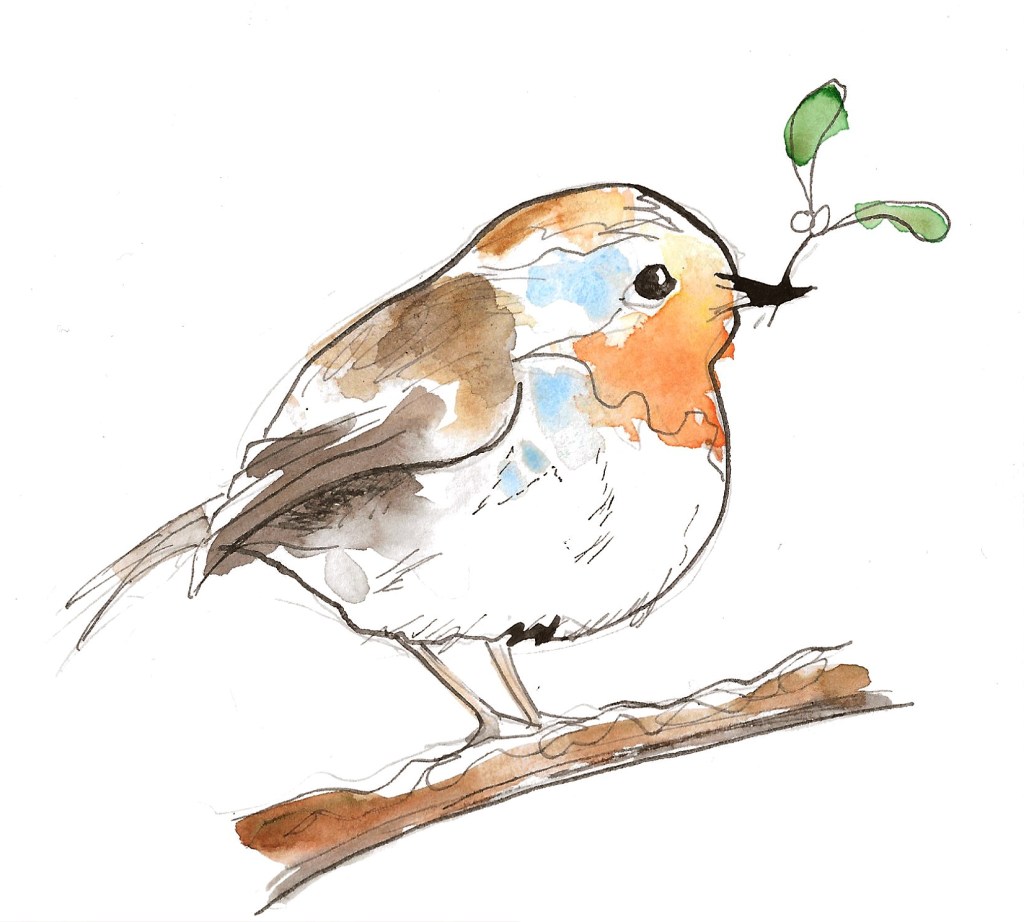
With different snowy backgrounds, goldfinches, kingfishers and even the jenny wren are all attractive. Gobblers and geese are out, of course, as they finish up on the wrong side of the oven door on the great day. I suppose, come to that, so do some pheasants and duck.
During the year from our Scotstown, Banff perch we saw two species of bird for the first time, a spotted redshank and a little awk. We remember the violent hail storm of the 5th June killing the young oystercatchers and destroying or damaging young plants. The August phenomenon was the unusual Forglen tame heron. During September we enjoyed the company of a flock of mistle thrushes and a solitary visit from a red admiral butterfly. In October we saw again the now famous Loch of Strathbeg flamingo. Also in October we saw free flying budgerigars behind Muirfield golf club in East Lothian. In November it was not easy knowing how many readers caught on to my invention of herons on manure trees at the mouth of the Don at Hillhead, Aberdeen – a typists or printer’s error really – it should have read ‘mature trees’.
1981
With the landscape covered in snow and record low temperatures being recorded in various places in Britain, the birds find it more difficult than ever to get enough food to stay alive. It might have been weakness from lack of food that caused a tawny old to strike our car the other evening as we were going along the Forglen road to Turriff. When it struck we thought it might have been a bird or a lump of snow falling from a tree. A following car saw it standing dazed in the middle of the road. Unfortunately it did not survive.
In this kind of weather almost any kind of food will do for birds. Toast is better than ordinary bread. Breaking up the food into small bits is a help to the smaller birds and if the food can be put up high out of the reach of cats, so much the better. Each morning during the week we put out the scrapings from the porridge pot as well as crumbs and next morning all is gone. During the week we do not have time to notice what happens to the food, but on Saturday, as well as the blue tit, great tit, chaffinch, dunnock, robin, blackbird and starling, I noticed a couple of jackdaws were helping themselves to the porridge.
In the middle of a very mild, windless day, the drizzle relented and we decided to go and look for duck on the river Deveron. Going down an avenue of mature firs and beeches, there was an atmosphere of rest and decay, but we expected more life at the riverside and anyway the air was like wine. We passed an ash tree where barn owls roost and there were fresh droppings and owl pellets on the ground. We first saw two pairs of tufted ducks. The drake is the only water fowl with a drooping black crest. He has a black back with white sides. They took off and in flight they have a distinct magpie appearance with male and female showing black and white on their wings as they fly. Frequently now mallard took off with a woosh and a clatter of noisy wings. We disturbed a heron just below us on the river and from close up its plumage is almost light grey, though flying in the distance it looks quite dark. We heard the harsh screech of a snipe and watched it fly down river with its zigzag flight. Greater black backed and herring gulls frequently flew over our heads on river patrol. As I picked up the tufted duck again with binoculars, a moorhen and a carrion crow crossed my field of vision, the moorhen seeming almost to walk across the river.
We stood beside a proud willow tree that was dropping leaves individually as one looked at it. A robin was in the willow tree. The purple catkins on the alder trees were very striking. Fish were jumping in the river. Somehow one never gets used to the shock and thrill of a big salmon jumping and landing, splash, back in the river. Small salmon smolts were occasionally jumping clean of the water. As we headed home four duck flew down river fairly low overhead. The mallards always fly over well above shotgun height. The four ‘innocents’ turned out to be sawbills, the red breasted mergansers. We heard a wren scolding us from some trees across the river. A solitary black headed gull, without its black head in winter, flew down river and a number of noisy jackdaws crossed the river above us. Away to the south in the distance we could just see a skein of geese going west up the Deveron valley. We had a very rewarding river walk with plenty of life on, above and beside the river, even in winter time.
At this time of night, late evening, our cat is firmly ensconced in his box in the kitchen and acting as if he were not there. In another hour or so he will be put out for the night and he doesn’t particularly like that. He would like us to forget all about him. He is an ordinary farm cat, just a generation or two removed from his ancestors, the wild cat. His back is nearly black. He has tigerish, grey-brown stripes on his sides and legs, white on his nose and under his chin and he has four white paws. Our previous cat was a female calico who adopted us when life became too hectic at her old home a couple of miles away because of new dogs coming to live there. We liked her personality and temperament so we wanted another female. The present puss arrived when quite young, duly sexed as a female, but after six months or so he proved everyone wrong. He was neutered when he was about a year old.
There are many arguments about whether a dog or cat has more intelligence and probably more people come down in favour of the dog, particularly as it gives many humans the chance to exercise, but our cat has considerable intelligence and has many personality changes. He is not normally allowed ‘through the house’ and if the kitchen door should be left open he will go through into the corridor, dig his claws into the runner and then roam on in a wild tigerish way, a completely different cat from the deep-sleeping, or high-tailed leg rubbing, fawning creature of a moment before. Bliss is getting through to the sitting room fire, and lying, at full stretch, warming his tummy. Normally he is fed by my wife, but occasionally when I feed him, he’ll tell my wife blatant lies that he has not had his food. In the morning he fusses about the porridge pot and he likes a drop of hot porridge to warm up any milk that might be left in his dish. Too much petting and stroking are not for him. He is independent and will show it. The claws can come out. Every night when we come home he comes out of his shed to greet us. He is our faithful, family moggie cat and there are many more like him.
Wet areas are becoming increasingly important for the preservation of wildlife and farmers and other landowners are being encouraged to preserve small wet areas so that various birds, animals and insects can survive in their natural habitat. A very good example in our area is that of the pond or loch or lake created by Mr George Norrie, Slackadale Farm, Turriff. Mr Norrie has stocked his lake with trout, landscaped round about, planted various shrubs and trees and created a very good environment for all sorts of wildlife. Already this winter some whooper swans have made the loch their base and lots of different varieties of duck have visited it. It was hoped that mute swans might have nested last spring. Whether a fox disturbed them it was not known, but the swans stayed for a number of weeks and then moved off.
Our local pond was becoming a general dump until the community council got the district council to erect a ‘No dumping’ sign. This seemed to do the trick and over the years we have known our pond and surrounds to be visited by many different varieties of birds. We have seen mallard, teal, tufted duck, snipe, moorhen, heron, dipper and comparative rarities, water rail and green sandpiper. Though it is only 40 yards square, swans have rested on it. They usually like more room than this from which to take off. In the gean, willow, rowan and elm trees that are around the Forglen pond, plenty of small birds such as blue tit, robin, chaffinch, wren and blackbirds are to be found. In summer breeding reed buntings and grey wagtails nest about the bank of the burn that leads into the pond, so that is a bonus.
I remember golfing at Douglas Park golf club in the Milngavie district of Glasgow where I was a member before coming to the north east. In frosty winter conditions when possibly the Allander river was partly frozen over some swans landed with a bump on the fairway beside us golfers. They appeared none the worse of their experience and waddled away towards the river.
Recently coming home in the half light, I have on two separate occasions seen woodcock. Another small game bird which I heard in the gloaming, but did not see, was the snipe. Some woodcock breed here, but a number come from the continent in October and return again in March. A little smaller than a pigeon with a three inch probing beach, the woodcock comes out at dusk and feeds at night, mainly on earthworms. It flies with a faint twisting flight and usually in the evening they follow territorial flight lines along the same route so that hunters, could in olden days put up vertical nets across the rodings, and so catch the woodcock. The plumage is handsome and is composed of three shades of brown and as every feather on the upper part of the body contains the three shades, the back presents a beautiful variegated appearance. The snipe is a half cousin of the woodcock and has proportionately the longest bill of any bird of the region. If the woodcock’s flight is twisting, then that of the snipe is positively zigzag and very rapid. It is brown like the woodcock, but smaller and more slimly built.
So from January 1st to the end of December I have tried to share my bird watching experiences with you. What you see must be something in the bird world or in nature as no new species have been created for a long time. Ornithology or bird watching must be one of the cheapest hobbies to take up for those who have retired and there must be thousands who want to start, now that they are out walking every day taking their exercise. They can add to the fun of the ordinary constitutional by looking at and identifying birds.
A retired Turriff postman who since his retiral has taken up birdwatching, has while walking recently by the Turriff burns, seen a kingfisher about 8 times in the last three weeks. It might be the most northerly wintering kingfisher in the British Isles. This is towards the end of January 1992. It all adds to the fun of the daily walk.
In identification, the ‘jizz’ of a bird is important, or the GIS, the general impression of size and shape. It’s the new in word in bird world identification. Three other factors are important, voice, habitat and colour.
‘The Birds of Britain and Europe’, by Heizel, Fitter and Parslow, published by Collins, is as handy a book for bird identification as I know. My one cost £1.50. But it is nearer £7 in price now. Binoculars are very handy to identify birds, especially if the birds are up on wires against the light. Bringing them closer can help with colours particularly. Our children gave us a present of a pair of ‘Praktica’ sport 10 x 25 binoculars and we find them very handy as they can be slipped into an anorak pocket quite easily. Cost about £60.
I hope it is obvious from what I have written that bird watching can be great fun, especially if one gets the family involved when the children are young. The interest will remain and they can pass it on to their children when they grow up.
“The illustrations in this book are the original creations of Sheila Chapman and she retains the copyright in them (Reproduced here under licence). More information about the artist can be found at www.sheilachapmanart.com “
 Cunning Systems