Building a windfarm

There’s not been much public blogging lately because I’ve been posting the quantum notes in private, for the project which I’m supporting to spinout from Heriot Watt university.

There’s a different big infrastructure project going on, and we have a way to get pictures of some of the components that it takes to build.

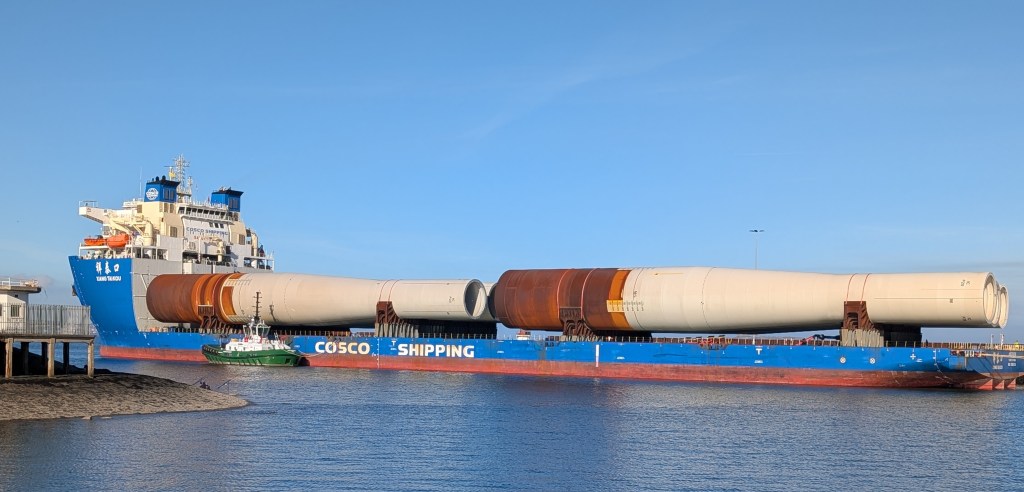
The heavy semi-sub Xiang Tai Kou

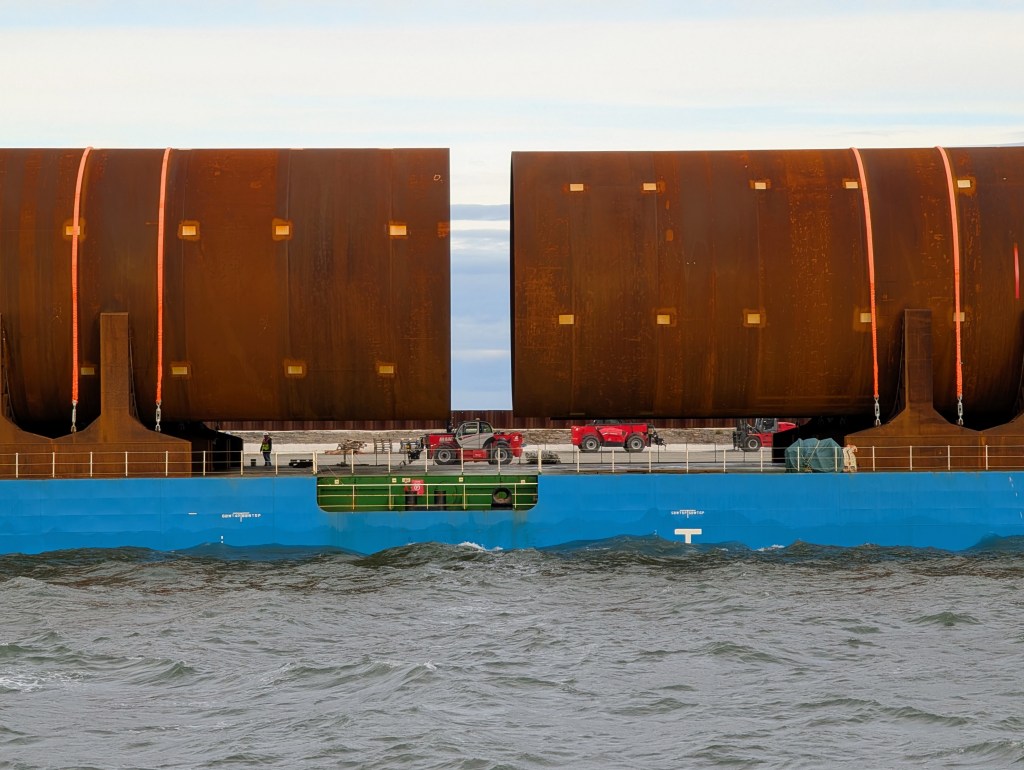
We’d watched the Xiang Tai Kou backing in to the deep water dock at Leith on the evening of 11 October 2025, trying to see from 2 miles up town (with binoculars) what she was carrying. Eight huge cylinders .. monoplies for the Inch Cape windfarm. For scale, the Targe Guillemot holding position in front of it is 25m long. The big ship is 231m long and 46m wide.

This was the first arrival of a procession of these Chinese flagged heavy deck cargo vessels, last port Suez. It was preceeded by months of dredging, in the channels on the Forth as well as in the entry to the main Leith dock behind the lock.

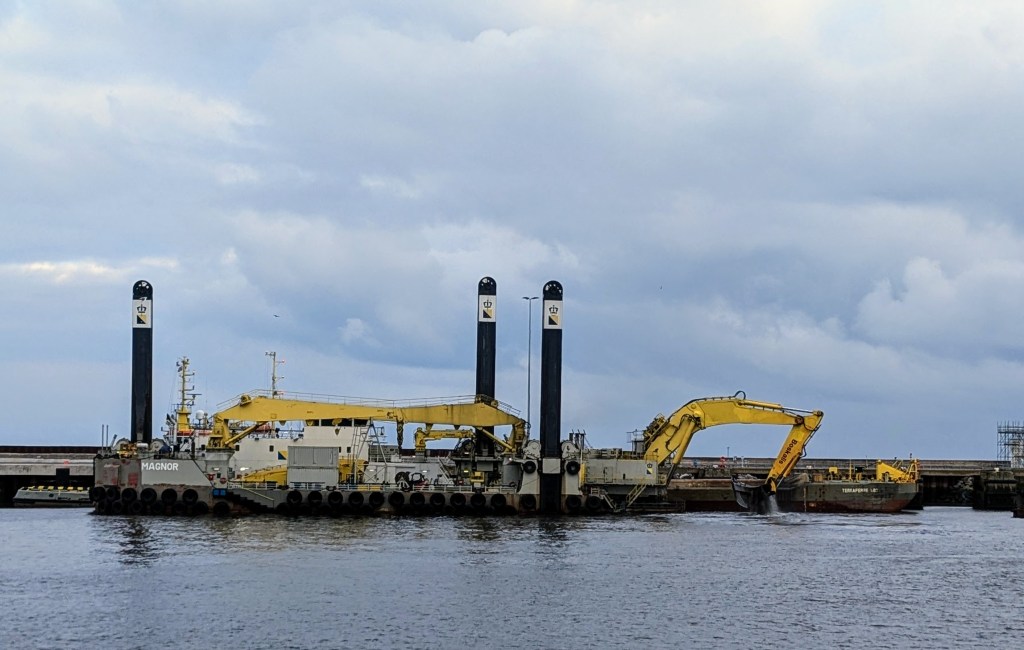
The dredger Magnor, February 2025

Th operation also had at least three tugs involved, the GPS Avenger, Union Onyx and Union Topaz, moving and shepherding the big hulls being used for the material dredged up.

Sheng Chang 777 on the 23rd October 2025

The next ship in was the Sheng Chang; this image has people underneath the monopiles.

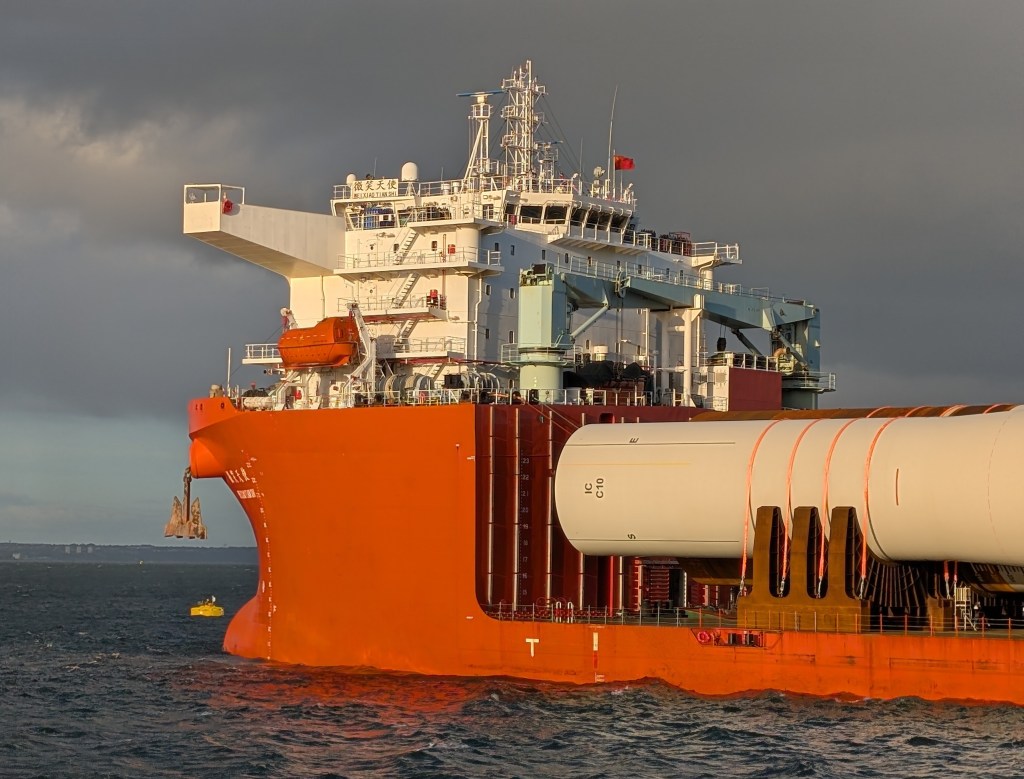
Wei Xiao Tian Shi on the 31st October 2025

This was the third ship in; there were 8 bogies with 10 axles each underneath the cylinders.

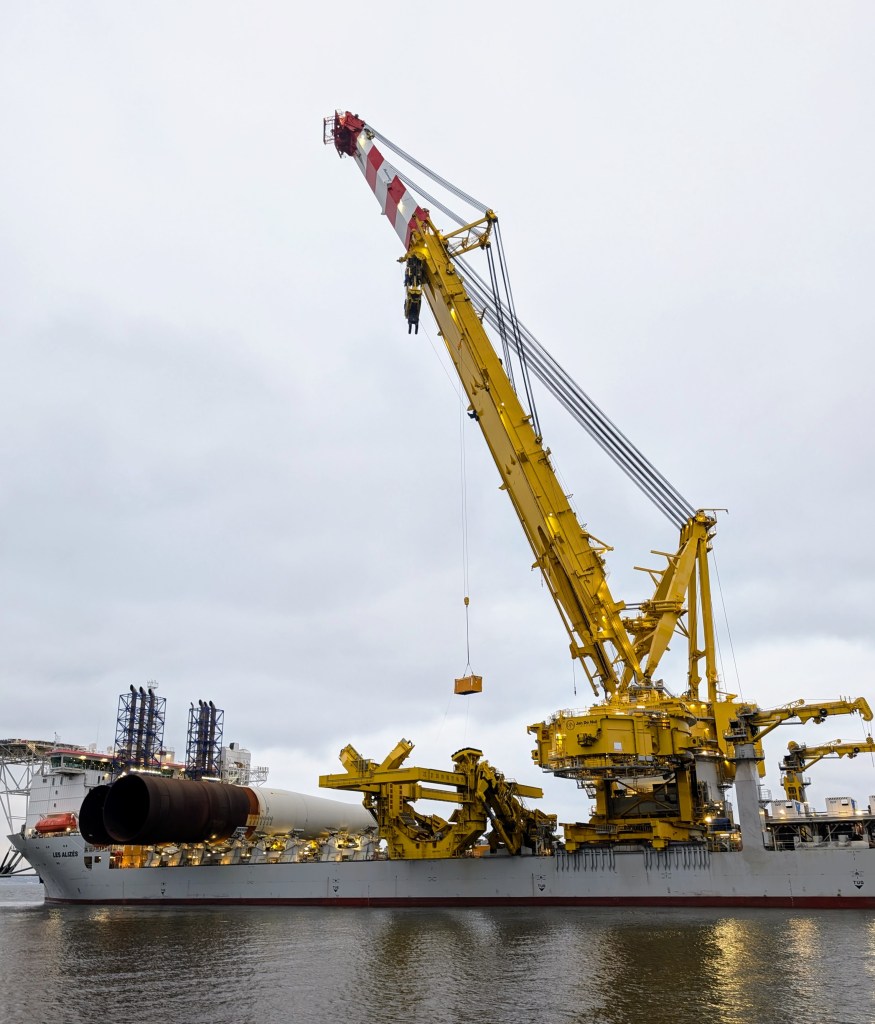
Heavy lift vessel Les Alizés, 23 December 2025

This is the start of the next stage, where the heavy lift vessel loaded on 4 or 5 of the monopiles and went off to set them in place at the windfarm, which is more or less due East of Dundee.

Inch Cape wind farm is offshore Montrose, connected to Cockenzie by subsea cable. The lift ship, made in China, is owned by a Belgian company, Jan de Nul, headquartered in Luxembourg.

Weeknotes 6

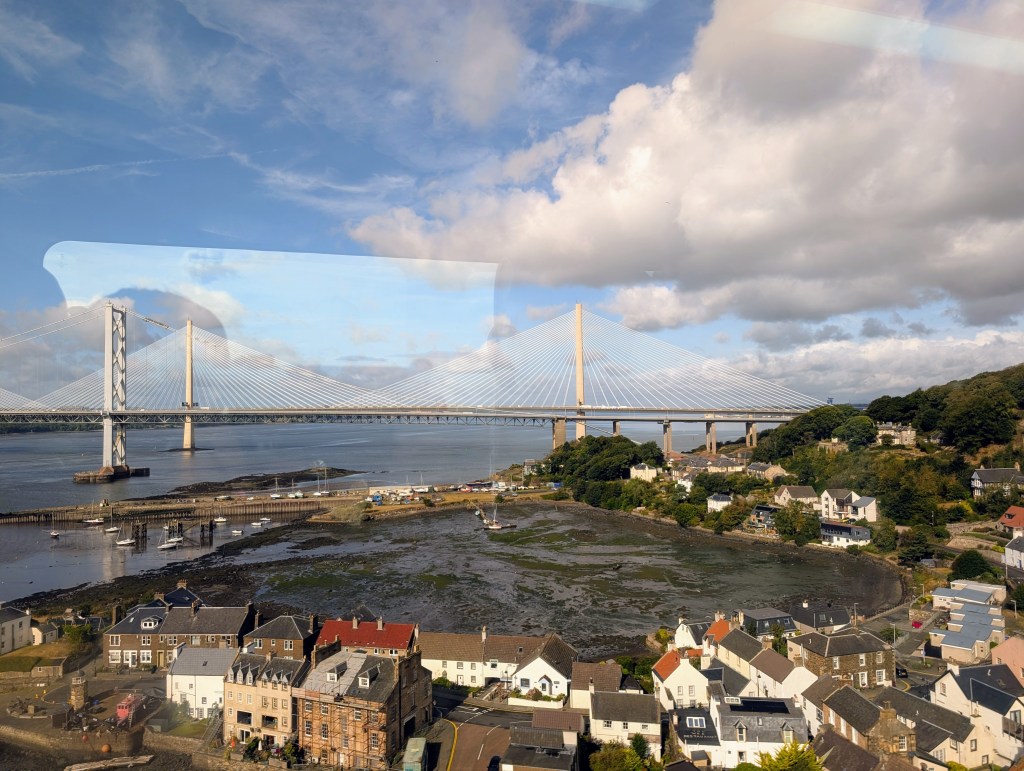
North Queensferry and the Forth bridges from the train on the railway bridge.

There wasn’t so much quantum technology this week, and more administration. The concept of distributed infrastructure had to be explained to some of the audience using familiar consumer experiences.

There was a useful note about the NQCC quantum computing testbeds https://www.eetimes.com/u-k-startup-scaling-quantum-computing-with-photonics/ 

Aegiq is one of two companies on the NQCC campus utilizing silicon photonics to deliver a full stack quantum computing platform.

Weeknotes 5

Infrastructure in the street

Quantum hasn’t yet got to the point where I can say, like I did with Cisco routers long ago “I know where the bits come from and go to underneath that piece of road digging”, though there have been SQUIDs (superconducting quantum interference devices) in use as very sensitive magnetometers for a long time. SQUID sensors market trends

Packaging and photonics links

Lasers https://www.scottishfinancialnews.com/articles/scottish-tech-firm-powerphotonic-targets-new-markets-with-ps26m-maven-funding-boost Maven Capital Partners has invested £2.6 million in Scottish advanced laser systems pioneer PowerPhotonic .. follow on from Archangels and Scottish Enterprise Headquartered in Dalgety Bay, Scotland, with a high-volume manufacturing facility in Arizona, USA, PowerPhotonic is a global leader in precision micro-optics for laser applications.  

https://www.novuslight.com/first-electronic-photonic-quantum-chip-manufactured-in-commercial-foundry_N13549.html Global Foundries. Northwestern University, Boston University (BU) and University of California, Berkeley (UC Berkeley) have built a tiny photonic quantum system into a traditional electronic chip.

Nvidia co-packaged silicon photonics – switches – and the partner list https://www.nvidia.com/en-us/networking/products/silicon-photonics/https://developer.nvidia.com/blog/scaling-ai-factories-with-co-packaged-optics-for-better-power-efficiency/ block diagrams

Microsoft – quantum safe cryptography https://www.microsoft.com/en-us/security/blog/2025/08/20/quantum-safe-security-progress-towards-next-generation-cryptography/

Quantum weeknotes 2

Following the money ..

Funding for deeptech companies in Europe – 20 VCs https://tech.eu/2025/07/29/chasing-tech-milestones-not-just-capital-key-lessons-from-the-deeptech-hardware-napkin 

McKinsey quarterly report June 2025 https://www.mckinsey.com/capabilities/mckinsey-digital/our-insights/the-year-of-quantum-from-concept-to-reality-in-2025#/ 

QC companies began a shift toward revenue generation, earning an estimated $650M–$750M in 2024, and are expected to surpass $1B by the end of 2025. The QComm landscape has three key categories (security, networks, and services) and six key verticals: quantum key distribution (QKD) solutions, postquantum cryptography (PQC), modular interconnects, regional networks, quantum global internet, and QComm services. PQC, which has experienced the most commercialization, has the highest level of maturity

Quantum activity in Scotland https://technologyscotland.scot/wp-content/uploads/2023/04/Quantum-2023-Report.pdf hardware suppliers 

https://www.sdi.co.uk/news/quantum-drive-boosting-the-commercial-potential-of-tech-innovations SDI April 2024

Securing funding for quantum technology projects that may not be immediately profitable is a huge hurdle. However, there are various avenues in the UK to promote development and support ventures scaling up for commercialisation. 

Innovate UK, a UK Government agency, has assisted 15 Scottish companies involved with quantum technologies. Earlier this year, the agency awarded £2.34 million to Skylark Lasers to develop critical equipment for quantum-powered navigation systems. The company has also received investment from Scottish Enterprise. 

Scepticism and optimism

Sceptics about quantum computers and the requirement for post quantum cryptography https://www.theregister.com/2025/07/17/quantum_cryptanalysis_criticism/ 

Scott Aaronson being optimistic https://scottaaronson.blog/?p=8329 Quantum Computing: Between Hope and Hype

by Scott Aaronson September 16, 2024

Origins of quantum computing – Ray LaFlame obit https://scottaaronson.blog/?p=8949 All of a sudden, there was a viable path to building a quantum computer out of photons, where you wouldn’t need to get pairs of photons to interact with each other, which had previously been the central sticking point. The key insight was that feedforward measurements, combined with the statistical properties of identical bosons (what the photons are), are enough to simulate the effect of two-photon interactions.

A language for programming quantum algorithms, independent of the specific type of quantum computer on which they are to run. That this kind of thing gets developed is critical to the enabling larger scale use; CUDA is the NVIDIA programming language which enabled GPUs to be used for other things than ray-tracing and running graphics for gaming.

Quipper language embedded in Haskell – functional programming https://arxiv.org/abs/1304.3390 Quipper has been used to program a diverse set of non-trivial quantum algorithms, and can generate quantum gate representations using trillions of gates. It is geared towards a model of computation that uses a classical computer to control a quantum device, but is not dependent on any particular model of quantum hardware. Quipper has proven effective and easy to use, and opens the door towards using formal methods to analyze quantum algorithms.
Quantum weeknotes 1

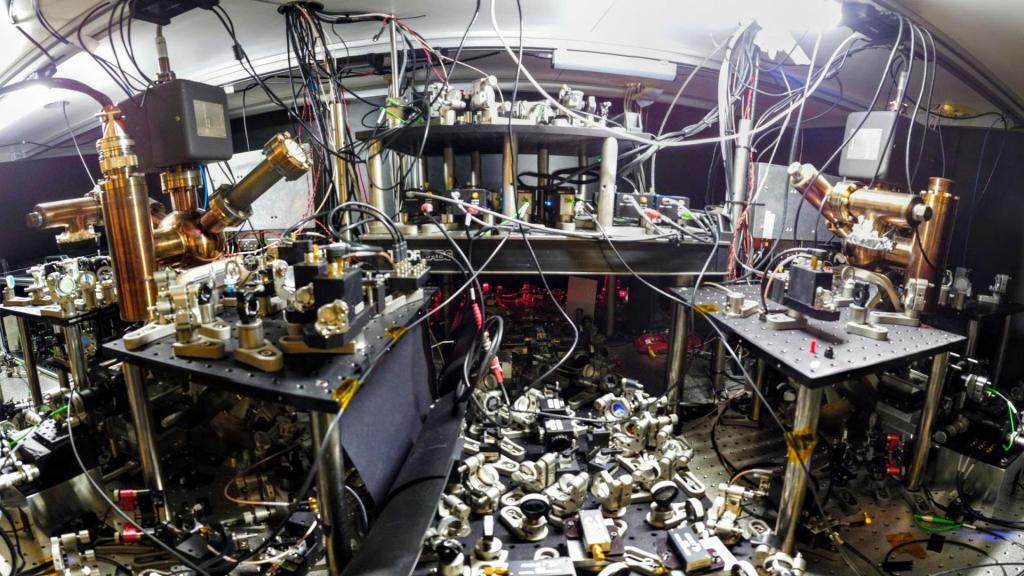
University of Oxford Department of Physics Optical lab

Image illustrating the Department of Physics page describing their quantum networking research

This is my collection of references to examples of explanations of quantum networking.

There are roughly three categories of audience

  • physicists and people who have experience with quantum mechanics
  • people who understand conventional computer networking, who start from ‘How many gigabits per second, with what delay, and what error characteristics’ and go on to ‘what do the connectors look like’ ?
  • people who are unfamiliar with both computing and networking but are interested when I say ‘I’m working with a new company’ and for whom I want a description that doesn’t start from ‘entanglement is like magic operations at a distance’

These audiences are not disjoint: any material for the non-specialists in the topic has to be accurate and precise. This is a rapidly moving field so that references to material from previous years needs to indicate that.

The Oxford description above is for physicists. So is the description from Imperial College, about ‘quantum dots’ producing (non-entangled) photons, which were then passed to a quantum memory system that stored the photons within a cloud of rubidium atoms. A laser turned the memory ‘on’ and ‘off’, allowing the photons to be stored and released on demand.

Bell Labs (of storied history) is now part of Nokia. The Register (a source of long standing for networking people) has a good attempt at addressing their audience with the description of the topological qubits Bell Labs are building, which require cryogenics. Doesn’t at all answer questions about speeds and feeds, though.

McKinsey has a description which summarizes to ‘this is still research’, but follow the money. Lists chip developments from Google (Willow) and Microsoft (Majorana 1); AWS’s Ocelot for cat qubits.

Cisco, Nvidia, and IBM all have labs with working hardware.

Useful summary for computing and network people :

  • Quantum computing. Quantum computing is a computing paradigm leveraging the laws of quantum mechanics to significantly improve the performance of certain applications and to enable new territories of computing.
  • Quantum communication. Quantum communication is the secure transfer of quantum information across distances.
  • Quantum key distribution (QKD). QKD is the use of quantum technology to securely share a secret key that can be used with classical encryption algorithms.
  • Quantum sensing. Quantum sensing uses a new generation of sensors based on quantum systems that provide measurements of various quantities—for example, electromagnetic fields, gravity, and time. Quantum sensors may be orders of magnitude more sensitive than classical sensors.

Caltech explanation “Entanglement can also occur among hundreds, millions, and even more particles. The phenomenon is thought to take place throughout nature, among the atoms and molecules in living species and within metals and other materials. When hundreds of particles become entangled, they still act as one unified object. Like a flock of birds, the particles become a whole entity unto itself without being in direct contact with one another.”