1971
The call of the curlew. We seem to be surrounded by it just now ! The curlews near where we stay have settled into their territories and they are going through their annual courtship.
On a mild warm spring evening when there is a real sense of re-awakening in every living thing, this wonderful, mellifluous, plaintive call comes oh so clearly across the fields. These curls are the autocratic aristocrats of the air in our neighbourhood. This big bird is very graceful in flight and flies strongly with vigorous thrusts of its powerful wings. One’s descriptive powers are so inadequate, but on an evening such as tonight, one feels one would like to wax eloquent, to pass on something of the mysticism that the call of the curlew evokes. The call comes across so clearly in our undisturbed country area that one feels one must stand and listen to all the burbles, the cadences, the soft pipings of the sounds as it dies away in the still evening air.
Any bird such as the carrion crow or gull which flies into its territory is very quickly intercepted. The curlew will dive swiftly into attack, braking and swerving just short of its quarry. This tactic is repeated over and over again until the intruder is chased far away. It is a sight worth seeing. To have this bird thrust at one, with its long fearsome, curved, powerful beak must be quite frightening. Fortunately there are no known records of them diving at humans as do lapwings and terns at nesting time, or they might really be a bird to be feared.
The birds in our area will rear their young until August and then depart for the coast. Large numbers of curlews winter just south of Cruden Bay golf course around the Skares Rocks. We have seen thousands rise up off the rocks when a low flying jet aircraft passes overhead. “Last of the Curlews” is an interesting book to read about curlews. Probably one would have to ask the library for a copy as I believe it is no longer in print. This is the story of the Eskimo curlew which nests on the Arctic Circle, north of Hudson Bay in Canada. It winters not far from Cape Horn in Patagonia. During the 19th century the curlews were slaughtered in their thousands as they migrated north in the spring up the Mississippi and over the prairies of the USA and Canada. It was thought that they had become extinct, but I saw an exciting press reference recently saying that some pairs of Eskimo curlews had been seen again.
April could be described as the month in which resident birds build their nests. Without carrying out an active search we know of two already in the garden, a wren’s and a blue tit’s. From the window the wren seemed very busy around the bole of the elm tree and on closer inspection, there was the nest, carefully built into the trunk of the tree on the east side, about four feet from the ground. The old mature elm tree is covered in a green moss and this moss has been skilfully used in the final nest covering for maximum camouflage. As the elm tree is just about to come into leaf these words of Browning’s from ‘Home-Thoughts, from Abroad’ seem to fit the situation.
“The lowest boughs and the brushwood sheaf
Round the elm tree bole are in tiny leaf
While the chaffinch sings on the orchard bough
In England now “
The nest is beautifully constructed by the master craftsman and dome shaped with a small hole in the side. The cock bird may build several nests before the female is satisfied and presumably says “This is ‘the’ one”. For its size the wren lays a large clutch of eggs, up to about nine in number. The wrens will nest in a hedge or a wall. I have seen a nest in a gooseberry bush and the wren used the green lichen off the bushes to get the whole edifice to harmonise with the surrounding twigs.
The blue tit’s nest is in our bird box against the wall of the house. If one is good with one’s hands these boxes can be constructed fairly easily; but the diameter of the hole in the box is all important, one and a quarter inches. Our box was purchased from the Royal Society for the Protection of Birds, The Lodge, Sandy, Bedfordshire, and for a modest annual subscription one can become a member of the RSPB and get their interesting bimonthly magazine. The society does a lot of good work in the course of the year and they are particularly conscious of the need for conservation. We purchased our box two years ago and were lucky to have blue tits nesting in it almost immediately. Ideally, one should put up the box in the autumn and allow the tits to roost in it over the winter and become acclimatised. Last year the blue tits did not nest in the box and I think we stopped feeding them too soon in the long cold spring we had then and they departed.
A fortnight ago the bottom layer of green moss, taken from the old wall under the ivy at the bottom of the garden, was put in the box by the blue tits. Since then I have seen the dry grass going in. The sparrows have obstructed and objected, but fortunately the hole is too small for them. Our box is six to seven feet off the ground. A weekly look at most is recommended. Get all the family round. The side can be lifted out quite easily by putting one’s finger in the hole. The children can share in the excitement, especially when the eggs are laid. One has to be careful or one can be conned into thinking there are no eggs in the nest as the tits drag feathers over the eggs to hide them when they leave the nest. Two years ago at six in the morning I was lucky enough to see one of the first sorties from the nest box. The parent birds and four babies were all balanced on the washing line just like a scene from a Walt Disney film.
The swallows will soon be here – especially, if like other things in nature this season, they are a fortnight earlier than usual. In the Banff-Turriff area the earliest we have seen the sandmartin, usually the first of the forked tail family to arrive, is April 23rd. The swallow is usually seen in the first week in May. In Perthshire, on the banks of the Tay at Caputh, near Dunkeld, the sandmartin has been known to arrive as early as April 8th. Until last year a lady, whose name is already enshrined in the history of salmon fishing in Britain and whom we had the pleasure and privilege of knowing, lived in the boathouse by the bridge at Caputh. Miss Ballantine caught the largest salmon ever landed by rod in Britain, a 64 lb fish. She was the local registrar in the parish for many years and for 100 years the family have lived at the ferry at Caputh. The river was in her blood. Her father had been boatman at Caputh until the present bridge was built with stone from the ill-fated Tay Bridge. She was troubled by bad circulation and arthritis and towards the end of her life she lost first one leg and then the other.
When one went to her house, after the usual exchange of greetings and news, one was invited to help oneself to a dram, and the children were given a sweet or some fruit. Although she must have suffered quite considerably towards the end of her days, she was uncomplaining and her spirit was tremendous. She quite naturally spoke of her ‘stumps’ and their condition. If ever anyone radiated true christian spirit, this fine old lady did. In December 1969 she sent me a Christmas card which I will always treasure. It had this Gaelic blessing on it which I willingly pass on.
“May the roads rise with you
May the winds be always at your back
And may the Lord hold you in the hollow of his hand “
On our house there are no suitable eaves where the house martins might nest. Last year I nailed up two boards at right angles to each other below a rhone on one of our outbuildings. The martins did not nest then, but we are hoping for success this season.
A Banff lady has succeeded in getting waxwings to winter in the area by feeding them mostly on apples. Not to be outdone, a month or two ago I threaded some apples on a wire and hung them on a branch of a gean tree close to the house. With the late frost the apples became poor wizened looking things and came in for some adverse comment. But lo and behold, last week, early in the morning, a solitary waxwing was feeding on the rotten apples.
Growing vigorously on the banks of the River Deveron, all the way from Huntly to the sea, is the plant called the giant hogweed. For the first time last year it attained a considerable degree of notoriety and drew quite a bit of attention to itself, even to the extent of being mentioned in BBC news reports. We initially thought it was giant hemlock because of its poisonous nature. The sap from the stem and leaves of the plant can cause blisters and severe irritation and eruption of the skin. It can grow to a height of 10 or 12 feet with a large spread of seeds on the top. The umbrella-like cluster can have a width of four feet when it is mature. For a number of years it has tucked itself away on waste ground or on the river bank and spread quite rapidly. Collins pocket guide to wild flowers gives it a two star category. This is for scarce plants which usually grow in limited areas. It has most assuredly moved out of this category now. Obviously it is a considerable nuisance to the fishermen. When casting flies and minnows can be caught on too many things without the additional hazard of the giant hogweed. On the banks of the Deveron beside Duff House Royal golf course, it is growing profusely. I have noticed a strange thing about the plant. It seems to be able to seed itself upstream against the current. On the east bank of the Deveron, just above Macduff distillery, there is a stream which flows down a steep incline and the giant hogweed can be seen growing up either bank. Obviously it has ascended from the Deveron, but how ? For the last two years the plant has grown by a mill dam close to where we stay and this pond is over a mile up from the Deveron by the side of the Cunning Burn. Birds or simply the wind seem the most likely carrier of the seed.
In our family the giant hogweed is called the triffid. In his science fiction book, “The Day of the Triffids”, the late John Wyndham wrote of these strange triffid creatures practically conquering the earth which, in the book, is lived in by mostly blind people. The triffids were giant, mobile, turnip-like, flesh eating creatures, with a long lashing sting which could kill humans. At first, like giant hogweed, they grew up in inconspicuous places and when it was found that they could be used to produce oil, they were docked and farmed. There was a series of spectacular, aurora borealis-like, violent nuclear explosions in the atmosphere. Most of the population of the world who saw them were made blind and the way was now open for the conquering triffids. There is something slightly sinister in the giant hogweed. What has upset the balance of nature to remove it from the scare plant category into the menace to humans and agriculture that it became last summer ? Opportunities for a PhD thesis ? Some research is needed to discover more about this plant which is rapidly becoming quite a nuisance in our countryside.
While in Perthshire for a few days we were greeted with the startling clarity of the song of the wren. For a small bird it does sing remarkably well and sweetly. With eager anticipation we visited the Loch of the Lowes nature reserve near Dunkeld, but the ospreys had not yet arrived. Nevertheless on Easter Sunday some three hundred people had visited the hide. The great crested grebe had been displaying on the morning of our visit, but we were again unlucky. However, by way of consolation, we did see a tufted duck, goldeneye, coot, mallard and our first teal of the season.
On the fairly wooded, secluded part of the estate where we were staying, we heard first and then saw a great spotted woodpecker. On two evenings of our stay a large bird of prey flew over the wood and it settled once right at the top of a large pine tree. Some jackdaws didn’t at all like this intruder which at first we thought was a buzzard, but afterwards we came to the conclusion that it was an osprey. Closeby was the estate curling and skating pond with some reasonable sized trout in it so the osprey could get food there and the jackdaws do not usually bother attacking buzzards so vigorously.
I saw my second migrant of the season, the wheatear, on the first fairway of Montrose golf course. My playing companions though it might have been a skylark, as at this time of year on the links land the sky seems full of the lark’s song, but the clear patch of white on the rump, just above the tail on this slightly smaller bird, made me reasonably sure of my identification. We walked on the now famous saltings of the St Cyrus nature reserve between St Cyrus and the River North Esk where some remarkable plants and insects are to be found. I followed the continual chirping of a small bird through and around some very prickly briars until I discovered that it was – a wren.
On the way back from Aberdeen on the Turriff side of Oldmeldrum, at the top of the rise in the long straight stretch of new road, we saw the rather pitiful sight of an oystercatcher standing on the road beside the mass of feathers which presumably been its mate. There are many bird fatalities on the road, but one does not often see the mate of the dead bird still keeping it company and possibly mourning over it. We wondered whether this had been the spot where last year’s nest had been built and even though it was now part of the Banff-Aberdeen road, the oystercatchers had returned to the same place to nest with fatal results for one of them.
I can’t vouch for the veracity of the brighter story about homing instinct told by a Highland schoolmaster. A good sized burn ran by the bottom of his garden and it was eroding a bit more of his land each year. He decided to do something about it. In the spring he got some loads of rubble and earth to put in the hole and he built a low wall along the bank of the burn. One afternoon, six years later, as he was sitting in his garden he heard a loud flop. A large salmon had jumped over the wall. As he was going forward to investigate another big fish landed in his garden. He spent a busy afternoon returning the fish to the stream. The explanation was that these were salmon returning to where they had been spawned six years before and the place was now his lawn.
There are five known nests in our garden – two blackbirds’, one thrush with four eggs, which has possibly been deserted as the eggs were cold when last I felt them, a chaffinch’s and the bluetit’s. The thrush’s nest has a fairly heavy lining of mud inside and the blackbird’s may have muddy grass on the outside, but it is lined with finer grass. The story of the discovery of the chaffinch’s nest is quite interesting. To the north of our house stand an aged sycamore tree and in ten years there has, as far as I am aware, never been a nest in it. It is still very bare looking and when the youngest member of the family declared while at his lunch one day that he could see a nest in the tree, the rest of the family were fairly sceptical. As he continued with his assertion, even to seeing the bird visiting the nest, we paid more attention, and sure enough, a pair of chaffinches had built a nest in a crotch between two branches. At the moment the whole edifice is rather bare, but once the tree comes into leaf, the nest will be well hidden.
1973
March went out like the proverbial lion and the first of April brought strong cold showers of sleet and snow. Some of us hardy souls tried to play golf on one of the most unprotected links on our northern coastline, namely Strathlene. Everything fairly whistled across the Moray Firth from the Sutherland Hills. We lasted two holes in the blizzard conditions and then retired to the sanctuary of the clubhouse, almost suffering from frostbite. One realises in this kind of weather how quickly unprotected climbers on the high hills are powerless against such elements. My hands were very painful when thawing out and even after full circulation had returned, my fingers still felt like bunches of bananas. The wild day ended with as brilliant display of Aurora Borealis or ‘Northern Lights’ as we have seen for years. The ‘searchlights’ from the north probed the sky, with the beams interchanging, sometimes weak and sometimes strong and very bright.
Touch wood, all our November-planted shrubs appear to be growing. For some years we have admired an early flowering daphne in a neighbour’s garden and this year we have one of our own, a daphne mezereum. About the second week in March the nice pink to purple blossoms appeared and put up a brave show when there is not much colour in the garden. Apart from its rich colour, it has a delightful perfume.
A joke is a joke but April’s weather has been anything but a joke. After my mentioning a few snow showers on the first of April, on the Sunday a week later it snowed nearly all day and by the end of a cold day, the snow had beaten the sun ans was covering the ground, and so the rhyme was reversed
“The frost and the snow have gone from the lane.
They both had to go when the sun came again.
They skulked off together as out it came prancing.
It must be the weather that sets them a dancing”
An elderly neighbour whom I might describe as a craftsman and a woodcarver and who writes Scots verse passed on to me the rhyme for fixing Easter (Pace is presumably connected with the French word for Easter, Paques)
“First comes Candlemass, then the new meen,
That meen out, and the next meen’s height,
The first Sunday after that is aye Pace night. “
Farmers must delight in this time of year when they can save two hours or more each day by letting their cattle out to graze instead of the feeding having to be done inside by hard labour. I suppose asking the farmer what he does with the time saved is like asking a family who do not smoke or drink what they will do with all the money they save. However it is the beasts out in the field that interest me. Their first job is to see that all the fences around the field are secure, and they generally do this quite quickly going around the perimeter of the field. Then even the large animals will behave like calves again, kicking up their heels, celebrating their freedom, having a box at one another, establishing a pecking order or a boxing order before settling down to sample the grass.
Up early en route for the ‘big county’, and the front lawn was grey with frost. A pair of pied wagtails and a blackbird were feeding on the cold carpet and from out behind the elm tree popped a weasel. The weasel, unlike the stoat, does not change its brown coat in the winter time. It is slightly smaller than the stoat. One of the wagtails ran over the grass towards the weasel and it darted back behind the elm tree again and made off down the dyke-side with a sparrow keeping close watch just a couple of feet above it in the shrubs and bushes. Whether the weasel had already breakfasted and was just playing we never found out. We have not seen one around our house for some time.
In Perthshire later in the day, we soon saw the farmers’ enemies of the day, wild geese (now protected), and pigeons. The geese, mostly greylags, seemed very active. I watched various skeins landing in a field close by and I went over a field of young grass and got behind a boundary dyke to get a closer look. Eventually I put up over 200 of them and amid a great clamour, they flew off to find feeding elsewhere. Earlier I had seen a Rhode Island Red hen giving its laying cackle from the top of a pile of bales. I went with a junior member of the family to collect the ‘treasure’, eighteen free range eggs from ‘gan aboot’ hens. Whether they were all still fresh was a matter for the farmer’s wife to discover by dipping them into a basin of water. If they sink they are good and if they float they are bad.
1975
Farmers cannot recall being unable to work the land for four weeks at this time of year. This is certainly an unusual happening. It is a long time since we have had such a wet spring. Now that it has dried somewhat, the push is on to get the crops sown.
At the weekend we were counting rooks and found that another rookery had vanished at Westside of Carnousie, where there are only a few Scots fir trees left. To compensate another rookery appeared at Bogenhilt. What was interesting to us was that there were large flocks of fieldfares gathered with starlings and chaffinches in scrub rowans and other trees at the top of the hill. The fieldfares have put on their breeding plumage and their underparts appear a very light grey, nearly white in certain attitudes as they fly. They were calling very loudly, obviously excited at the thought of the long flight across the North Sea. We disturbed a mallard duck and she circled round and did not go far, so we presumed we were fairly close to her nest. Coming back to a north facing dyke, we came across a six inch drift of snow, this about 600 feet above sea level. As a bonus, when we returned home, we got a wonderful closeup of a tree creeper. He was hunting for insects, but this time up the wooden garden fence as he stopped to preen himself at the top we were able to watch him closely. His breast was pure white and he looked very smart in a coat much darker than that shown in my bird books.
Undoubtedly some of our neutered male cat’s nine lives were used up recently when he arrived home one morning after being missing for a day, with an injured leg. The vet diagnosed a broken leg between femur and tibia and there turned out to be a dislocation also. Presumably he had been struck by a passing car or had received some heavy knock, not the type of injury one cat inflicts on another in a fight. The possibilities were 1) putting the suffering beast down- and from his angryish, anguished yowls which he gave when touched wrongly or put down awkwardly, he was suffering; 2) leaving him alone to form a new joint when he would always have a bad limp; or 3) having him operated on and the bone drilled and pinned with wire. We opted for 3) and this meant a couple of trips to Aberdeen.
The vet’s surgery there was a fascinating place and a new experience for us. Our depositing night seemed to be a cat night and various families, like us, were in with their pets. Unfortunately we did not have time to enquire all round about other suffering animals. Collecting night seemed to be a doggy one. There was a large, young, almost talking, friendly Alsatian, an amiable basset hound and an old spaniel who had been before, we thought. The poor old boy just shook all the time because of the presence of the other dogs or he just knew the smell of the place. We took home a very dazed, still partly anaesthetised, glass-eyed puss with a shaved, stiff, stitched leg and some aureomycin pills. One day this week, five days after the operation, we arrived home in a blink of sunshine and opened his shed door. The cat hopped out, lay down, and rolled over in the sunshine to have his tummy rubbed. It had all been worth it.
For the past few weeks I have been conscious in all humility, of the famous steps I follow in writing for the Banffshire Journal. A friend in Macduff lent me his copy of ‘The Life of a Scotch Naturalist’, by Samual Smiles. In this extremely interesting and readable book, the undoubted genius of the remarkable Banff naturalist, Thomas Edward, is revealed. From his birth Thomas Edward was unusual. As he said himself “He grew up with an irresistible and unconquerable passion, an insatiable longing and an earnest desire, always to be among living animals”. He pursued this passion all his days until his death on 27th April 1886, at the age of 72. He left school at the age of six. He learned to read and write much later in life. He was a souter, a cobbler, a mender of shoes, to trade and it is quite remarkable that he lived so long, as he used to sleep ‘rough’ very often, when out after specimens.
Like some other famous people, he required very little sleep in the course of a 24 hour spell. He nearly killed himself on the rocks at Tarlair, Macduff, when he was after a sand martin that he had shot. He fell forty feet into a cleft in the rocks and jammed himself in. Two ploughmen who had seen him fall and a fisherman eventually released him. He was off work for a fortnight. He also had a near disaster on the cliffs at Gamrie. Genius, it is often said, is the infinite capacity for taking pains, and Thomas Edward had this capacity in great measure. In spite of ridicule he would not waver from his belief that the ‘auld been’, the old bone, found at Inverichny in the Parish of Alvah on the east side of the Deveron, was of great significance. Eventually it was verified as the bone of the fore-paddle of the prehistoric Plesiosaurus, the only bone of its kind ever discovered in Scotland. Thomas Edward contributed so many learned articles to the Banffshire Journal that it makes me wonder why I am putting pen to paper. I suppose his kind do not come very often down through the centuries.
If farmers should see strange humans walking through their woods looking up at the skies they should know that it is probably someone local who has been asked to take part in the rook count. The last count was done 30 years ago in 1945. My wife and I did part of the Forglen one last weekend and we discovered that Waulkmill rookery has increased by 117, now 288 nests. In 1945 there were 50 nests at Cairnhill and there are none now, but there are 50 nests at the Free Church and there were none in 1945, a fair swop here. There were a number of grain pellets under the trees, evidence of the damage the rooks do to planted crops, especially in this rough, cold weather; but we must also take into account the great deal of good the rooks do in eating insects which are harmful to the farmers’ crops. As often in nature, it is a matter of balance.
Two weeks ago we were privileged in getting a close-up, practically underneath it, of one of the largest static waders in the world – 300 feet long, 200 feet high, the McDermott oil production platform under construction at Ardersier. Our first mistake was in referring to it as a drilling rig, a different ‘bird’ entirely. Our political connections gained us a valuable tour of this fascinating establishment. The giant welding sheds and the platform are easily seen from the Elgin-Inverness road. Some wading saltings have been lost at Ardersier, but the company are naturally quite proud of the artificial loch which they have created for the birds and I can vouch for the fact that it is being used by waders.
1976
The buds are swelling on the trees, the grass is greening and the first crops are just showing through the soil down at Buckie and in the Ladysbridge area. At Cullen, where we have been for a few days, the primroses are out on the grassy slopes of the cliffs facing the sea. We went on that fine walk that the people of Cullen have, east of the town to Logie Head. On our recent walk we saw, at the salmon fisher’s cottage, a pair of stonechats. They are small birds and the male is particularly showy at this time of year with his black head and pink breast, not red like a robin’s. On the shore we saw redshanks, oystercatchers and small waders, purple sandpipers.
We saw a lady returning from her walk carrying a bunch of primroses. It seems a shame to see these pretty flowers picked after their hard struggle for survival, but maybe she lives in the Seatown and had no garden. The fulmars have settled into their nesting sites on the outer edge of what was the viaduct. One could frequently hear them cackling. How gracefully they fly and glide, with only an occasional flap of their wings. From where we stayed we could see rabbits scuttling among the whins on the railway embankment.
Back home another black-headed small bird has been in evidence for the past few weeks. It is the reed bunting and its black head is even more noticeable than the stonechat’s because it contrasts more sharply with its chestnut plumage. We are hoping that it might nest. As I write I can see sparrows tearing away at a last year’s nest in an elderberry tree, gathering material for this year’s nest. This old blackbird or thrush’s nest has withstood all the ravages of the winter’s wind and now the lazy or clever sparrows are making use of well tried material.
Our cat, fully recovered from last year’s broken leg, apart from a stiff pinned joint, still lives in fear of any strange motor car coming into our yard. Last night, affected by the spring, it seemed he was having a mad gambol round the garden and he shot up a willow tree. I wished I had a camera at this point. He began batting with his paw at a solitary pussy willow on the tree and it was, amusingly, pussy versus pussy, with the cat eventually knocking the pussy willow bud off the tree.
Our lawn has had its second cut. Flowering Japanese cherry trees are coming out in all their beauty and our young prunus pissardii nigra with its small pink flowers is having its best season so far. Summer came five days earlier this year. At least I saw the first of the genuine summer migrants, the sand martins, over the Deveron opposite the Forglen South Lodge on April 17th and this is five days earlier than usual. The sand martin is the smallest of the swallow family and it is usually the first to arrive. It is dark brown on top with white underneath and it has a stubby forked tail. The arrival order here is sand martin, swallow, swift, and last of all the house martin.
Interested bird watchers on the coast have seen wheatears at Spey Bay and further east sandwich terns have been heard calling in the mist. The hot news I have kept to last. A peregrine falcon has been seen in an area of Banffshire where it has not been for many years. It is hoped that the solitary bird seen earlier in the year may have a mate. To have these wonderful fliers nest and rear a brood and become more numerous would be a tremendous thing for all naturalists in the north-east.
1977
Last Thursday was the day of the badgers. Two were found dead in the course of 24 hours, probably struck by cars. We found the first one, a male, weighing nearly 30 lbs on the side of Sandyhill Road, a few hundred yards outside the ‘Welcome to Banff’ sign. Possibly, by the trail of blood, it had been struck and had dragged itself to the side of the road where it had died. It is not often we have the opportunity of seeing at close quarters this interesting nocturnal animal. He had a white stripe stretching back over his head from his nose and two black stripes going back from each eye, then two more white ones. The distinctive stripes, however, do not continue down the body where the strong wiry hair has a brindled appearance and a fine feel. His paws and claws were powerful, obviously good for digging, and his teeth were strong and able to clamp well. Badgers feed on grubs and small mammals. The other badger, a smaller female, was found on the Forglen-Turriff road. It was a strange coincidence that the two should suffer such a fate. It is to be hoped that these fairly harmless, interesting beasts may be on the increase in our area. I am reading with greater interest Phil Drabble’s book ‘Badgers at my Window’.
Further to my query some weeks back asking how far up the Deveron seals go, I had a very interesting letter from a Huntly reader who saw a seal in the Log Pool near Inverkeithny Church in the autumn of 1966. I would estimate that this is some 18 miles from the sea, quite a long way for a seal to travel up our comparatively narrow river.
As I went out early into the garden the other morning the cat met me inside the gate and introduced me to his present playing companion, a young wild rabbit, about one third grown. Now feline animals delight in anything that affords a chase and our cat is no exception. He let the rabbit go and then chased after it, gripping it fairly carefully by the back of the neck, but bunny did not like this treatment at all and squealed abominably. When I approached the cat uttered a low growl, saying quite clearly to me, ‘this is mine so don’t you interfere’. Well eventually I had to interfere as young rabbits and gardens do not go together and maybe pussy was getting a bit rough.
The weather of the past few days can be described as that of the drippy nose variety. Cold north-west winds with showers of hail and rain make gardening into a mockery compared to what one sometimes accomplishes at this time of year. If one’s hands are earthy then the nose just has to drip. One is tempted to use the sleeve of one’s old coat, but there are limitations, I suppose. There is a certain degree of masochism in being under a gooseberry bush on a cold spring evening, pulling out bishop weed when hailstones are falling and going into the top of one’s welly boots. How patient farmers have to be. Lots of sowing still to be done, but fields too wet to get working. This is not good lambing weather either. One farmer’s count is down on last year, but then he said last year the returns were exceptionally good.
At home on April 13th we saw our first queen bumble bee of the season gathering pollen on the large willow catkins. On April 20th outside the “chipper” in Turriff High Street we could hardly believe our eyes when we saw a solitary swallow. This is ten days earlier than usual. We have usually seen the sand martin by this time. Well, perverse or not, nature continues on its round and some of the summer migrants are here.
A day last week was the day of the wagtails. The lawn had just been cut and was looking a bit burnt, but the wagtails seemed to like the short grass. Many flies and other insects were hatching out in the warmer weather and the birds were really fly catching at a great rate, either running very quickly or flying and zig zagging here and there. This pair of pied wagtails came almost as frequently as if they were feeding young nestlings. The birds looked very smart in their spring black and white plumage. Later the same morning a pair of grey wagtails arrived. They are much rarer than the pied, being blue-grey on top and yellow underneath. They are slightly slimmer with longer tails than the pied. They like the water too and were not far from the burn which is at the edge of the lawn. Their presence at this time might mean that they have wintered here.
1979
Spring – summer arrived suddenly, on a sunny windless day last weekend, and the whole world celebrated. We have a clump of crocuses at the corner of the house and were in Easter festive dress, being opened up to the sun in all their glory of white, orange, mauve, purple and violet. They were being visited by many honey bees and flies. Even to hear the humming of the bees was encouraging after our long winter. It was sometimes so cold that one wondered if the bees would survive, but nature’s creatures are hardier than we think. As there have not been many warm days so far everything was happening at once. The daffodils were just out, over three weeks later than in some years. We saw our first bumble bee and tortoiseshell butterfly and we had a bonfire to get rid of some of the prunings of winter and spring. The jasmine has reflowered against the south wall and so has the viburnum bodnantense, but pride of place must go to the lovely daphne mezereum which is glorious in full exotic blossom.
The local farmers were ahead of the 1916 late sowing date by one day. On April 15th they disced, harrowed, sowed and rolled all in one busy day-long operation. During the past pre-election week we have seen Banffshire from Tomintoul to Banff coming to life and it is a fine county. Still great patches of snow around Tomintoul, but the landscape softening in spring sunshine; white-coated black-faced lambs in the uplands; the shrouded peak of Ben Rinnes must be a weather indicator, I’m sure; a splendid fresh 16 pound salmon on the slab of the hall table in the Richmond Arms in Tomintoul. Birds! A buzzard just about Tomnavoulin, tumbling lapwings at Forglen, a dipper at Muiresk; sun on the body, the martins and the swallows not far away.
I put dung around most of our fruit bushes and shrubs yesterday and today the blackbirds, robins and chaffinches were very busy among them all. I am still putting out food for the birds and the great tits seemed especially glad to see me today. I saw a pair of greenfinches looking as if they were prospecting for nesting sites. The beautiful flash of yellow on their tail helps to identify them when in flight. It is not often nature is so perverse. As though it knew the children and teachers were back to school it relents in its weather pattern and turns on the spring sunshine. We have not had such a wet, windy, cold spring for many a year. No doubt the farmers who keep records will be able to tell us when last they were so late in planting their crops, that is if their records stretch that far back. A usually early farm in the Deveron valley at Forglen did not start sowing until April 18th.
On a minor safari to Nairn during the Easter holidays we walked up a fir wood to escape from the tearing wind. In a circular clearing in the woods, almost like an artificially created area, we disturbed two fallow deer. These large majestic animals galloped away showing large white patches on their rumps on either side of their tails. We have seen fallow deer in Perthshire, but never this far north before. From a ditch in the wood we put up a pair of mallard duck. We saw coal tits and we came across a badger’s latrine pit in the wood. We scouted around for a bit, but were unable to find the badger’s sett. On another occasion, again to escape the wind, we walked inland, up the River Nairn. We came across our first shelduck of the year and further up the river our first dipper singing little snatches of its song.
Back home I stood quietly, hidden by a fir tree, and a female chaffinch came into view carrying a feather for her nest. She saw me and dropped the feather as if to say, “I wasn’t doing anything really”, but the nest won’t be far away. I saw a carrion crow among the branches of our elm tree getting twigs for its nest. There is something special about elm twigs for this job. No doubt someone has analysed the composition of a crow’s nest. They are really wonderful structures too to stand up to all the spring gales buffeting them about on the tops of the trees. Continuing my tour of the garden, the buds on the acer (palmatum atropurpureum) were bright copper. To my surprise, in spite of all the snow and cold we have had, the large buds on the euonymus (planipes) spindle tree had burst and the large leaves were uncurling from their cases. Passing the south house wall at the end of my tour, my faith in spring was restored when I saw, hard against the wall, a lovely spray of plum blossom.
When I was out a pair of mallards took off from the dam pond and circled two or three times, the drake quacking noisily. Like the cock pheasant, he is in full splendour with his green head, white collar, dark purple-brown breast and grey back and underparts. I tried to hide in a clump of broom that has grown up conveniently on the side of the pond, but they did not immediately return. While hiding there I heard a cock partridge call in an adjoining field. A partridge chase is one of the sights of spring. When two males fight over a female, the dominant one chases the other. They race along, very fast, a couple of feet apart as if one were tied to the other, like marionettes or as if they were playing follow my leader.
On one day last week was the evening and morning of the hawks. We saw a merlin in the evening and a kestrel the following morning. It was misty on the high hill and the dark hawk was rather like a wood pigeon as it flew parallel to the car for a bit. It was more compact and broader at the base of its wings than a kestrel. The merlin is noted for its audacity in attacking birds superior in size to itself. It strikes its prey on the ground or while flying and will select a victim from a flock of small birds and follow it in an undeviating way until the fugitive succumbs from terror and exhaustion. In common with the peregrine falcon, the merlin is much used in falconry, especially in the striking of partridges.
1981
A journey to the south east of Scotland at this time of year is interesting because one is coming to a region that, from a growth point of view, is two to three weeks ahead of our own area. Crops are much further through the ground, both winter barley and seen sown this year. Beech, sycamore and elm trees are not much further on, but the hedges of hawthorn, snowberry and privet seem well ahead of our hedges and shrubs. At Dunbar harbour we had a very good view of nesting kittiwakes around the old castle and they can be quite noisy in their activities. They are handsome birds with pure white heads, light yellow bills, black legs and wing tips. They pack themselves very close on the cliff edges and can be seen very nicely in our area at the Bullers of Buchan, just north of Cruden Bay. Out at sea we observed gannets diving into the water for fish and this is always a dramatic sight, these big sea birds propelling themselves vigorously with the thrust of their wings, head first, unlike the osprey which goes in feet first, into the water from thirty feet or more and making quite a splash.
Round about where we were staying in a country cottage, there were plenty of roe deer and we saw four in a short stroll one evening. We thought it should be mentioned in the tourist brochure. One ‘Monarch of all he surveyed’ roe buck stood in the middle of a young barley field and watched us for a long time before trotting off showing his distinctive rear-end white patches. Our neighbours liked the deer in a qualified sort of way as the ‘varmints’ had clipped off all the tulip heads and rose buds from the plants in their very nicely kept garden. As I write I can hear the rooks cawing in the nearby rookery and the cooing of wood pigeons. As we left Dunbar golf course on 13th April we were delighted to see our first pair of wheatears perched at five yards distance on the sea wall. They are about the size of a skylark with a lot of white on the neck and shoulders and they have a particularly large patch of white on their rump which can be easily seen when they are in flight.
1984
All winter the passage of gulls, herring, common and black-headed, has been quite regular through our area, the gulls going south to feed in the morning and flying north back to the coast at dusk, to roost on or by the sea. In a short time this pattern will be altered by some gulls going inland in the evening to places like the moor above Mossat to nest. “Why do some herring gulls nest on the sea cliffs and others go to the moors ?” was a question I was asked recently. It is not an easy one to answer unless nesting on the moor is something that has been going on for centuries among herring gulls and those that are born there, in their turn, go back to rear their young. Herring gulls will nest in peculiar places, of course. Witness the large numbers that in the past few years have taken to nesting on the roofs of many buildings in Banff and Macduff.
Frequently on our journeys from Forglen to Banff we see a pair of magpies or maybe two. From a distance they are easily recognisable. They are fairly large black and white birds with long tails. The large white area on the wings gives them a peculiar fluttery appearance as they fly. In the urban areas to the south they come closer to habitation than they do with us. The last time we were in Redbourn in Hertfordshire we saw and heard them squabbling on the roof tops. They steal lots of small birds’ eggs in gardens. With us they like fir woods. Their nest is a domed shaped one, quite a large pile of sticks and difficult to get into if one is not a magpie. Normally one sees a pair of magpies, but occasionally we have seen larger gatherings of up to a dozen birds. Their latin name of pica pica is quite attractive.
The small birds of the roadside at this time of year are the yellowhammers. They are frequently to be seen on fence posts or on grass verges. Their back is chestnut or light brown and the amount of yellow on the heads of the male birds particularly can vary quite considerably, and so they can be difficult to identify. The flash of yellow seen on the head of a mature male bird can be quite brilliant. Both sexes have white flashes on the side of their tails. During the Easter holiday period we have been on the move more than usual and have seen and heard a variety of birds in different places. Having just recently written about magpies in an urban environment, it was interesting to see one flying at Westerlands, near Anniesland Cross, Glasgow. We heard geese flying early in the morning over the Bruntsfield district of Edinburgh.
Nearer home and inevitably on a golf course, this time at Garmouth, which incidentally has a fine 18 hole layout nowadays, we saw a pair of shelduck come down onto one of the many waterways of the Spey estuary. The shelduck is a fairly large attractive bird with striking plumage of dark green, black, chestnut and white. The Loch of Strathbeg is the nearest we have seen them to the Deveron estuary.
From the seventh fairway at Nairn west we put up a pair of ringed plovers which were feeding there. At Nairn, we also saw our first migrant of the season, a common tern. It was feeding and dived dramatically from a good height into the cold waters of the Moray Firth. On the day we played golf a considerable amount of wind erosion was taking place with clouds of good sandy soil and fertiliser being blown out into the Moray Firth by the strong south west wind. On the way home we played golf at Forres and saw a missel thrush which appeared to be collecting food for its young, although this would be rather early to have young hatched out.
1985
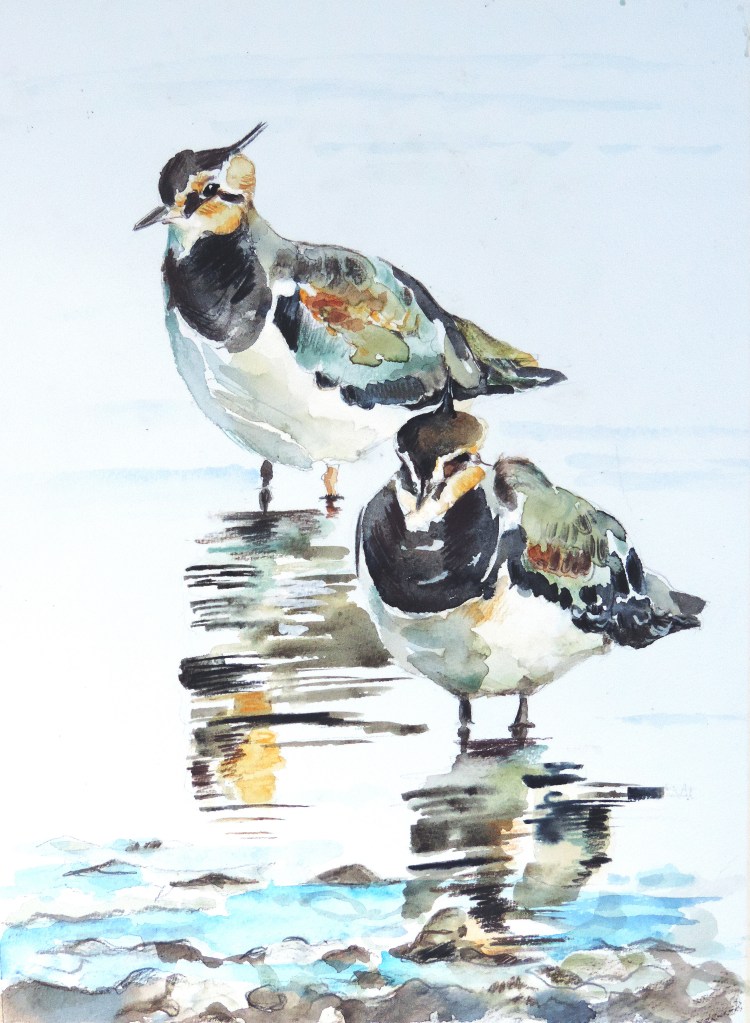
Birds which have been scattered all over Buchan to winter, the redwings and fieldfares which have started to collect in larger flocks, ready for their migration flight back across the North sea to Norway and beyond. The black headed gull has assumed its black head again and plumage changes are noticeable among the fieldfares particularly. Their feathers are much more striking and vivid than they were a month ago. They have a slate grey head and rump, a brown back and light underparts. Since 1962 fieldfares have nested in Orkney, Shetland, Inverness and one English county. They could be getting nearer to Banff and Buchan. It would be exciting to be the first person to discover a fieldfare’s nest in our area. At the coast the small wader which is changing its summer coat is the turnstone. A lot of the head feathers change from grey to white and the back feathers become a dramatic reddy-brown.
My friend Doddy Duncan phoned and invited me to an orchestral concert. This was one of a series that went on for the best part of a week like miniature promenade concerts. It happened at the right time of the evening at the lochy, just after dusk. A number of geese were on the pond and they had raised their voices and at times the full orchestra and chorus were giving vent to a greylag and pinkfoot Easter Cantata. After Doddy phoned, I went to the lochside. I could see nothing, but the sounds were quite remarkable. The greylags would call and be answered by other greylags or pinkfeet on the pond and then the percussion would come into prominence with the tremendous crashing and flapping of wings on the surface of the loch. Apart from the honking, other geese kept up a continuous gabble. The audience was not completely appreciative as an occasional raspberry issued forth – a loud quack given by a mallard duck whose peace had been disturbed. The timpani was an occasional squeak from a moorhen. For safety reasons nature’s creatures do not normally advertise their presence in this way, particularly when it is dark. What I had heard might have been an evening washing session, or it might have been some courtship activities.
In the middle of Edinburgh recently I watched the courtship activities of a pair of mute swans who had built their nest on the side of the Union canal, not far from Tollcross in the Leamington district. Nature programmes sometimes feature the spectacular dances of the great crested grebes. The display given by the swans was more static. Side by side in the water they dip their heads into the water at first alternately and then the rhythm changes gradually until they are both dipping in together. On the lock of the canal there were about a dozen tufted duck, a pair of mallard and two pairs of moorhens. A large dog did sentry duty in a builder’s yard near the swan’s nest, but he had come to some form of understanding with the swans and all seemed to get on quite amicably.
After our Easter visit to Edinburgh, we travelled west into Argyll and the most common birds we saw as we journeyed were buzzards and hooded crows. It is an event if I see a buzzard over Forglen, but they are much more common over the rougher ground in the hilly areas of Donside, Deeside and in the west. When they hover and glide the casual observer could easily confuse the buzzard with the golden eagle, as they fly in a similar way. Of course the golden eagle is much larger, with relatively longer wings and tail than the buzzards, but at great distances and heights it is easy to be confused. The hardy black faced sheep in Argyll were starting to lamb and on some occasions we saw an attendant hooded crow. The Argyll hoody is, I consider, the real hoody with upper back and belly quite light grey. Our northeast bird is a hybrid, having interbred with the black beaked carrion crow. Any weakness in mother or lamb at this time in the spring and the hoody is quick to take advantage. The eyes of the sheep are usually first to be attacked. Naturally the farmers do not like the grey-backs, but since the demise of the keepers on big estates, the hoodies have undoubtedly increased in numbers.
1986
Many people will be familiar with the emblem of the Royal Society for the Protection of Birds, the avocet. It is shown on the RSPB tie. We have a painting of a group of avocets in our sitting room. Until this Easter it was a bird of some fame about which we had heard, but never seen. Now we have visited the RSPB reserve at Minsmere in Suffolk and seen the avocets. My wife and I had a varied holiday with friends. We visited many Suffolk villages and went into their Norman-towered churches as well as nature reserves. In Suffolk we played golf at Thorpeness and Aldeburgh. On the way home we stopped for two nights in Nottinghamshire and played golf at the Lindrick club, the scene of the famous 1957 Ryder Cup victory.
Minsmere consisted of a number of large areas of water and islands and smaller pools. There are hides strategically placed and at one we were able to see our first avocets. They are black and white with long stilt-like legs and an upcurved bill (recurvirostra avosetta) and they are about the size of an oystercatcher, but because of their long legs they appear larger. They feed by sweeping their bills from side to side in the water. It was mating time when we were there and we were able to see exciting flying displays and the courtship preening, bowing and splashing in the water. As well as avocets we saw Canada geese, great crested grebe, pochard, tufted duck, shoveler duck, moorhens, lapwings, redshank, snipe, godwit, black headed gulls, shelduck, heron and dabchick. The birds we did not see were sand martins which according to local walkers and birdwatchers, had arrived on March 29th. There were very few cattle to be seen in this mostly arable area and not a Suffold tup visible anywhere.
It is not often that one has the black swan of Perth, Western Australia, at one’s elbow begging for food, or the eider duck almost speaking at one’s feet. This unusual bird experience happened to friends and my wife and I when we visited Wetlands Waterfowl reserve and Exotic bird park, at Sutton-Cum-Loud, near Retford in Nottinghamshire. We stopped on our way home from Suffold and had the experience of seeing many ordinary and many exotic birds in the reserve. There was no need for binoculars. All the birds were tame. We got there at the ideal period, in the morning just before feeding time, and many of the birds came across the ponds to us expecting to be fed. The most friendly were probably the greylag and the Canada geese. With bird book in hand, we excitedly identified mandarin duck, falcated and marbled teal, red crested pochard, great crested grebe, gadwall, wigeon, tufted duck, shelduck, ruddy shelduck, barnacle goose and many more. The black swan was almost too friendly and could have been frightening to someone not used to the ways of nature’s creatures. Feeding time came and there was a tremendous scramble for food and some skirmishing among different varieties. The Canada geese in particular were aggressive towards each other. The birds got barley, wheat, bread and greens to eat, a mixed diet. I would say to anyone interested in birds and going down the A1 into England, that this waterfowl reserve at Wetlands is well worth a visit.
There has been an interesting response to my drawing attention to the fact that our cat had taken a dive across the room at the fieldfares shown on TV. A number of people have mentioned the interest their animals take in the TV programmes. I have even received a photo of two cats sitting on the arms of an easy chair looking at birds pecking at food on a bird table on the telly. The writer of the letter accompanying the photo says that the cars are very fond of Tony Soper, and many nature programmes, especially ones with birds. One cat in particular views all the ‘Watch with Mother’ programmes. The writer’s conclusion, that the cats are more intelligent than we give them credit for, is probably true.
A constant job for the farmer is that of trying to protect his crops. In our part of the northeast the pigeons are a particular menace and various types of scarers are used. One sees the occasional scarecrow in fields. The dress, attitude and stance of some of them show that old hands have been at the job of their construction. Up to a point, no doubt, they are effective. There are three noisier ones which seem to be in use. First there is what one would call an ordinary banger. A cartridge explodes at regular intervals. Secondly, there is a type which emits a bugle call for a few seconds, followed by an explosion. Thirdly, there is the more sinister sounding, more modern, even more futuristic, whiplash sound which is used to scare birds. It is not ebay knowing which is most effective.
The other evening, as my wife and I were standing at our bedroom window admiring the daffodils in the light of the evening sun, a large bird, something like a wood pigeon, crossed in front of us. It was the low level attack of the sparrowhawk on evening patrol, looking for his tea. I followed its flight for a few hundred yards and most of the time it kept very low to the ground like a Harrier strike aircraft.
Transport difficulties made my wife and I spend an enforced hour or two in Cornhill, one of the most pleasant and unsung of Banffshire’s villages. We walked along quiet country roads with unfenced access to paths among mature beech, elm and fir trees and that is not a common occurrence nowadays. In place the road verges were bordered with laburnum shrubs to which last year’s seed pods still hung. The rooks were noisy in various rookeries. I counted at least eight nests in the top of one large fir tree. We actually saw a part albino rook with more white on its wings than there is on a magpie’s wings. Rooks have a very varied language, more especially at this time of year when they are nesting. We heard a peculiar yelping, but it was just a pair of rooks speaking as they flew overhead.
A hedge sparrow or dunnock burst into song quite close to us and we were able to compare its solo efforts to that of the robin. The hedge sparrow’s song is more fluid and fluent and a richer burbling than the slightly harsher, mournful, colder song of the robin. The day was one of the first days of spring. There were occasional glimpses of sunshine and the temperature up at least twelve degrees from the day before. We have been watching and listening carefully to TV and radio for this improvement. One can only hope that the warmth will stay with us. The buds on the elm were nicely rounded and alder catkins hung in long rich dark red tails from the branches. Some whin was starting to yellow. It will be some time yet before the “yellow comes on the broom”. We saw another lovely flash of yellow as a pair of grey wagtails flew down a burn. We were prepared to offer a Cornhill pony a digestive biscuit and a polo mint, but, wise beast, he was having nothing to do with foreigners from Forglen.
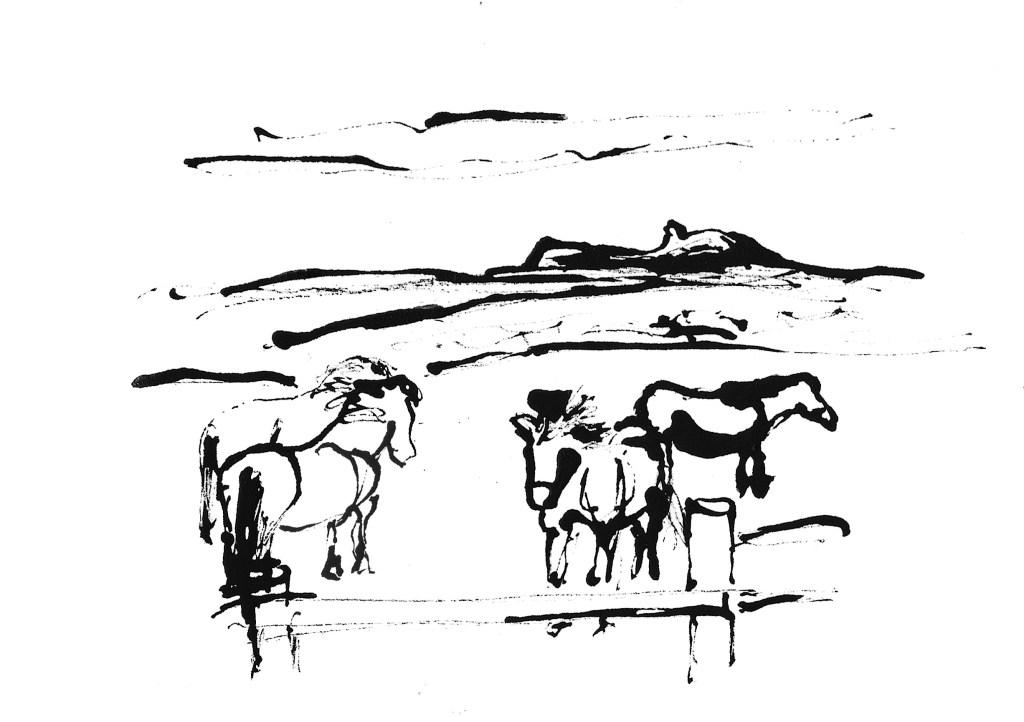
The illustrations in this book are the original creations of Sheila Chapman and she retains the copyright in them (Reproduced here under licence). More information about the artist can be found at http://www.sheilachapmanart.com
 Cunning Systems